
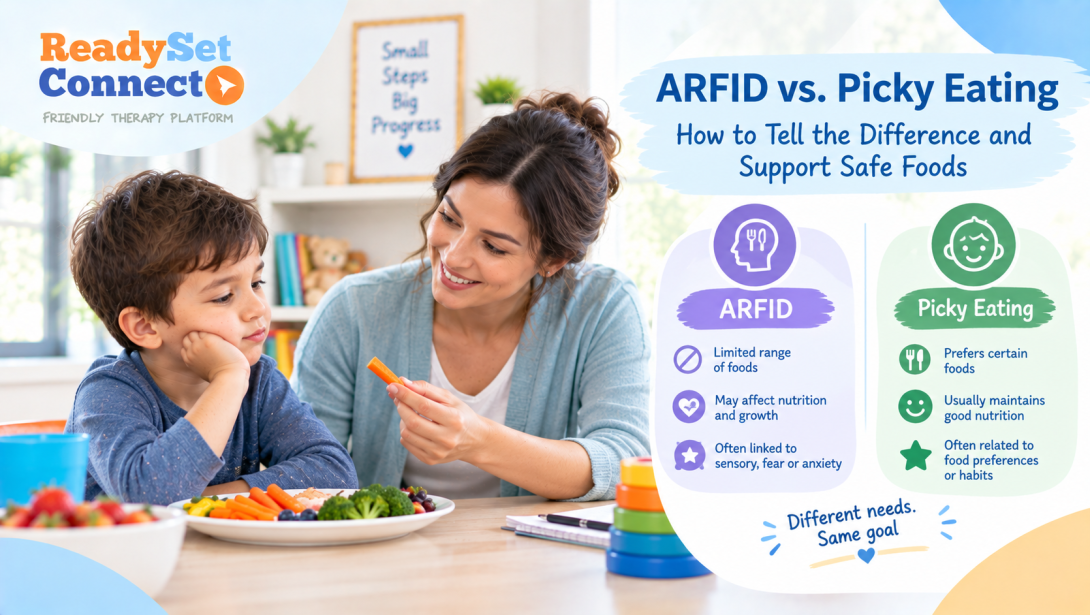
Almost every parent of a toddler has watched dinner turn into a standoff. Usually that is ordinary development. For some children, though, limited eating is something more, and understanding ARFID vs. picky eating helps families and clinicians know when to step in. This guide covers the key differences, why “safe foods” matter, and how therapists support children who struggle to eat.
What is picky eating?
Picky eating is common, especially in the preschool years. Picky eaters may refuse certain textures or flavors, want foods prepared a particular way, or go through phases of rejecting old favorites. Even so, they typically eat a reasonable range of foods across food groups, grow along their expected curve, and respond to patience and repeated, low-pressure exposure.
What is ARFID?
Avoidant/restrictive food intake disorder (ARFID) is a feeding and eating disorder in the DSM-5. Unlike anorexia, it is not driven by concern about body weight or shape. Instead, a child avoids or restricts food because of sensory sensitivity, fear of choking, vomiting, or pain, or very low interest in eating. To meet criteria, the restriction must lead to problems such as significant weight loss or poor growth, nutritional deficiency, reliance on supplements or tube feeding, or clear interference with daily life.
Key differences at a glance
- Range of foods. Picky eaters accept a variety. Children with ARFID often rely on a small set of foods that may shrink over time.
- Impact on growth and health. Picky eating rarely affects growth. ARFID can lead to weight loss, stalled growth, or nutrient deficiencies.
- Level of distress. A picky eater may grumble. A child with ARFID may panic, gag, or melt down when a non-preferred food appears.
- Flexibility. Picky eaters can usually be coaxed to try new things. Children with ARFID may not tolerate small changes in brand, texture, or presentation.
- Social impact. ARFID often limits birthday parties, school lunches, and family meals.
Only a qualified professional can diagnose ARFID, so families who recognize several of these signs should talk with their pediatrician.
Understanding safe foods
ARFID safe foods are the items a child reliably accepts, often highly predictable ones such as a specific brand of crackers or a particular style of chicken nuggets. They are not a problem to eliminate. They are the starting point for treatment. Clinicians map safe foods by texture, flavor, temperature, color, and brand, then look for similar foods to build from. This approach, often called food chaining, introduces tiny, predictable changes rather than forcing new items onto the plate.
Warning signs include a safe-food list that keeps getting shorter, refusal of foods that used to be accepted, or intense distress at any variation.
Picky eating and ADHD
Parents often ask about picky eating and ADHD. Children with ADHD may be more likely to have selective eating, possibly because of sensory sensitivities, difficulty sitting through meals, or medication effects on appetite. ADHD does not mean a child has ARFID, but the two can occur together, so a thorough evaluation should look at the whole picture.
How therapists help
ARFID is best handled by a team: a pediatrician, a dietitian, a mental health professional, and often an occupational therapist or speech-language pathologist. An occupational therapist for feeding therapy looks at sensory processing, oral-motor skills, positioning, and mealtime routines. For very young children, feeding therapy for infants focuses on early oral-motor development, the transition to solids, and building positive mealtime experiences. Therapists also support caregivers, who often feel blame and exhaustion.
Finding ARFID therapists
When searching for ARFID therapists, look for clinicians with eating disorder or pediatric feeding training, and ask about their approach. Cognitive-behavioral therapy adapted for ARFID has research support, and family-based approaches are being studied. Good providers will involve caregivers, coordinate with your pediatrician, and move at the child’s pace.
Practical tips for caregivers
- Keep safe foods available at every meal so the child never faces an empty plate.
- Offer new foods beside safe ones without pressure or bribes.
- Keep a simple log of foods eaten, refused, and tolerated.
- Seek an evaluation early rather than waiting for a child to “grow out of it.”
For clinicians: build your feeding skills
If you are a therapist, ReadySetConnect offers on-demand CEU learning, including Pediatric Feeding Therapy: Addressing Sensory and Sensorimotor Challenges and Unlocking Solutions: How Occupational Therapy Can Transform Picky Eating and Eating Disorders. To track feeding goals, session notes, and home programs in one place, explore practice management software for occupational therapists.
Why early support matters
Feeding difficulties rarely resolve on their own when nutrition or growth is affected. Early evaluation gives families clearer answers, reduces mealtime conflict, and helps children build a calmer relationship with food. If you are unsure whether your child’s eating is typical, a conversation with the pediatrician costs little and can prevent months of worry.
Frequently asked questions
Is ARFID just extreme picky eating?
No. ARFID involves nutritional, growth, or functional consequences, and it usually needs professional support.
Should I force my child to eat new foods?
Pressure tends to backfire, especially with ARFID. Gradual, predictable exposure works better.
When should I see a doctor?
Seek an evaluation if your child is losing weight, growing slowly, avoiding entire food groups, or showing intense distress around food.
Take the next step
Understanding the difference is the first step toward the right support. Explore CEU courses for therapists or start free with ReadySetConnect.