
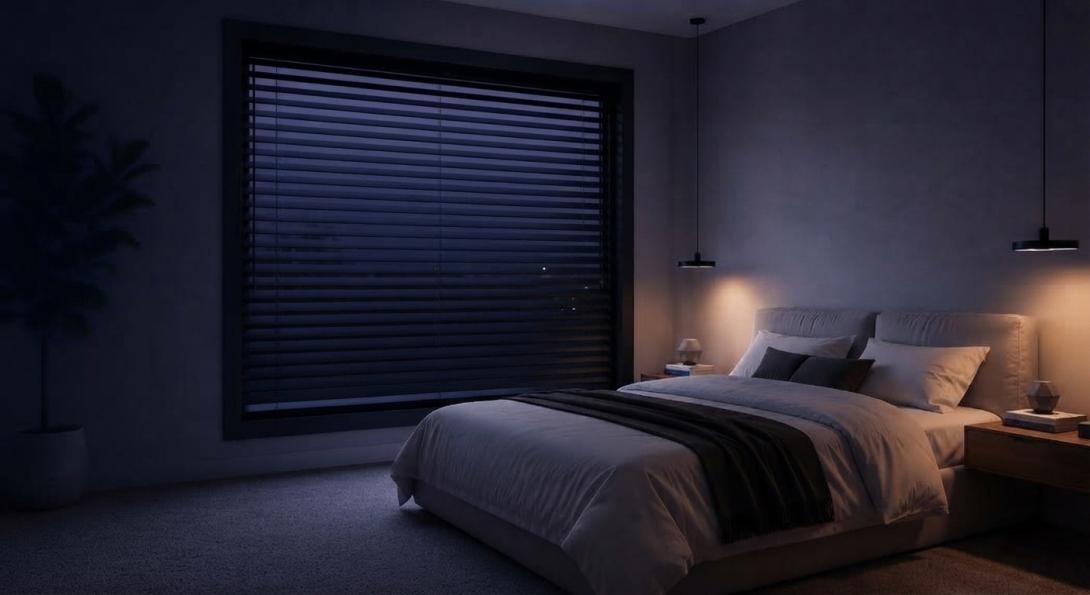
Yes, blackout blinds can help keep a bedroom cooler in summer, particularly when they reduce the amount of direct sunlight and heat entering through the window. However, the cooling effect depends on the blind's material, fit, window exposure and how much heat the room receives during the day.
For bedrooms that become uncomfortable by late afternoon, the right window covering can be a surprisingly useful part of a summer cooling strategy. It won't replace ventilation or air conditioning, but it can reduce one of the main ways heat enters a room: solar radiation through the glass.
Why do bedrooms get so hot in summer?
A bedroom can become noticeably warmer simply because sunlight falls directly onto its windows for several hours.
Glass allows sunlight into the room, where that energy is absorbed by floors, walls, furniture and bedding. These surfaces then release heat gradually, which is one reason a bedroom can remain warm well after the sun has gone down.
The problem can be worse when:
- The bedroom faces south or west.
- Large windows receive direct afternoon sun.
- The room is on an upper floor.
- Existing blinds leave gaps around the window.
- Curtains are thin or provide little thermal resistance.
- Windows are kept closed during the hottest part of the day.
This is where blackout blinds can make a practical difference.
How do blackout blinds help with summer heat?
Blackout blinds are primarily designed to prevent light from entering a room. But a well-designed blackout covering can also reduce the amount of solar heat reaching the interior.
The principle is straightforward.
When a blind blocks sunlight before it reaches the room, less solar energy is absorbed by the surfaces inside. The room may therefore heat up more slowly during periods of strong sunshine.
The result isn't necessarily a dramatic drop in temperature. Think of blackout blinds as part of a wider heat-management approach rather than a replacement for cooling equipment.
Their effectiveness also varies considerably between products.
A thin roller blind that blocks visible light but leaves substantial gaps around the edges won't necessarily provide the same thermal benefit as a close-fitting system designed to cover the window more completely.
The fit matters more than many people realise
When people think about blackout blinds, they often focus on the fabric.
The fit deserves just as much attention.
Light and heat can still enter around the sides, top or bottom of a conventional blind. In a bedroom, even a narrow gap can be obvious when the sun rises. It can also reduce the overall effectiveness of the window covering.
Made-to-measure blackout blinds are designed around the dimensions of an individual window. Some systems go further by using side channels, frames or seals to reduce the gaps around the blind.
For example, LumiGlide describes its blackout system as custom-fitted, with a precision seal system intended to create a gap-free closure. Its product information also highlights an enhanced thermal layer designed to reduce heat transfer.
That distinction is useful when comparing different types of blackout window coverings. "Blackout" doesn't automatically mean "maximum thermal performance". Construction and installation matter.
Are blackout blinds better than curtains for keeping a bedroom cool?
There isn't one universal answer.
Heavy curtains can provide useful insulation, particularly when they are lined and fitted closely to the window. However, curtains may leave gaps at the sides or above the window, and sunlight can still reach the glass before being absorbed by the curtain material.
Blackout blinds offer a different approach.
A well-fitted blind can sit close to the window and prevent much of the incoming daylight from reaching the room. Some specialist systems combine blackout fabric with additional thermal layers or frames.
For a particularly hot bedroom, consider the complete setup rather than choosing a window covering based solely on its colour or appearance.
Look for:
- A genuine blackout fabric or system.
- A close fit around the window.
- Thermal or reflective properties.
- Minimal gaps around the edges.
- Appropriate sizing for the window.
- Easy operation so it can be closed before the room heats up.
When should you close blackout blinds in summer?
Timing matters.
If direct sunlight is already pouring through a bedroom window, closing the blind at midday may be too late to prevent much of the heat build-up.
A better approach is to close the blind before the strongest sunlight reaches the window.
For an east-facing bedroom, that might mean closing it during the morning. A west-facing bedroom may need protection from stronger afternoon and early evening sun.
During a particularly hot spell, keeping the bedroom shaded during the hottest part of the day can help prevent the room from accumulating as much heat.
At night, the strategy changes. If outdoor air is cooler than the bedroom, opening the window and blind when conditions are suitable can help release accumulated heat.
What about bedrooms used for daytime sleeping?
This is one area where blackout blinds have a benefit beyond temperature.
People who work night shifts, sleep during the day or have irregular schedules may need a dark bedroom when the sun is high outside. Parents may also want to create darker conditions for daytime naps.
Blackout blinds can address both problems at once.
A darker room may make daytime sleep more comfortable, while reducing direct sunlight can help limit heat entering through the window.
This is particularly relevant in nurseries and children's bedrooms, where bright summer mornings can arrive long before the household is ready to wake.
The same principle applies to anyone whose bedroom is affected by street lighting, early sunrise or other unwanted external light.
Can blackout blinds reduce the need for air conditioning?
They may reduce the amount of heat entering through a sunny window, but it's unrealistic to treat blackout blinds as a substitute for air conditioning in every situation.
A room's temperature is affected by many variables, including:
- Outdoor temperature.
- Window size and orientation.
- Glazing quality.
- Insulation.
- Roof exposure.
- Internal heat from appliances and people.
- Air movement and ventilation.
- The blind's material and construction.
In a well-insulated bedroom with one sunny window, a good blackout blind could be quite useful. In a poorly insulated loft room exposed to intense afternoon sun, it will only address part of the problem.
The sensible approach is to combine shading with other passive cooling measures.
Other ways to keep a bedroom cooler
Blackout blinds work best as part of a wider summer routine.
Try closing blinds or curtains before direct sunlight reaches the room. Ventilate when outdoor air is cooler, particularly overnight or early in the morning. Keep unnecessary lights and heat-producing electronics switched off.
If possible, use cross-ventilation to encourage airflow through the home.
External shading can also be highly effective because it stops solar energy before it passes through the glass. Where external shading isn't practical, an internal blackout system is a simpler option for many bedrooms.
The key is to stop heat building up in the first place rather than relying entirely on cooling the room afterwards.
What should you look for when choosing blackout blinds?
If keeping a bedroom comfortable in summer is one of your priorities, don't judge a blind by its darkness rating alone.
Consider the whole system.
1. Blackout performance:
Does it genuinely block light, or does it simply dim the room?
2. Edge coverage:
Can sunlight enter around the sides or bottom?
3. Thermal properties:
Does the material or construction help reduce heat transfer?
4. Fit:
Is it available in a made-to-measure size?
5. Installation:
If you're renting, a no-drill solution may be more practical than a permanently mounted blind.
6. Bedroom use:
If the room is used for daytime sleeping, total darkness may be particularly valuable.
7. Safety:
For children's rooms, consider cordless designs and other appropriate safety features.
These details can make a bigger difference than simply choosing a product labelled "blackout".
So, do blackout blinds actually keep bedrooms cooler?
They can. Their main advantage is reducing sunlight entering through the window, which can help limit solar heat gain during sunny periods.
The biggest benefits are likely to come from a combination of effective blackout material, good thermal properties and a close-fitting installation that minimises gaps.
For a bedroom that overheats in summer, it's worth thinking beyond the question of whether a blind is "blackout". Ask how well it covers the window, when it will be closed, what thermal properties it has and how the room behaves throughout the day.
A darker bedroom can be more comfortable for sleeping, too. For some households, that makes blackout blinds useful throughout the year—not just during a heatwave.
The practical takeaway
If your bedroom gets hot because of strong sunlight, close-fitting blackout blinds are worth considering as one part of a passive cooling strategy. Close them before direct sun hits the window, keep the room shaded during the hottest period, and ventilate when outdoor conditions become cooler.
That combination is far more useful than expecting any single window covering to solve every summer cooling problem.