


Achieving the Chartered Professional Engineer (CPEng) credential is a significant milestone for any engineer practising in Australia. This certification, awarded by Engineers Australia, serves as a formal validation of an individual's competency, ethical standards, and commitment to the profession.
It is not merely a title but a legal and professional requirement for certain roles, particularly under the National Engineering Register (NER) and state-based registration schemes in Queensland and Victoria.
What Role Does a Certified Chartered Professional Engineer (CPEng) Play?
Chartered engineers carry a high level of accountability within the Australian engineering landscape. They are expected to function independently and provide leadership in complex environments where public safety and environmental sustainability are paramount, meeting the rigorous professional standards required of a CPEng Australia.
- Complex Problem Solving: Applying advanced engineering principles to resolve issues that lack established precedents.
- Risk Management: Identifying and mitigating technical and operational risks in high-stakes projects.
- Ethical Oversight: Ensuring all engineering activities align with the Engineers Australia Code of Ethics.
- Stakeholder Management: Communicating technical findings effectively to both expert panels and non-technical clients.
- Regulatory Compliance: Certifying that designs and processes meet strict Australian standards and legal frameworks.
Becoming a Certified Chartered Professional Engineer (CPEng) in Australia
The transition from a graduate or professional engineer to Chartered status involves a multi-stage assessment process designed to evaluate Stage 2 Competency.
Before diving into the documentation, an applicant must undergo a self-assessment to determine their readiness across 16 defined competency elements.
1. Initial Self-Assessment and Industry Review
Candidates begin by rating their own performance on the Engineers Australia portal, from 'Developing' to 'Advanced'. Following this, an Industry Reviewer, usually a senior Chartered engineer, must verify these ratings based on observed professional performance.
2. Enrolment and Evidence Submission
Once the industry review is finalised, the applicant enrolls for the Chartered assessment. This phase requires the submission of a detailed CV, Continuing Professional Development (CPD) logs, and the evidence narratives, which are often structured as Career Episodes.
Drafting the Three Career Episodes for Competency Assessment
The core of a successful application lies in preparing three distinct Career Episodes. These narratives provide the qualitative evidence required to prove that you possess the 16 Stage 2 competencies.
When drafting these episodes, the focus must shift from collective team achievements to individual professional agency. Engineers Australia assessors look for specific actions you took, the technical calculations you performed, and the engineering problems you personally solved.
Each episode should ideally follow a structured format:
- Introduction and Background: Briefly define the project, the employer, and your specific role.
- Personal Engineering Activity: This is the most detailed section (1,000 to 2,500 words) where you describe the technical tasks you managed.
- Summary: A concise reflection on how the project contributed to your professional growth and met the specific competency elements.
Strategic Competency Mapping for Stage 2 Assessment
A critical component of the submission is the Summary Statement or Evidence Mapping. This document acts as a guide for the assessor, linking paragraphs from your Career Episodes to the 16 competency elements. Accuracy is vital here; if a competency element like "Local Equilibrium" or "Ethical Conduct" is not clearly evidenced in your episodes, the assessment may be delayed.
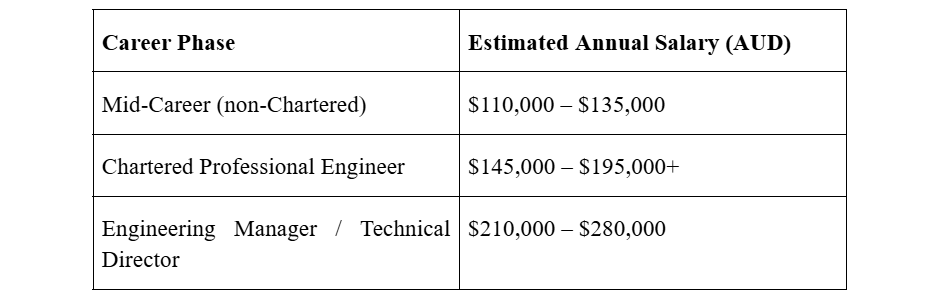
Salary of Certified Chartered Professional Engineer (CPEng) in Australia
Earning Chartered status significantly enhances an engineer's market value. Employers often prioritise CPEng holders for senior management and lead technical roles due to the reduced oversight required.
Final Submission and Review
The path to becoming a Chartered Professional Engineer (CPEng) in Australia requires a high degree of precision in documentation. A single oversight in your Career Episodes or a lack of technical depth can lead to a request for revisions. If you are seeking to ensure your application meets the stringent requirements of Engineers Australia, professional support can be invaluable.
For comprehensive guidance on drafting your narratives and mapping your competencies, consider the expertise available at Australia CDR Help to secure your professional future in Australia.