

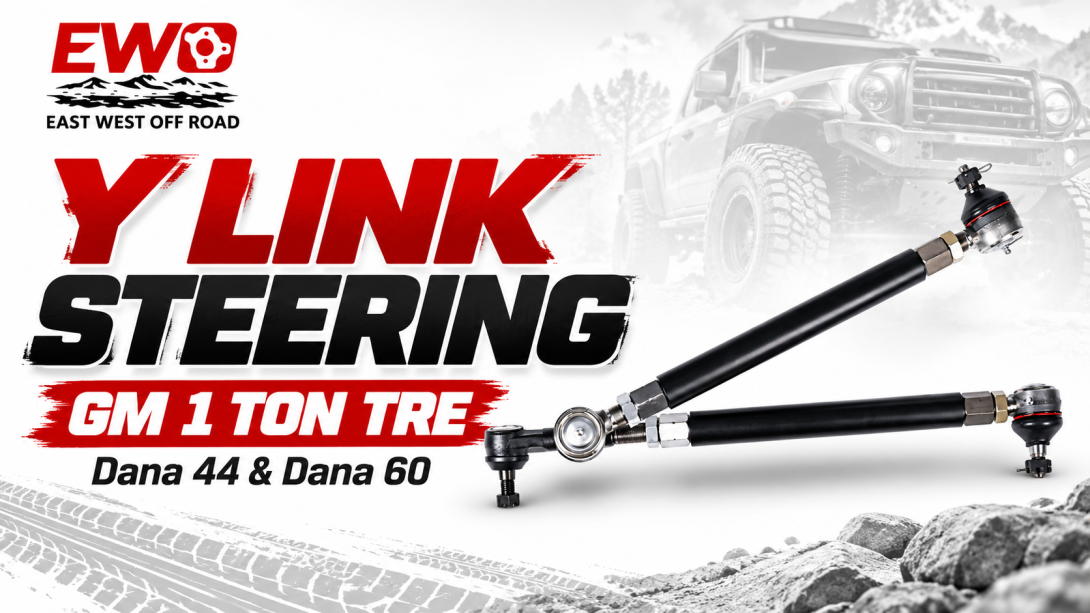
Buy Now: https://www.eastwestoffroad.com/product/y-link-steering-for-gm-1-ton-tre
A useful under the knuckle steering kit question gives EWO more than the vehicle name and axle label. Custom builds can contain swapped knuckles, changed steering boxes, aftermarket arms, modified suspension, and parts from different donor vehicles. E90065’s UTK option should be evaluated against what is physically present now. A concise fitment brief can organize that information: axle and knuckle identity, current tie rod and drag link, steering gear relationship, planned orientation, nearby components, and clear photos. It does not replace professional measurement, but it makes the first compatibility conversation far more productive.
Direct answer: A strong UTK fitment brief identifies the exact axle and knuckles, current steering-end and linkage arrangement, steering-box/pitman relationship, intended E90065 UTK option, nearby suspension and wheel/brake components, and any prior modifications. Avoid model-year assumptions; describe the hardware that is actually on the vehicle.
Lead With Axle and Knuckle Identification
Start the brief with what can be verified: axle family, knuckle style or part identification, and whether the axle appears to have swapped or aftermarket ends.
A GM 1 ton Y link steering kit can only be discussed meaningfully when the receiving steering interfaces are known. Dana 44 or Dana 60 by itself is not enough. This is where a build sheet is more useful than a broad product label. Confirm: What evidence supports the knuckle identification, and what remains uncertain? Searchers may use the phrase GM 1 ton Y link steering kit for this kind of shopping task, but the phrase itself does not establish fitment, geometry, or installation requirements.
Describe the Current Steering Architecture
Note how the tie rod and drag link connect today and where steering input enters the linkage. If the current system is not Y-link, state that clearly.
This helps EWO understand whether the project is replacing a GM 1 ton TRE steering kit arrangement or changing linkage architecture entirely. For a buyer, that turns the discussion from a generic upgrade claim into a compatibility question: What is the existing tie-rod/drag-link path, and which components are being replaced versus retained? Searchers may use the phrase GM 1 ton TRE steering kit for this kind of shopping task, but the phrase itself does not establish fitment, geometry, or installation requirements.
State the UTK Intent Explicitly
Write that the project is evaluating the E90065 under-knuckle configuration. Do not rely on a photo alone to communicate orientation.
The phrase UTK Y link steering kit keeps the request specific while still leaving knuckle preparation and compatibility open for confirmation. The practical planning question is therefore specific rather than universal: Is the requested orientation stated in words and tied to the exact E90065 SKU? Searchers may use the phrase under the knuckle Y link steering kit for this kind of shopping task, but the phrase itself does not establish fitment, geometry, or installation requirements.
Keep the discussion anchored to the current Y Link Steering for GM 1 Ton TRE product page so the project scope stays tied to E90065.
List Threaded Interfaces Without Making Fitment Claims
E90065’s tube adapters and jam nuts are 7/8-18 in left- and right-hand versions. Include that as package information if relevant to the discussion.
Do not say the vehicle “has a 7/8-18 knuckle” based on that number. A 7/8-18 Y link steering kit describes the tube-side interface, not the knuckle taper. That distinction matters before parts are ordered. A qualified steering specialist should be able to answer: Are tube threads and knuckle/stud interfaces recorded as separate specifications? Searchers may use the phrase UTK Y link steering kit for this kind of shopping task, but the phrase itself does not establish fitment, geometry, or installation requirements.
Show the Nearby Packaging
Clear photos can show springs or links, shocks, differential cover, brakes, wheels, steering stabilizer hardware, and other parts that may occupy the linkage envelope.
An under the knuckle Y link steering kit may place components closer to different obstacles than an OTK plan. The brief should make those relationships visible without predicting clearance from a photo alone. Instead of treating the label as proof of fit, use it to start a more useful check: Which nearby components are most likely to constrain the tie-rod or drag-link path? Searchers may use the phrase 7/8-18 Y link steering kit for this kind of shopping task, but the phrase itself does not establish fitment, geometry, or installation requirements.
Flag Unknowns Instead of Guessing
A good fitment brief can contain “unknown” entries. That is better than identifying a part incorrectly and building the rest of the purchase decision on the error.
A qualified specialist may ask for additional measurements or part markings. Treat that follow-up as normal steering planning, not as a failure of the product description. The purchase decision is stronger when that point is documented for the actual axle and knuckle package: Which unresolved item could change the kit selection or orientation if the current assumption is wrong? Searchers may use the phrase GM 1 ton Y link steering kit for this kind of shopping task, but the phrase itself does not establish fitment, geometry, or installation requirements.
Buyer Planning Checklist
Fitment-brief field
Example of useful information
Product
E90065, evaluating UTK option
Axle
Confirmed Dana family plus any known variant details
Knuckles
Part/casting identity if known; clear photos
Current linkage
Describe tie rod and drag-link connections
Existing modifications
High-steer arms, swapped parts, brackets, suspension changes
Packaging
Wheels/brakes, differential, springs/links, shocks
Unknowns
Clearly list anything not confidently identified
Frequently Asked Questions
Do I need the vehicle model year in the fitment brief?
It can be useful background, but the prompt specifically warns against implying model-year fitment for E90065. On a modified vehicle, the installed axle, knuckles, steering components, and suspension may differ from factory configuration. Current component identity and measurements are more important than assuming the vehicle still matches its original specification.
What photos should I include?
Useful photos can include a straight-on front view of the axle and linkage, close views of both knuckle steering connections, the drag-link/pitman-arm area, and nearby suspension or differential components. Photos help identification and packaging discussion, but they do not replace measurements or professional inspection. Keeping that distinction clear prevents a catalog term from becoming an unsupported fitment or performance claim.
Should I tell EWO I want the UTK option?
Yes. State the exact SKU and intended under-knuckle configuration clearly. That separates your request from the OTK option and reduces ambiguity. Still, leave the final knuckle-preparation and compatibility questions open until the exact receiving components have been reviewed. A build-specific review is still needed before the package is treated as compatible with the vehicle’s actual steering interfaces.
Does a 7/8-18 thread measurement prove fitment?
No. In E90065, 7/8-18 refers to the tube adapters and jam nuts. It does not prove the steering-end taper fits a knuckle, that the joint has enough articulation, or that surrounding parts clear. Record each interface independently. That is why the exact vehicle, current components, and current product documentation should guide the final steering decision.
What if I cannot identify the knuckles?
Say so. Provide clear photos and any readable markings, and ask what additional information EWO or the installer needs. Guessing a knuckle identity can create a chain of incorrect assumptions about steering ends, taper, OTK/UTK suitability, and other components in a safety-critical system. For a safety-critical steering system, treat that detail as a verification point for EWO or a qualified installer rather than an assumption.
Conclusion
The best UTK inquiry is specific about the vehicle and modest about what is unknown. Build a fitment brief around actual hardware, current linkage, the exact E90065 SKU and intended orientation, then let EWO and a qualified steering professional request whatever additional measurements are needed. That is more reliable than a model-year fitment shortcut. When the E90065 package matches the documented steering plan, review the current Y-link steering package and confirm the configured option and knuckle requirements with EWO or a qualified installer before ordering.