

Wireless technologies are becoming more complex, and testing them in realistic conditions is becoming equally important. From 5G smartphones and IoT devices to connected vehicles and aerospace communication systems, engineers need reliable ways to evaluate wireless performance without being limited by the location of a traditional laboratory.
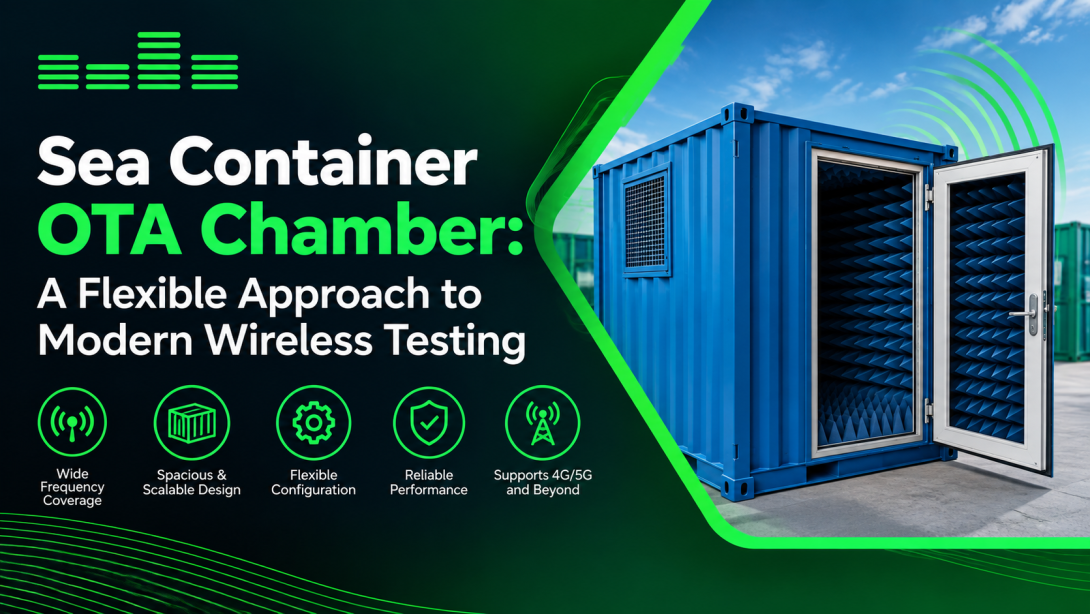
A sea container OTA chamber offers an interesting solution to this challenge. By transforming a shipping container into a controlled, RF-shielded testing environment, organizations can bring OTA testing capabilities closer to production sites, field locations, research facilities, or other remote environments.
Unlike a conventional fixed OTA laboratory, a container-based solution is designed around mobility and deployment flexibility. It can provide controlled RF conditions while reducing the infrastructure requirements normally associated with building a permanent test facility.
What Is a Sea Container OTA Chamber?
A sea container OTA chamber is an over-the-air testing environment built inside a modified shipping container. The container is equipped with RF shielding, absorbers, antennas, positioning equipment, test instrumentation, and other components required for wireless measurements.
The primary purpose is to create a controlled environment where engineers can evaluate how a wireless device transmits and receives signals without unwanted interference from the surrounding environment.
Modern container-based OTA platforms can support Sub-6 GHz testing and can also be configured for mmWave applications. Depending on the system design, they may include programmable DUT and antenna positioners, automated measurement equipment, configurable fixtures, and remote control capabilities.
This approach effectively turns a standard transportable structure into a mobile wireless test facility.
Why Is Mobile OTA Testing Becoming Important?
Traditional OTA testing facilities are generally designed as permanent installations. They can provide highly controlled environments, but constructing or expanding such facilities may require significant space, infrastructure, and planning.
Not every testing program operates from a single permanent location.
A manufacturer may need to test devices close to a production facility. A telecom company may require testing at a field location. An engineering team could need additional OTA capacity during a development program. In these situations, moving every test back to a central laboratory can introduce logistical delays.
A mobile OTA chamber provides another option.
Because the testing environment is contained within a transportable structure, organizations can deploy testing capabilities closer to where they are needed. This can be particularly useful for remote-site testing, temporary test programs, production support, and expanding existing laboratory capacity.
How Does a Container-Based OTA Chamber Work?
The concept is relatively straightforward, but the engineering behind it is more sophisticated.
The container is converted into an RF-controlled environment using shielding materials and absorbers. The absorbers help manage reflections inside the chamber, while the shielding reduces the influence of external RF signals.
Inside the chamber, the device under test can be mounted on a positioning system. Antennas and other measurement equipment are arranged according to the required test configuration.
A programmable positioner can then move the device or antenna through predefined angles and positions. This allows engineers to collect measurements across different orientations instead of relying on a single fixed measurement point.
Automation can further improve repeatability. Modern platforms may use REST APIs and other interfaces to control test sequences, positioning, measurement equipment, and data collection.
The result is a controlled OTA testing workflow that can be moved or deployed without constructing an entirely new permanent facility.
Key Advantages of a Sea Container OTA Chamber
1. Flexible Deployment
One of the biggest advantages is mobility.
A containerized OTA system can be deployed at a customer site, production facility, research location, or remote testing area. This makes it useful when testing requirements are not tied to one permanent laboratory.
For organizations operating across multiple locations, this flexibility can also help bring testing closer to the teams or manufacturing processes that need it.
2. Reduced Infrastructure Requirements
Building a permanent OTA laboratory involves more than installing a chamber. It can require dedicated space, building modifications, electrical infrastructure, HVAC considerations, networking, and other site preparation.
A container-based approach packages much of the testing environment into a transportable structure.
This does not mean site preparation becomes unnecessary. Power, grounding, network connectivity, foundations, and the surrounding RF environment still need to be considered before deployment.
However, the overall approach can simplify deployment compared with constructing a new permanent test facility.
3. Support for Different Wireless Technologies
Wireless products increasingly operate across multiple frequency ranges and technologies.
A properly configured container OTA platform can support Sub-6 GHz applications and may be extended for FR2/mmWave testing. Some platforms can also be designed around specific antenna configurations, device sizes, measurement distances, and test requirements.
This makes the architecture useful for applications involving 5G, IoT, connected devices, automotive communications, and other wireless technologies.
4. Better Testing Flexibility
Testing requirements can change throughout a product's development cycle.
During early R&D, engineers may need flexible configurations for prototypes. Later, production teams may prioritize repeatability, automation, and throughput.
A modular container-based chamber can be configured around these changing requirements. Positioners, fixtures, measurement equipment, RF switching, and automation can be incorporated according to the intended application.
This modularity is particularly useful when the testing system needs to evolve alongside the products being tested.
Applications of Container-Based OTA Testing
A sea container OTA chamber can support a wide range of wireless testing applications.
5G device testing is one obvious use case. Engineers can evaluate wireless performance across different orientations and configurations while working in a controlled RF environment.
IoT testing is another important application. Connected sensors and industrial devices may need reliable wireless performance testing before deployment across distributed environments.
Automotive and connected mobility applications can also benefit from controlled OTA validation, particularly as vehicles incorporate increasingly sophisticated wireless communication systems.
In addition, telecom operators, OEMs, aerospace organizations, and other technology companies may use mobile OTA platforms for R&D, field verification, or production-related testing.
What Should You Consider Before Choosing One?
A container is only the physical starting point. The actual testing capability depends on how the chamber is engineered and integrated.
Before selecting a solution, engineering teams should consider the required frequency range, DUT dimensions, measurement distance, antenna configuration, positioning accuracy, RF equipment, automation requirements, and future expansion plans.
The surrounding installation environment also matters. Remote deployments may require additional planning for power, grounding, networking, access, foundations, and RF interference.
Calibration and commissioning should also be part of the deployment plan. These steps help ensure that the chamber provides repeatable measurements over time rather than simply functioning as a shielded enclosure.
Sea Container vs. Fixed OTA Chamber
A fixed OTA chamber and a containerized OTA chamber serve different operational requirements.
A permanent laboratory can make sense when an organization has a stable testing location and requires continuous, dedicated testing infrastructure.
A containerized chamber becomes particularly relevant when mobility, rapid deployment, or additional testing capacity is important.
The decision therefore should not simply be about which chamber is more advanced. It should begin with the testing environment, expected workload, deployment location, frequency requirements, device types, and long-term testing strategy.
In some organizations, both approaches may even complement one another: a permanent chamber can handle regular laboratory work while a mobile platform provides additional or remote testing capacity.
Designing for Future Wireless Testing
Wireless standards and device architectures continue to evolve. A testing platform designed only around today's requirements can become restrictive as new frequency bands, antenna architectures, and testing methods emerge.
For this reason, scalability should be considered during the initial chamber design.
Modular systems can allow additional capabilities to be integrated as requirements change. For example, a platform initially configured for Sub-6 GHz testing may be designed with future mmWave or automation expansion in mind.
This forward-looking approach can make the testing infrastructure more adaptable as wireless products move toward increasingly complex antenna systems, beamforming, massive MIMO, and future-generation connectivity.
Final Considerations
A sea container OTA chamber brings together two important requirements in modern wireless testing: controlled RF measurement and deployment flexibility.
Instead of requiring every test to take place inside a permanent laboratory, organizations can deploy a purpose-built OTA environment closer to production, field, R&D, or remote locations.
The effectiveness of such a system ultimately depends on more than portability. RF shielding, absorber design, positioning accuracy, measurement equipment, automation, calibration, and site preparation all contribute to reliable testing.
For companies looking to expand wireless testing beyond the traditional laboratory, containerized OTA platforms provide a practical architecture worth considering. Orbis Systems, for example, develops sea container-based OTA platforms with RF shielding, integrated absorbers, programmable positioning, Sub-6 GHz capabilities, and options for mmWave expansion and automated control.