

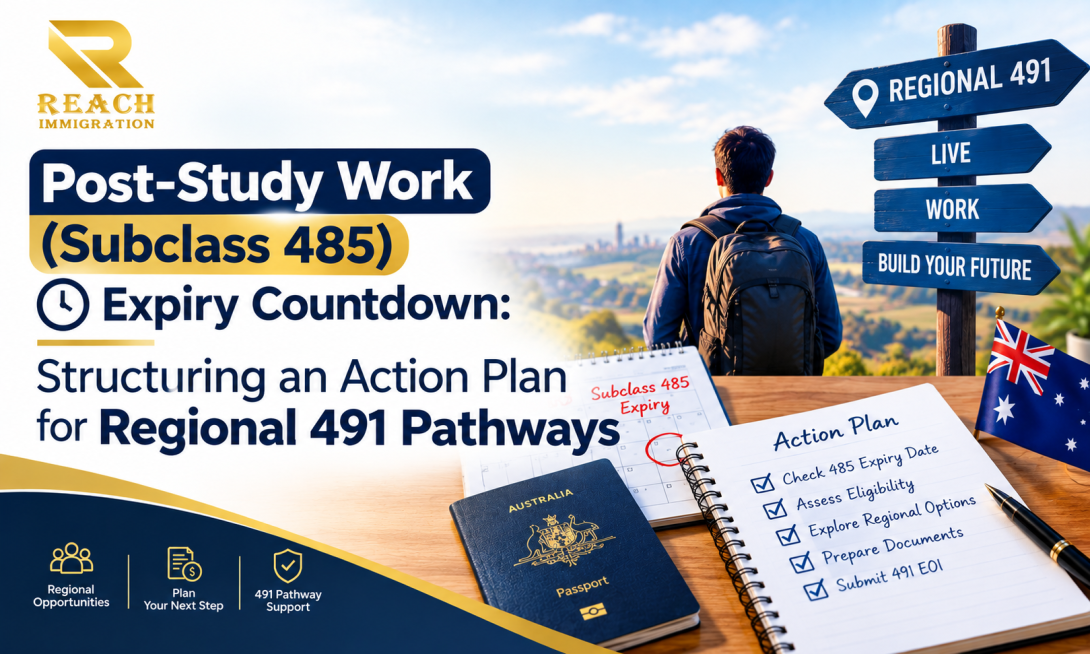
A Temporary Graduate visa subclass 485 should not be treated as a visa that simply gives an international graduate extra time in Australia. For graduates considering a regional skilled migration pathway, the 485 period is a limited planning window.
The key question is not just “When does my 485 expire?” It is:
“What needs to be completed before expiry so that a viable subclass 491 strategy is ready?”
This distinction matters because subclass 491 requires an invitation through SkillSelect and, for the state-nominated stream, nomination by a state or territory government. A person cannot assume that submitting an EOI automatically creates a bridging arrangement or guarantees an invitation. Home Affairs confirms that an EOI is required before an invitation for subclass 491, and meeting the minimum points threshold does not guarantee an invitation.
For graduates planning Skilled Migration Visa Australia, the 485 expiry date should therefore become the starting point for a structured migration timeline.
First: Identify the Exact 485 Stream and Expiry Date
The current subclass 485 program has different streams, including the Post-Higher Education Work stream and Post-Vocational Education Work stream. The Post-Higher Education Work stream is generally for graduates with eligible degree-level qualifications from Australian institutions. Home Affairs currently states that applicants must generally be aged 35 or under when applying, subject to exceptions.
The stay period depends on the qualification and circumstances. The current Post-Higher Education Work stream generally provides a stay of two to three years, although specific arrangements apply to certain passport holders and circumstances.
Before designing a 491 strategy, confirm:
- Current visa subclass
- Visa grant date
- Visa expiry date
- Visa conditions
- Qualification completed
- CRICOS course details
- Age
- Current occupation
- Skills-assessment pathway
- English test status
- Current location
- Potential state nomination options
Do not calculate the remaining migration window from the date you graduated. Calculate it from the actual visa expiry date shown in the applicant's visa records.
Why Waiting Until the Final Months Creates Risk
A 491 strategy can involve several sequential stages:
Qualification → Skills Assessment → English → EOI → State Nomination/Invitation → Visa Application
These stages do not necessarily happen immediately.
SkillSelect requires an EOI before an applicant can receive an invitation for subclass 491. Once invited, the applicant has 60 days to submit the visa application.
The important point is that an EOI is not itself a visa application.
An applicant whose 485 expires in November should not assume that submitting an EOI in October solves the status problem.
The EOI may remain active, but the applicant still needs to consider what lawful visa status they will hold while waiting and whether another visa pathway is available to them.
That is why a Skilled Migration Consultant Australia should assess the status strategy alongside the points strategy.
The 6–12 Month Countdown
A practical approach is to divide the remaining 485 period into stages.
12 Months Before Expiry: Profile Audit
If approximately one year remains, review the entire skilled migration profile.
Check:
- Occupation eligibility
- ANZSCO occupation selection
- Skills-assessment authority
- Qualifications
- Skilled employment
- English level
- Age points
- Partner points
- Australian study points
- Regional study circumstances
- Potential state nomination pathways
- Current location
Home Affairs confirms that different skilled visas use different occupation lists and that applicants need to check the occupation applicable to their intended visa.
This is the point to identify a fundamental problem, such as an occupation that is not eligible for the intended subclass 491 pathway.
9 Months Before Expiry: Skills Assessment
If the applicant does not already hold the required assessment, this should be treated as a priority.
The assessment authority depends on the nominated occupation. ACS, Engineers Australia, VETASSESS, AHPRA and other bodies have different criteria.
Do not choose an occupation simply because its title sounds similar to the applicant's job.
The nominated occupation must correspond to the applicant's qualifications, employment and assessment requirements.
A positive assessment can also affect the points calculation because the applicant needs accurate information when preparing the EOI.
6–9 Months Before Expiry: English and Points Optimisation
English should be assessed against the applicant's target score rather than the minimum required for one particular visa.
Improving English can potentially affect the points calculation, but the benefit depends on the applicant's existing score and overall profile.
At this stage, calculate at least three scenarios:
Scenario A: Current points
Scenario B: Points after improved English
Scenario C: Points after nomination-related points are added
The purpose is not to chase points indefinitely.
The purpose is to identify the minimum profile needed to create realistic nomination options.
Why Regional Location Matters
Subclass 491 is a regional provisional visa. Home Affairs states that it is for people nominated by a state or territory government or sponsored by an eligible family member to live and work in regional Australia.
The definition of a designated regional area is therefore important.
Regional migration incentives do not simply mean “anywhere outside Sydney.”
Home Affairs identifies Category 2 and Category 3 designated regional areas, while Sydney, Melbourne and Brisbane are Category 1 major cities for the relevant regional framework.
A graduate considering a regional strategy should therefore check the actual postcode and applicable regional category rather than relying on informal descriptions such as “regional city.”
3–6 Months Before Expiry: Build the State Strategy
This is where the migration plan becomes state-specific.
An applicant should compare:
- Occupation eligibility
- Current state nomination criteria
- Onshore requirements
- Employment requirements
- Residence requirements
- English thresholds
- Minimum points
- Work experience requirements
- Nomination availability
- Current program-year settings
A state may have an occupation open for nomination but still impose additional requirements concerning employment, residence or other factors.
Therefore, simply having an eligible occupation does not establish nomination eligibility.
A Skilled Migration Agent Australia can compare the applicant's profile against the current nomination criteria rather than relying on previous invitation rounds.
Do You Need Regional Employment Before 491?
Not necessarily in every case.
The answer depends on the nomination pathway and state or territory requirements.
Some state nomination programs have specific employment or residence criteria, while others may have pathways for offshore applicants or applicants meeting different criteria.
The applicant should therefore avoid the assumption:
“I must work regionally for 12 months before I can apply for 491.”
That may be incorrect for the particular nomination pathway.
At the same time, moving to a regional area without checking the relevant state criteria can also be a poor strategy.
The correct sequence is:
Identify eligible nomination pathway → check its requirements → then decide whether relocation or regional employment makes sense.
The Final 90 Days: Do Not Treat the EOI as the Safety Net
The final three months before 485 expiry should be treated as a contingency period, not the beginning of the migration strategy.
At this stage, the applicant should already know:
- Which occupation is being nominated
- Which assessing authority applies
- Whether the skills assessment is positive
- Current points score
- English status
- Which state pathways are available
- Whether an EOI has been submitted
- What alternative lawful visa options may exist
A Skilled Visa Australia plan should include a status contingency if the 491 invitation does not arrive before the 485 expires.
This does not mean applying for an unrelated visa simply to remain in Australia. Any alternative pathway must independently satisfy its own eligibility requirements.
Subclass 491 Is a Pathway, Not the Final Destination
The subclass 491 is a provisional regional visa.
Home Affairs identifies subclass 191 as the permanent residence pathway for eligible holders of regional provisional visas, including subclass 491 and subclass 494. The Department's current program information confirms that eligible applicants generally need to demonstrate the required regional residence and other conditions before applying for subclass 191.
This makes long-term planning important.
A graduate should not select a regional location purely because it creates a short-term nomination opportunity.
Consider:
- Employment opportunities in the occupation
- Regional residence requirements
- Family circumstances
- Career progression
- Access to services
- Future permanent residence requirements
- Whether the applicant can genuinely comply with regional conditions
A Practical 485-to-491 Timeline
Time Before 485 Expiry
Priority
12 months
Full profile and occupation audit
9–12 months
Skills assessment strategy
6–9 months
English and points optimisation
3–6 months
State nomination strategy
3 months
EOI and invitation-status review
90–30 days
Confirm lawful status contingency
Final 30 days
Avoid assumptions; verify every available pathway
This timeline is deliberately conservative.
Applicants with complex skills assessments, changing occupation eligibility or weak documentation may need to start substantially earlier.
The Most Common Strategic Mistakes
Waiting for an Invitation Before Preparing Evidence
An invitation can create a short visa-application deadline. Documents should already be organised.
Choosing a State Based on Historical Cutoffs
Past invitation numbers do not guarantee future nomination.
Assuming “Regional” Means Any Location Outside a Capital
Regional classifications are defined by government rules and postcode categories.
Ignoring the 485 Expiry Date
An active EOI does not itself provide a new visa.
Treating 491 as an Automatic PR Route
The subclass 191 pathway has its own eligibility requirements.
Relocating Without Checking State Rules
Moving regional may not solve an applicant's nomination problem if the relevant state pathway requires something else.
Building the Plan Before the Countdown Becomes Urgent
For international graduates, the strongest 491 planning usually begins while there is still enough time to correct weaknesses.
A graduate with an incomplete skills assessment has a different strategy from one with a positive assessment. Someone with 80 points has a different strategy from someone with 95. A graduate living in a designated regional area may have different options from someone living in Sydney or Melbourne.
That is why Skilled Migration Services Australia should be based on the applicant's actual visa expiry date, occupation, points, location and evidence—not a generic “apply for 491 before your 485 expires” checklist.
Reach Immigration can assess the 485 expiry timeline, skills-assessment position, points profile and available regional pathways and then structure the next steps around the applicant's actual circumstances.
For graduates planning Australian Skilled Migration, the objective is to reach the 485 expiry date with a documented pathway and a lawful status strategy—not to start planning when only a few weeks remain.