

Regular electrical building maintenance directly reduces unplanned downtime and lowers long-term repair costs by identifying faults before they escalate. Businesses that follow a structured preventive schedule experience fewer emergency breakdowns, extend the lifespan of critical equipment, and improve energy efficiency across their facilities — delivering measurable ROI that reactive maintenance simply cannot match.
Why Electrical Failures Cost More Than You Think
Most facility managers focus on the visible cost of an electrical failure — the repair invoice. But that number rarely tells the full story. When a critical system goes down unexpectedly, the real losses stack up fast: halted production, idle labour, spoiled inventory, regulatory penalties, and in some cases, permanent equipment damage.
According to a report by ABB and the Economist Intelligence Unit, unplanned downtime costs industrial manufacturers an estimated $50 billion annually worldwide. In Singapore's dense commercial and industrial landscape, even a few hours of electrical downtime in a facility can translate into tens of thousands of dollars in losses — far exceeding what a quarterly maintenance programme would have cost.
The math is straightforward: prevention is cheaper than cure. The challenge is convincing stakeholders to invest in maintenance budgets before something breaks.
What Is Electrical Building Maintenance and What Does It Cover?
Electrical building maintenance refers to the systematic inspection, testing, servicing, and repair of all electrical systems within a commercial or industrial property. This includes:
- Main switchboards and distribution boards
- Wiring systems, conduits, and cable trays
- Lighting circuits and emergency lighting
- Motor control centres and industrial machinery
- Earthing and bonding systems
- Power factor correction equipment
- Uninterruptible Power Supply (UPS) systems
In Singapore, electrical installations in commercial and industrial buildings must comply with SS 638 (Code of Practice for Electrical Installations) and are governed by the Energy Market Authority (EMA). Routine maintenance is not just best practice — in many cases, it is a regulatory obligation, especially for Licensed Electrical Worker (LEW) supervised inspections.
The Direct Link Between Preventive Maintenance and Reduced Downtime
Catching Faults Before They Become Failures
Preventive maintenance benefits begin with early detection. Thermal imaging, insulation resistance testing, and load analysis can reveal deteriorating connections, overloaded circuits, or failing components months before they cause an outage. A loose busbar connection that takes 30 minutes to rectify during a scheduled visit can — left unchecked — arc, trip the main breaker, and shut down an entire production floor for 12 hours or more.
The difference between a planned 30-minute fix and an emergency 12-hour shutdown is entirely a function of whether maintenance was scheduled or skipped.
Reducing Emergency Call-Out Frequency
Facilities with structured maintenance contracts consistently report fewer emergency call-outs. This is not coincidental. When technicians inspect equipment on a regular cycle, minor issues are resolved before they compound. Each emergency call-out carries premium labour rates, potential part sourcing delays, and the indirect costs of operational disruption — all of which accumulate quickly in a high-demand environment like a manufacturing plant or data centre.
Minimising Cascading Failures
Electrical systems are interdependent. A failing capacitor bank can degrade power quality across an entire facility, causing sensitive equipment like CNC machines or server hardware to malfunction. Regular maintenance isolates weak points and prevents single-component failures from triggering wider system collapses a scenario that is disproportionately expensive to recover from.
How Maintenance Directly Lowers Repair Costs
There are three primary mechanisms through which a consistent maintenance programme reduces overall repair expenditure:
- Component replacement at the right time: Predictive and preventive maintenance allows worn components — contactors, capacitors, insulation — to be replaced during scheduled downtime, not during a crisis. Planned replacement costs a fraction of emergency procurement and installation.
- Avoiding collateral damage: Electrical faults that go undetected can damage adjacent components. A degraded motor winding, for instance, can burn out the motor drive if not caught early. Replacing one component is always cheaper than replacing three.
- Preserving warranty and insurance validity: Many equipment manufacturers require documented maintenance records to honour warranties. Some commercial insurers in Singapore also factor maintenance history into claims assessments. Skipping maintenance can invalidate both.
Equipment Lifespan: The Long-Term Financial Case
Industrial electrical equipment transformers, switchgear, motors represents significant capital investment. The equipment lifespan of a well-maintained motor can exceed 20 years; the same motor neglected may fail in under 10. This is not a marginal difference. It represents the difference between capital replacement on a 10-year cycle versus a 20-year cycle — a direct saving that compounds across a facility's entire asset base.
Maintenance also preserves resale and residual value. When facilities are refurbished or sold, documented maintenance history commands better valuations and reduces due diligence risk for buyers.
Energy Efficiency: The Hidden ROI of Regular Maintenance
Degraded electrical systems consume more energy. Loose connections create resistance, which generates heat and wastes power. Dirty or worn motor windings draw higher current to deliver the same output. Power factor issues force facilities to draw excess reactive power — leading to utility penalties under Singapore's tariff structures.
A well-maintained electrical system operates closer to its design efficiency. Studies from the Carbon Trust and similar bodies indicate that addressing power factor issues and ensuring motor efficiency alone can reduce a facility's electricity consumption by 5–15%. At Singapore's commercial electricity rates, that translates to meaningful annual savings especially for energy-intensive operations like cold storage, manufacturing, or large retail facilities.
Energy efficiency is not a sustainability buzzword here. It is a line item on the operating budget.
Building a Maintenance Programme That Delivers Real Results
Key Elements of an Effective Schedule
A maintenance programme that genuinely reduces downtime and costs must be structured, not reactive. Effective programmes typically include:
- Monthly visual inspections: Check for signs of overheating, moisture ingress, or physical damage
- Quarterly thermographic surveys: Use infrared scanning to detect hot spots in panels and connections
- Bi-annual insulation resistance testing: Identify degraded wiring before it becomes a shock or fire hazard
- Annual switchboard servicing: Clean, tighten, and test all protection devices under load conditions
- LEW-supervised annual inspections: Required under EMA regulations for many commercial and industrial installations in Singapore
Documentation Is as Important as the Work Itself
Every inspection, test result, and repair should be logged systematically. Maintenance records serve multiple purposes: they identify trending issues before they become failures, satisfy regulatory requirements, support insurance claims, and provide the data needed to optimise future maintenance intervals. Facilities that treat documentation as an afterthought undermine the value of the work being done.
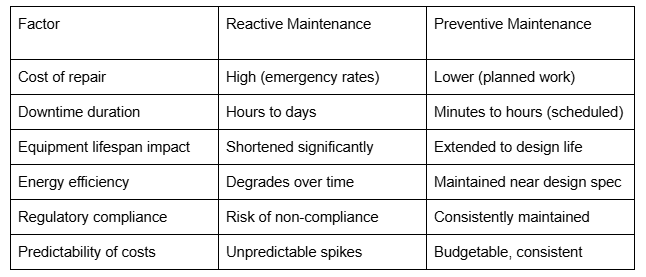
Reactive vs. Preventive Maintenance: A Cost Comparison
What to Look for in an Electrical Maintenance Partner in Singapore
Not all maintenance providers deliver equal value. When selecting a partner, commercial and industrial facilities should prioritise:
- Licensed Electrical Workers (LEW) on staff or retained — mandatory for certain inspections under the Electricity Act
- Experience with your specific installation type (high-voltage systems, industrial machinery, data centres)
- Comprehensive reporting and documentation practices
- Emergency response capability with defined response time SLAs
- Familiarity with EMA regulations and SS 638 compliance requirements
The right maintenance partner functions as a proactive advisor, not just a reactive repair crew. They flag emerging risks, recommend efficiency improvements, and help you plan capital expenditure around actual equipment condition — not guesswork.
For commercial and industrial facilities looking to reduce operational risk and keep energy costs in check, Tayeng Services provides structured electrical building maintenance programmes tailored to Singapore's regulatory environment and the operational demands of high-uptime facilities.
Frequently Asked Questions
How often should electrical building maintenance be carried out?
For commercial and industrial buildings in Singapore, a combination of monthly visual inspections, quarterly thermographic surveys, bi-annual insulation testing, and annual switchboard servicing is recommended. LEW-supervised annual inspections are also required by the Energy Market Authority for many installations. The exact frequency depends on equipment age, criticality, and operating environment.
What are the main preventive maintenance benefits for businesses?
Preventive maintenance benefits include reduced unplanned downtime, lower emergency repair costs, extended equipment lifespan, improved energy efficiency, and maintained regulatory compliance. Businesses also gain predictable maintenance budgets, valid equipment warranties, and stronger insurance positions — all of which contribute to a measurable return on investment compared to reactive maintenance strategies.
How does electrical maintenance improve energy efficiency?
Poorly maintained electrical systems develop resistance in connections, degraded motor windings, and power factor imbalances — all of which increase energy consumption. Regular maintenance restores systems closer to their design efficiency. Addressing power factor correction and motor condition alone can reduce a facility's electricity consumption by 5–15%, delivering direct savings on utility bills.
Can skipping electrical maintenance void equipment warranties?
Yes. Most industrial and commercial electrical equipment manufacturers require documented maintenance records as a condition of warranty coverage. Skipping scheduled maintenance — or failing to keep proper service logs — can void warranty claims entirely. In Singapore, some commercial insurers also factor maintenance history into electrical fault or fire-related claims assessments.
What is the role of a Licensed Electrical Worker (LEW) in building maintenance?
A Licensed Electrical Worker is a certified professional regulated by Singapore's Energy Market Authority. Under the Electricity Act, certain inspection, testing, and certification tasks for electrical installations must be performed or supervised by an LEW. Engaging an LEW ensures your facility meets statutory requirements and that maintenance work carries the regulatory weight needed for compliance and insurance purposes.
How does regular maintenance extend equipment lifespan?
Regular maintenance removes stress factors that accelerate component wear — heat from loose connections, voltage imbalances, contamination, and insulation degradation. By addressing these issues proactively, equipment operates within design parameters for longer. A well-maintained industrial motor or transformer can achieve its full 20-plus year design life, while neglected equipment may fail in half that time.