

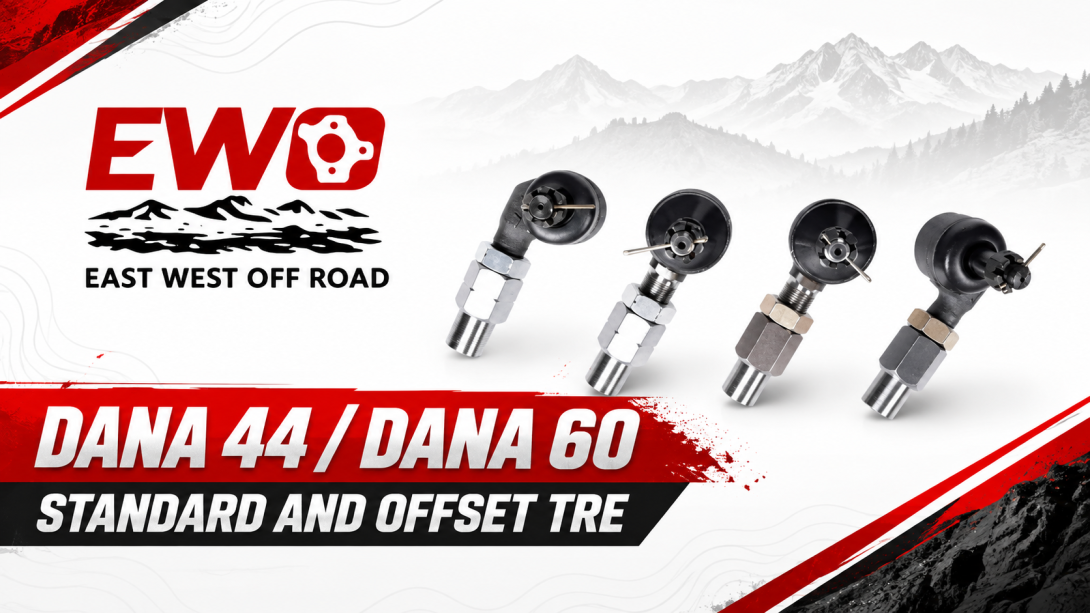
Buy Now: https://www.eastwestoffroad.com/product/dana-44-dana-60-standard-and-offset-tre
heavy duty tie rod ends are often searched as if one category name can answer every steering question, but the real decision depends on the exact parts and interfaces in the vehicle. For E90063, the useful starting point is the verified package identity: standard ES2234R/ES2234L ends, offset ES23434R/ES23434L ends, and matching 7/8-18 left- and right-hand threaded hardware. This guide focuses on evaluating supplier claims and documentation. It keeps the discussion at the product-selection and professional-planning level so buyers can compare the package without assuming universal fitment or turning aftermarket terminology into unsupported performance claims.
Short answer: “Heavy duty” is useful category language, but buyers should look for concrete product facts behind the label. For E90063, documented facts include the listed standard and offset part numbers, 7/8-18 threaded hardware, and metal-on-metal construction with spring technology. Strength ratings, service-life claims, and universal fitment should not be assumed when the product source does not publish them.
Evaluate “Heavy Duty” With Specific Questions
The phrase heavy duty tie rod ends is broad. A useful product comparison asks what the supplier actually documents: full part numbers, thread size, thread hand, included hardware, construction description, and compatibility boundaries. For E90063, those items are more dependable than an unsourced statement that one joint is “stronger” or will last a certain number of miles.
This approach also prevents apples-to-oranges comparisons. One supplier may publish an offset dimension or taper specification for its own part, while another may not. Those numbers should remain attached to the source that published them. If EWO does not publish a particular measurement for E90063, keep it as a verification question rather than borrowing another brand’s figure.
Read Construction Claims at the Level the Source Supports
E90063 is described as using metal-on-metal construction with spring technology. That is a legitimate product-description point for buyers researching heavy duty tie rod ends. It tells the reader something about the joint architecture the seller lists. It does not, by itself, provide a laboratory strength value, a service-life interval, a maintenance schedule, or a quantified comparison with another brand.
This distinction matters because steering content often drifts from descriptive terms into unsupported performance promises. A better buying habit is to separate what is documented from what still needs verification. Use the published part identities, thread information, package contents, and construction description as facts; treat strength, wear life, and use-case limits as questions unless the manufacturer publishes specific evidence.
Start With the E90063 Package Scope
For this topic, the most important reference point is the actual E90063 inventory. East West Off Road lists one ES2234R standard right-hand tie rod end, one ES2234L standard left-hand tie rod end, one ES23434R offset right-hand tie rod end, and one ES23434L offset left-hand tie rod end. The package also lists two 7/8-18 left-hand tube adapters, two 7/8-18 right-hand tube adapters, two left-hand jam nuts, and two right-hand jam nuts. That makes it a steering-end and threaded-hardware package rather than a complete linkage.
That scope matters when researching heavy duty tie rod ends. Similar search terms can lead to complete steering systems, individual replacement ends, or bundles with tubing and reamers. E90063 does not list DOM tubing, a reamer, ES2233L, ES2026R, ES2027L, steering knuckles, high-steer arms, a pitman arm, or a steering box. Buyers comparing standard tie rod ends, straight tie rod ends should keep those boundaries clear so they do not budget around parts that are not actually included.
The assigned supporting terms for this angle describe related buyer questions rather than new fitment claims. In practical language, the discussion may touch on standard tie rod ends, straight tie rod ends, heavy duty offset tie rod ends, tie rod end kit with jam nuts, and what are offset tie rod ends. Each phrase should be read in the context of the verified E90063 scope: four listed steering ends plus 7/8-18 threaded adapters and jam nuts. Where a phrase sounds broader than the product evidence, the article treats it as a question to verify instead of an automatic specification.
Keep the Part Numbers Exact
Part-number accuracy is central to E90063. The standard ends are ES2234R and ES2234L. The offset ends are ES23434R and ES23434L. The additional digit in ES23434 is not cosmetic. It distinguishes the offset family named in this product brief. A search for ES2234 vs ES23434 tie rod ends should therefore be answered by preserving the complete identifiers instead of shortening them into a generic 2234 label.
Part numbers also help separate replacement questions from system-design questions. If a vehicle already has an identifiable ES2234R, that is stronger evidence than an assumption based on axle model. If the installed part is an ES23434R, the offset geometry becomes part of the replacement question. A visual resemblance or common thread size is not enough to establish interchangeability.
Use a Pre-Order Compatibility Brief
Before purchasing heavy duty tie rod ends, write down the minimum facts that need to match. Start with the exact existing or planned part numbers. Add thread size and thread direction, the taper or mating steering interface, whether the position requires standard or offset geometry, and what nearby components define the clearance envelope. Then compare that list with the current E90063 product page.
If any of those items are unknown, that is the moment to ask the seller or a qualified steering professional. It is better to resolve one unanswered fitment question before ordering than to rely on a broad axle or “1 ton” label. The objective is a documented compatibility decision, not a guess based on a photo.
Where E90063 Fits in the Buying Decision
For shoppers whose verified parts list matches this component scope, review the E90063 Dana 44 / Dana 60 Standard and Offset TRE package and compare the current listing with the project notes. The page is the correct place to confirm current commercial details such as availability or price, which should not be frozen into evergreen technical content.
Keep the buying decision tied to the physical steering system. Confirm the four end identities, the required thread hands, the adapter and jam-nut needs, and the fact that tubing and a reamer are separate. If the project calls for a different bundle scope, move to the appropriate Y-link product rather than stretching E90063 beyond what it lists.
Keep Final Steering Fitment With a Qualified Professional
Steering components are safety-critical, and a product-selection article should not substitute for an installation plan. The useful role of this guide is to help a buyer ask better questions about heavy duty tie rod ends: what part number is present, what thread hand is required, what interface it mates with, and what clearance problem is actually being solved.
Any cutting, welding, reaming, torque setting, alignment work, or redesign of steering geometry should be handled according to the vehicle, parts, and professional procedures that apply to that build. E90063 can supply the listed ends and threaded hardware, but the finished steering system still has to be assessed as a complete mechanical system.
Quick Compatibility Checklist
Claim type
How to handle it
Published part number
Use as product fact
Published thread size
Use as product fact
Unpublished strength value
Do not invent
Competitor dimension
Keep attached to competitor
Frequently Asked Questions
What evidence supports the “heavy duty” description?
The supplied E90063 facts support the listed part identities, 7/8-18 hardware, and metal-on-metal construction with spring technology. They do not provide a quantified strength test or service-life result.
Should competitor strength claims be applied to E90063?
No. A competitor’s test data, dimensions, maintenance schedule, or marketing claims apply to that competitor’s part unless EWO independently publishes the same fact for E90063.
What is a useful buyer question about construction?
Ask what construction features are documented, whether the exact part numbers match the design, what hardware is included, and what fitment information the supplier can confirm.
Can customer reviews substitute for technical fitment information?
No. Reviews can describe an individual experience but do not replace part-number, thread, taper, and geometry verification for another vehicle.
Why avoid universal claims in steering content?
Steering is configuration-specific and safety-critical. Broad claims can hide differences in knuckles, steering arms, threads, clearance, and prior modifications that materially affect fitment.
Conclusion
The best answer to heavy duty tie rod ends: evaluating supplier claims and documentation is to work from exact component identity and the real steering layout. E90063 supplies a defined mix of standard and offset ends with 7/8-18 adapters and jam nuts, but it does not replace fitment confirmation, fabrication planning, or professional steering assessment. If the project notes match the package scope, review the current E90063 product page and confirm any remaining compatibility question before ordering. That approach keeps the purchase tied to documented interfaces rather than a broad axle name, a “1 ton” label, or appearance alone.