

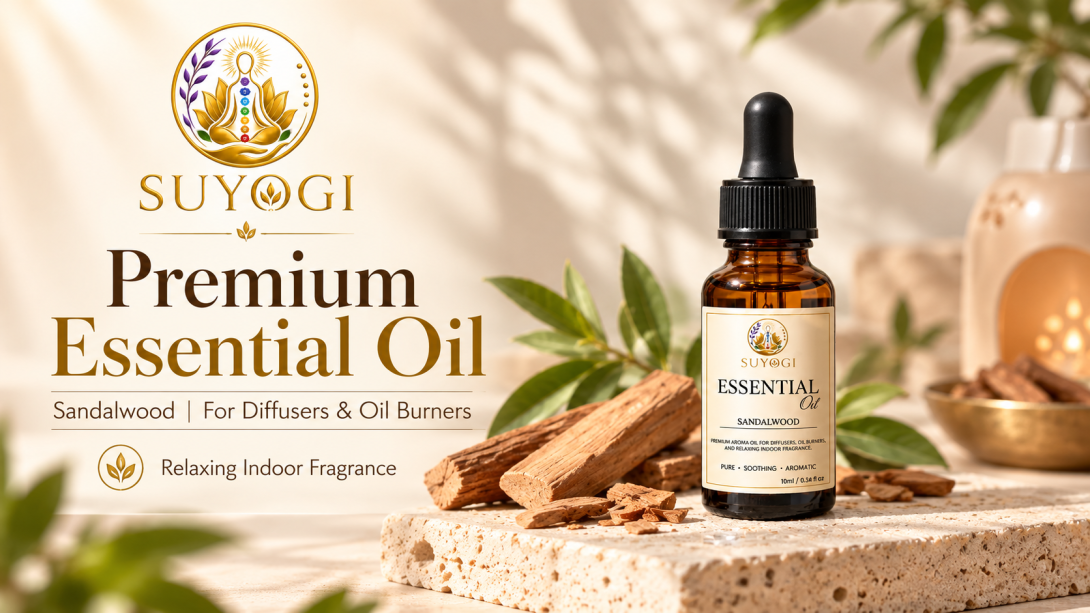
Buy Now: https://suyogi.in/product/essential-oil
People searching for essential oils for meditation often find lists promising calm, focus, stress relief or deeper spiritual states. A more grounded approach is to treat fragrance as optional atmosphere. Meditation does not require an essential oil, and a scent does not need a therapeutic promise to be part of a personal routine.
Decide what role fragrance will play
Before choosing an oil, ask why you want scent in the space. Perhaps you enjoy having a consistent aroma when you sit down to meditate. Maybe you want the meditation corner to feel distinct from the rest of the room. Or perhaps you simply like fragrance.
Those are clear, reasonable goals. They do not require saying that the oil treats anxiety, changes brain function or improves meditation performance.
NCCIH describes aromatherapy as the use of plant-derived essential oils and notes that evidence for many health outcomes is limited or uncertain. That makes modest language especially important when discussing meditation.
Build the routine around meditation, not the product
A simple practice can work like this:
· Choose a regular place to sit.
· Reduce obvious distractions.
· Set up your timer or practice method.
· If you want fragrance, use only a compatible device according to its instructions.
· Begin the meditation.
The oil remains secondary. If you stop enjoying the scent, remove it from the routine without feeling that the practice is incomplete.
Consistency can be a cue without being a claim
Humans often associate repeated sensory details with routines. A particular chair can signal “reading time”; a certain playlist can signal “work mode”. In the same ordinary sense, a fragrance can become part of the context for meditation.
That does not prove the fragrance itself creates mindfulness, reduces clinical stress or produces a spiritual result. The distinction keeps the article useful without turning ambience into treatment advice.
Choose fragrance by preference
If the exact Suyogi variant is verified later, you can decide whether that aroma suits your personal taste. Until then, do not assume the bottle is lavender, sandalwood, lemongrass or another familiar meditation-related scent.
A good fragrance for meditation is simply one that does not distract you and that you personally enjoy. Some people may prefer no scent at all.
Keep the device outside the practice zone
A meditation space should remain uncluttered. Place any diffuser or aroma device where it will not be knocked over or become the focus of attention, following the appliance manufacturer’s placement and operating directions.
If the device uses water, do not improvise with another liquid. If it is a humidifier, do not add oil unless the manufacturer explicitly supports essential-oil use.
Avoid borrowed drop counts
Meditation articles frequently publish exact drop numbers or blends. Those instructions may belong to a specific oil or diffuser and should not be copied to Suyogi without verified directions.
For SUY-003, the exact bottle size, composition and device compatibility remain unverified in this research session. Use the current label and device manual rather than a universal formula.
A meditation-space checklist
Before adding fragrance, confirm:
The practice works without it
Fragrance should be optional.
The product identity is clear
Know the actual oil or blend you are using.
The device is compatible
Read the diffuser manual.
The quantity guidance comes from the right source
Use manufacturer directions rather than a generic blog recipe.
The scent is welcome
If it feels distracting, strong or unpleasant, skip it.
What not to promise
A responsible article should not claim that Suyogi Essential Oil:
· treats anxiety or depression;
· cures insomnia;
· guarantees focus;
· balances chakras;
· changes spiritual energy;
· produces a particular emotional outcome.
These are either therapeutic or unverifiable outcome claims and are unnecessary for a home-fragrance article.
Know when to skip fragrance altogether
A meditation session does not become less meaningful because you decide not to use scent. There are several practical reasons to keep the diffuser off: the fragrance feels distracting, another person is sharing the room, the product identity is unclear, the device instructions are missing or you simply prefer fresh air that day.
This flexibility is useful because it stops the ritual from becoming dependent on a purchase. The product can support the atmosphere when appropriate without becoming a requirement for concentration or calm.
If you are trying a new fragrance, introduce only one new variable at a time. Keep the meditation method the same and decide separately whether you enjoy the scent. That lets you make a personal preference judgement without attributing every good or difficult session to the oil.
Avoid using a meditation article to recommend custom blends for emotional states unless those formulas are supported for the exact products involved. A list such as 'X oil for anxiety, Y oil for sleep, Z oil for focus' may look useful but quickly crosses into claims that require stronger evidence.
For Suyogi, the current product identity should come first. Once the variant and intended use are verified, the reader can decide whether that fragrance belongs in their routine - or whether meditation is better without any added scent.
A short trial can also stay deliberately simple: use the product only as directed in a compatible device, keep the rest of the meditation routine unchanged, and decide afterwards whether the fragrance was pleasant, neutral or distracting. This keeps the judgement personal and practical instead of turning one session into evidence of a health or spiritual effect.
Frequently asked questions
Do I need essential oils to meditate?
No. Meditation can be practised without fragrance or any special product.
Can an essential oil make meditation more effective?
There is no need to make that promise. Fragrance can simply be an optional environmental preference.
Which essential oil is best for meditation?
There is no universal best choice. Use a verified product whose fragrance you enjoy and whose intended use matches your device.
How many drops should I diffuse during meditation?
Follow the oil and diffuser manufacturer instructions. This article does not provide a universal number.
Can I put essential oil in a humidifier while meditating?
Only if that humidifier explicitly permits essential-oil use and explains the correct method.
Let fragrance stay in the background
A meditation routine should still make sense when the diffuser is switched off. If you choose Suyogi Premium Essential Oil for the space, verify the current variant and intended-use instructions, then let the fragrance remain a supporting detail rather than the centre of the practice.