

Buy Now: https://www.eastwestoffroad.com/shop?category=dom-tubes
Shopping DOM tubing for sale is easier when the order request is specific enough that the supplier and fabricator are discussing the same product. A good brief identifies whether the project needs a 3-link or 4-link tube package, nominal length variant, quantity, OD, ID, wall thickness and whether a separate panhard tube is part of the package. EWO’s DOM category already organizes those choices into four SKUs, but the buyer should still verify the unresolved nominal 3-foot cut lengths and avoid assuming that joints or hardware are included.
Direct answer: A useful DOM tubing order brief names the exact package or SKU, tube count, nominal length variant, OD, ID and wall thickness, plus any documentation the fabricator needs. It should also state which parts will be sourced separately so a tube-only order is not mistaken for a complete suspension package.
When requesting DOM tubing online, a precise order brief makes it easier to buy DOM tubing without confusing package scope. A 2 inch DOM tube kit should state the rest of the dimensions and tube count, while 3 link tubing for trucks needs to be tied to the correct 3-link SKU. Likewise, DOM tubing for 4 link bars should be sourced from the applicable 4-link package rather than assuming every DOM kit contains the same pieces.
Build an Order Brief Before You Buy
A concise order brief can prevent most procurement mistakes. Record the intended EWO SKU, whether the project calls for a 3-link or 4-link tube package, the tube count, listed dimensions and the length variant. For a 3-link package, note that a separate panhard tube is listed. For a 4-link package, do not add a panhard tube unless the professional design calls for one and it is being sourced separately.
Also list what the tube package does not contain. Joints, rod ends, bungs, brackets, shocks and vehicle-specific mounting hardware are not part of the supplied source-supported contents. Giving the fabricator that information before ordering helps separate material procurement from suspension design.
Buying Questions That Matter More Than Marketing Labels
A useful purchase conversation starts with measurable facts. Confirm the package SKU, number of tubes, nominal or stated cut length, OD, ID and wall thickness. Then identify what is not included so there is no assumption that tube adapters, rod ends, bushings, brackets, shocks or mounting hardware will arrive in the box.
Next, ask the fabrication shop whether the listed material dimensions fit the design they are responsible for. The shop may also need supplier documentation that is not present in an online product title, such as material grade or tolerance information. If a detail is important to the design but not published, the correct next step is verification—not filling the gap with a common industry assumption.
What EWO Actually Supplies in the Applicable Package
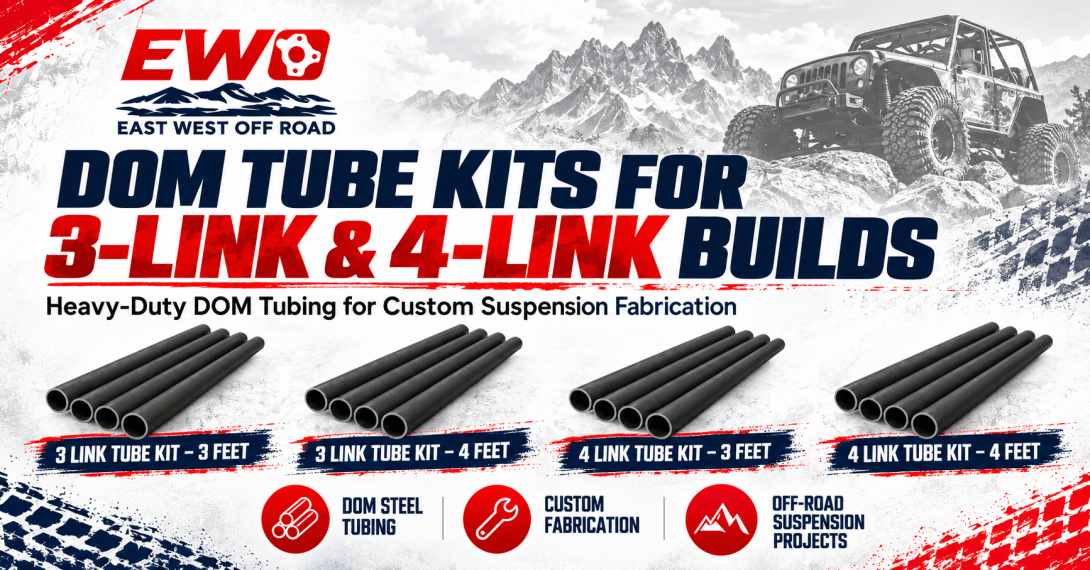
EWO’s DOM category contains four tube-only packages: E90627 and E90626 are 3-link sets, while E90625 and E90624 are 4-link sets. The main tubes across the supplied baseline are listed at 2.00-inch OD, 1.50-inch ID and .250-inch wall. The 3-link packages additionally list one 43-inch panhard tube at 1.50-inch OD, 1.00-inch ID and .250-inch wall; the 4-link packages do not. The 4-foot variants use 48-inch main tubes. The exact cut length of the nominal 3-foot variants remains unresolved in the source material and should be confirmed before ordering. These are not complete suspension systems, and the supplied contents do not list joints, rod ends, bungs, brackets, shocks or vehicle-specific installation hardware.
For current product identity and purchasing reference, review the 3 Link Tube Kit - 3 Feet page together with the project brief from your fabrication shop. That pairing keeps the shopping decision grounded in verified tube contents while leaving suspension geometry and fabrication choices to the professional designing the vehicle.
3-Link and 4-Link Packages Solve Different Procurement Problems
A 3-link tube package and a 4-link tube package should not be treated as interchangeable simply because the main tubes share dimensions. EWO’s 3-link sets list three main tubes and a separate panhard tube. The 4-link sets list four main tubes and no panhard tube. That package difference reflects two different shopping scopes; it is not an instruction for how to design either suspension.
Before ordering, tell the fabricator which package family you are considering and why. If the professional design needs different material, different lengths or additional parts, that decision should happen before purchase. A tube kit is most useful when its quantities and dimensions already match the project’s professionally defined material list.
What Documentation Should a Supplier Confirm?
If the fabrication plan requires information beyond basic dimensions, ask for it directly. Examples can include material grade, applicable tubing specification, dimensional tolerances or certification paperwork when those items are relevant to the professional design. Do not assume those facts from a category name or from another supplier selling tubing with similar dimensions.
The EWO baseline used for this cluster supports tube dimensions, quantities and package identity, but it does not state a steel grade, ASTM compliance, mechanical-property values, heat treatment or a load rating. Omitting those unsupported claims is not a weakness; it keeps the purchasing information aligned with what the source actually proves.
Keep Geometry and Fabrication With a Qualified Professional
Suspension geometry determines how an axle moves and how loads travel through the vehicle. Tube diameter and wall thickness are only part of that system. Final link length, mounting locations, joint selection, articulation, clearances and fabrication procedures require vehicle-specific engineering judgment.
For that reason, this guide does not provide cutting lengths, welding procedures, bracket locations or suspension-geometry instructions. Bring the verified product information to a qualified fabricator or suspension professional, confirm the package before ordering, and have the completed system professionally inspected. That keeps the buying decision useful without turning a product description into an unsafe fabrication recipe.
Frequently Asked Questions
What should I include in a DOM tubing supplier quote request?
Include the exact SKU or product identity, tube count, OD, ID, wall thickness and length variant. State whether the package is for 3-link or 4-link procurement and whether a panhard tube is listed. Ask separately for any material documentation required by the fabricator so the technical request stays precise.
Should current price be part of the technical tube description?
Current price can appear in a purchase quote, but it should be kept separate from the evergreen technical description because sales and shipping terms change. The article package intentionally avoids embedding time-sensitive price claims. Use the live EWO shopping page when a current commercial figure is needed.
How should I handle the unresolved 3-foot cut lengths in an order brief?
Name the exact SKU and nominal product name, then ask the supplier to confirm actual supplied cut length before the order is finalized. Do not silently choose 36 or 38 inches. Recording the discrepancy in the order brief protects the fabrication shop from planning around an unsupported dimension.
Can I order a 2-inch DOM tube package before joints are specified?
A tube-only purchase is possible, but it should still be coordinated with the professional design. Because EWO does not list joints or bungs in these packages, the fabrication shop should understand what interfaces will be sourced separately and confirm that the tube ID, material and other requirements are appropriate.
Why should tube quantities be written explicitly in a purchase brief?
Because the 3-link and 4-link packages have different scopes. The 3-link sets list three main tubes plus a panhard tube, while the 4-link sets list four main tubes. Writing quantities explicitly prevents the word “kit” from hiding a mismatch between the buyer’s order and the professional material list.
Conclusion
Dom tubing for sale is most useful when it is treated as verified raw material rather than a shortcut to suspension design. Start with the correct EWO package, tube count, dimensions and supported length information, then hand those facts to the qualified professional responsible for geometry, joints, fabrication and final inspection. Where the nominal 3-foot source data conflicts, confirm the supplied cut length before purchase instead of guessing.
When the professional material list is ready, compare EWO’s DOM tube packages and match the package to that documented requirement. That approach keeps the buying decision accurate, avoids unsupported compatibility claims, and preserves the difference between a tube package and a finished custom suspension.