

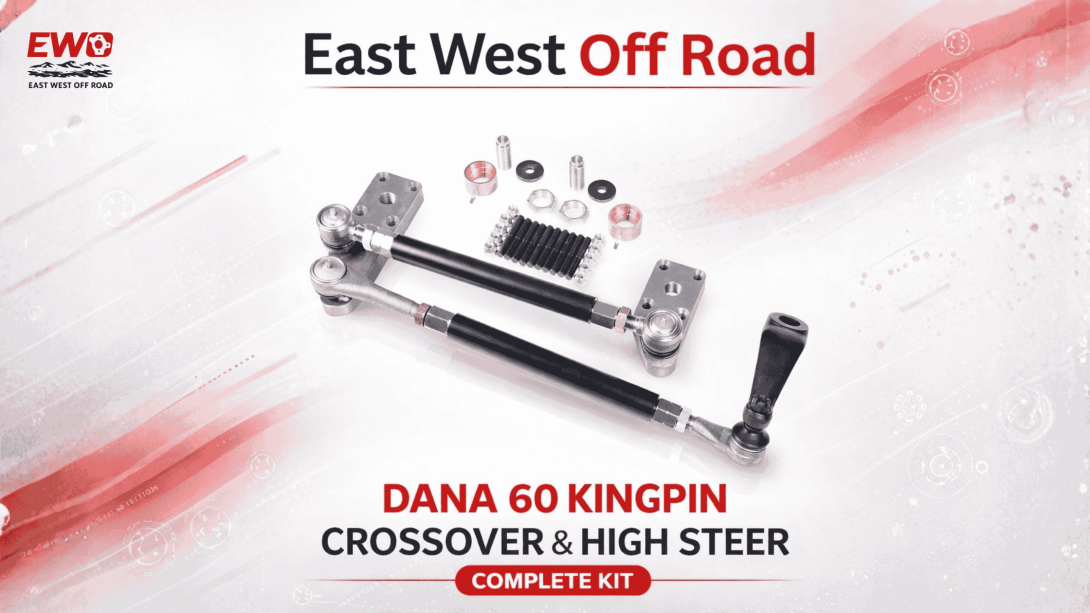
Buy Now: https://www.eastwestoffroad.com/product/dana-60-kingpin-crossover-high-steer-complete-kit
If your lifted truck or Jeep wanders on the highway, kicks back through the steering wheel on the trail, or chews through tie rod ends every other season, the factory linkage on your axle is probably the culprit. Switching to Dana 60 Kingpin Crossover Steering corrects the geometry problems that show up the moment you add lift and bigger tires, replacing the weak push-pull factory setup with a side-to-side drag link layout that tracks straighter, flexes further, and survives abuse the stock arms were never designed for. This guide breaks down why crossover steering matters for kingpin-style Dana 60 axles, what separates a true heavy-duty kit from a budget bolt-on, and exactly what to look for before you commit your hard-earned money to a steering upgrade.
What Is Crossover Steering and Why Kingpin Dana 60 Axles Need It
Every kingpin Dana 60 left the factory with a "push-pull" steering arrangement. The drag link runs front-to-back from the pitman arm to a steering arm tucked behind the axle, and the geometry only works correctly within a narrow range of ride height. The instant you add a lift kit and aftermarket tires, that factory geometry falls apart.
Understanding the Factory Push-Pull Steering Limitation
In a stock push-pull layout, the drag link angle changes dramatically as the suspension cycles. At full droop the steering can bind, and at full compression the angles get steep enough to load the tie rod ends and ball joints far beyond their intended range. Owners running 4 inches of lift or more typically notice the steering wheel needs constant correction, especially at highway speed, because the linkage is fighting itself rather than tracking the road.
How Crossover Steering Corrects Bump Steer and Geometry
Crossover steering relocates the drag link so it runs side-to-side, parallel to the tie rod, rather than front-to-back. This keeps both links moving through a similar arc as the axle articulates, which is the single biggest factor in eliminating bump steer. With both links following matched geometry, the front tires stay pointed where you aimed them, even when one side of the axle is flexed up over a rock and the other is hanging in a rut. This is also why a properly engineered Dana 60 Kingpin High Steer Kit is considered a foundational upgrade rather than an optional one once you're running real lift and trail-rated tires.
Why Upgrade to a Dana 60 Kingpin High Steer Kit
A high steer conversion does more than fix bump steer. It physically raises the steering linkage above the axle centerline, which solves a second problem entirely: ground clearance.
Signs Your Stock Steering Is Holding You Back
A few warning signs tend to show up before total failure. Excessive play at the steering wheel, clunking over washboard roads, premature tie rod end wear, a drag link that hangs low enough to catch on rocks and ruts, and a truck that constantly wanders in a straight line are all symptoms of factory steering that's been pushed past its design limits. None of these are issues you can torque your way out of with stock parts; they require a geometry correction.
Benefits of a High Steer Conversion for Lifted Rigs
Lifting the steering linkage up and out of the way protects it from trail strikes, while the longer crossover drag link improves leverage and steering feel. Builders running 35-inch tires and larger consistently report a noticeably tighter, more confident feel on the highway alongside better articulation off-road. If you're shopping for a Crossover Steering Dana 60 solution, this combination of protection and precision is the entire point of the conversion, and it's why so many rock crawling and overland builds treat it as a must-have rather than a nice-to-have.
Inside a Complete Dana 60 Steering Kit: What Makes It Different
Not all kits sold under the "high steer" label are built the same way, and the difference shows up the first time you hit a hard trail. A genuinely Complete Dana 60 Steering Kit eliminates the guesswork and the parts-chasing that comes with piecing a system together from multiple vendors.
Billet Steering Arms vs. Stamped Factory Arms
Factory steering arms are stamped or forged to a price point, not to a strength target. Billet arms, machined from solid domestic steel rather than bent or cast, hold their shape under load and resist the fatigue cracking that eventually dooms stamped components. This is the difference between a part that survives one hard rock crawling season and one that's still tight five years later.
Bronze Kingpin Bushings and Why They Matter
Kingpin axles rely on the upper and lower kingpin bushings to support the entire steering pivot. Worn bushings introduce slop that no amount of tie rod adjustment can fix. A set of Dana 60 Kingpin bronze bushings restores tight kingpin support, improves steering feel immediately, and extends the life of every other component in the system because the pivot point itself is no longer the weak link.
DOM Tubing Specs That Actually Hold Up On The Trail
Drawn-over-mandrel (DOM) tubing is the industry standard for steering links because of its consistent wall thickness and superior strength compared to mild steel pipe. A DOM Tubing Steering Kit Dana 60 builders trust will spec heavy wall tubing rather than the thin-wall stock sometimes used by budget kits. Look specifically for 1.50 OD 250 wall DOM tubing, which provides the rigidity needed to resist bending or twisting when the drag link takes a direct hit on the trail.
Premium Drag Link and Tie Rod Ends
The quality of the rod ends determines how much slop creeps into the system over time. Heavy-duty ES2026R ES2027L drag link ends paired with ES2234L ES2234R tie rod ends are built to handle the higher angularity and load that come with a crossover conversion, holding tighter tolerances under articulation than the lighter-duty ends found in many universal kits.
Dana 60 High Steer Arms Billet Construction Explained
The steering arms are the backbone of any crossover system, so it's worth understanding exactly what separates a durable arm from one that will eventually flex or crack.
1.25 Inch Thick Arms and 5 Hole Pattern Compatibility
Thicker material resists bending under the leverage created by larger tires and aggressive trail use. 1.25 inch thick Dana 60 billet arms provide substantially more cross-section than the factory arm, which translates directly into a stiffer, more predictable steering feel. Equally important is hole pattern compatibility. 5 hole pattern Dana 60 steering arms are machined to work with both stock knuckles and popular aftermarket knuckles like Reid Racing, so you're not locked into a single knuckle option down the road. If you're comparing arm options side by side, a properly engineered Dana 60 High Steer Arms Billet pair should always list both arm thickness and hole pattern up front, because those two specs determine fitment and long-term durability more than almost anything else.
180,000 PSI Studs and Why Strength Class Matters
Steering arms are only as strong as the hardware clamping them to the knuckle. 180000 PSI high strength fine thread studs provide significantly more clamping force and fatigue resistance than standard-grade hardware, which matters enormously given that this hardware is holding the entire front-end steering load. Pairing premium billet arms with lower-grade studs is a common shortcut that undermines an otherwise solid kit, so it's worth confirming stud strength rating before you buy.
Choosing the Right 1 Ton High Steer Kit for Your Build
Not every build has identical needs, and matching the kit to your use case prevents both overspending and under-building.
Rock Crawlers vs. Overland and Trail Rigs
A dedicated rock crawler benefits most from maximum ground clearance and the strongest possible arm and hardware combination, since the steering will absorb direct impacts regularly. Overland and trail rigs that spend more time on forest roads and moderate trails still benefit from the geometry correction and durability of a 1 Ton High Steer Kit, but may prioritize a setup that retains smoother on-road manners for long highway stretches between trailheads.
Matching Your Lift Height and Knuckle Setup
Lift height changes the angles your steering operates at, and knuckle choice affects which arm hole pattern and stud taper you need. Before ordering, confirm whether you're running a factory knuckle or an aftermarket knuckle, and double check that the kit you're considering is engineered as a true Billet Dana 60 High Steer Complete package rather than a partial kit that assumes you already own compatible drag link and tie rod hardware. Builders comparing options often start their search with East West Offroad Dana 60 kit because it's packaged as a single, fully accounted-for system rather than a collection of a la carte parts.
Installation Considerations for a Dana 60 Kingpin Steering Conversion
Crossover steering installation is a manageable weekend project for anyone comfortable with basic fabrication, but a few details make the difference between a clean install and a frustrating one.
Tools and Welding Requirements
Most kits require welding the weld bungs onto the DOM tubing after final length is determined, so access to a MIG or TIG welder (or a trusted local fabricator) is necessary. Standard hand tools handle the rest of the install, including socket sets for stud and nut torque and a tube cutter or angle grinder for trimming tubing to length.
Steering Box Position and Pitman Arm Notes
Many GM and Dodge applications require relocating or swapping the steering box to a 2WD-style mounting position to achieve correct crossover geometry, and Dodge applications in particular often need the steering shaft shortened to match. Confirm your specific application's steering box requirements before cutting any tubing, since this step affects your final drag link length calculation.
Setting Toe and Checking Full-Lock Clearance
Before final welding, always dry-fit the entire system and cycle the steering through full left and right lock while checking for any interference with the frame, engine, or crossmember. Set toe close to factory specification as a starting point, then fine-tune with a proper alignment once the vehicle is back on the ground. Skipping the full-lock clearance check is the single most common installation mistake, and it's far easier to catch before anything is permanently welded in place.
American Made Quality: Why Sourcing Matters
Steering components fail in ways that directly affect vehicle control, which makes material sourcing and manufacturing quality non-negotiable rather than a marketing footnote. American Made Dana 60 High Steer components are typically machined from certified domestic steel with traceable material specifications, giving builders confidence in the actual strength rating of the parts holding their front end together. This matters just as much for a daily-driven lifted truck as it does for a dedicated rock crawler, since steering failure at highway speed is a far more serious consequence than steering failure at walking pace on a trail.
East West Offroad Complete Dana 60 Kingpin Steering Kit Overview
For builders who want every component engineered to work together rather than sourced piecemeal, the EWO kingpin crossover complete kit consolidates the entire conversion into a single purchase.
What's Included in the Complete Dana 60 Kingpin Steering Kit
This complete Dana 60 kingpin steering kit ships with both driver and passenger side 1.25-inch billet arms in the 5-hole pattern, a full set of bronze kingpin bushings, 54-inch and 43-inch sections of 1.50 OD heavy wall DOM tubing, ES2026R and ES2027L drag link assemblies with hardware, ES2234L and ES2234R tie rod assemblies with hardware, ten 180,000 PSI fine-thread studs with tapered nuts, grease fittings, spacers, jam nuts, and 7/8-18 weld bungs and jam nuts for both sides. Every part needed to complete the conversion is accounted for, which removes the trial-and-error of sourcing individual components from multiple suppliers.
Specifications at a Glance
The kit is engineered specifically for Dana 60 kingpin axle applications, using a crossover and high steer steering style with domestic billet steel arms machined to 1.25-inch thickness in the 5-hole pattern. DOM tubing measures 1.50-inch OD, 1.00-inch ID, with a .250-inch wall thickness across both the 54-inch and 43-inch tube sections, and the entire system is manufactured in the USA. A pitman arm is available as an optional add-on for builds that need it. Builders looking at a complete, ready-to-weld Dana 60 Kingpin High Steer Kit or comparing Dana 60 High Steer Arm Pair options against partial kits will find the inclusion of bronze bushings, premium ES-series rod ends, and high-grade fasteners sets this package apart from arm-only or tubing-only alternatives on the market.
Frequently Asked Questions (FAQs)
What's the difference between crossover steering and high steer?
Crossover steering describes the side-to-side drag link layout, while high steer specifically refers to relocating the steering arms and linkage above the axle centerline. Most modern kits, including a full Dana 60 kingpin conversion, combine both upgrades into one system because they solve complementary problems: geometry correction and ground clearance.
Will a Dana 60 kingpin crossover steering kit fit my knuckle?
A 5-hole steering arm pattern is designed to work with both factory kingpin knuckles and popular aftermarket knuckles. Always confirm your specific knuckle's stud pattern and taper before ordering, since some older or heavily modified knuckles may require additional machining.
Do I need to weld anything during installation?
Yes. The DOM tubing typically ships slightly long so it can be trimmed to your exact application, then the weld bungs are welded on after the final length and steering geometry are confirmed through a dry fit at full lock.
Does installing high steer arms eliminate the kingpin spring?
It depends on the kit design. Some high steer arms use a set-screw style design that eliminates the need for the factory kingpin preload spring, while others retain the spring for OEM-style preload. Bronze kingpin bushings are recommended regardless of spring configuration, since they directly support the kingpin pivot itself.
How much lift do I need before crossover steering becomes necessary?
Most builders start noticing bump steer and binding issues in the 4-inch lift range and beyond, though tire size plays just as large a role as lift height. Heavier, larger-diameter tires increase the leverage and load placed on factory steering components even at moderate lift heights.
What size DOM tubing should I use for a Dana 60 high steer build?
1.50-inch OD tubing with a .250-inch wall thickness is the widely accepted standard for Dana 60 crossover and high steer applications, offering enough strength to resist bending under trail impact while remaining compatible with standard 7/8-18 weld bungs and tie rod ends.
Can I run my factory sway bar with crossover steering?
In most cases, the factory sway bar location interferes with crossover steering linkage and cannot be retained in its stock form. Builders typically switch to an aftermarket sway bar designed to clear crossover and high steer setups, or run without one on dedicated trail rigs.
Is a complete kit better than buying arms and tubing separately?
A complete kit ensures every component, from bushings to hardware to rod ends, is matched for strength and compatibility, which removes the risk of mixing a heavy-duty arm with undersized hardware or incompatible rod ends. For most builders, this also saves significant time compared to sourcing each part individually from different suppliers.