

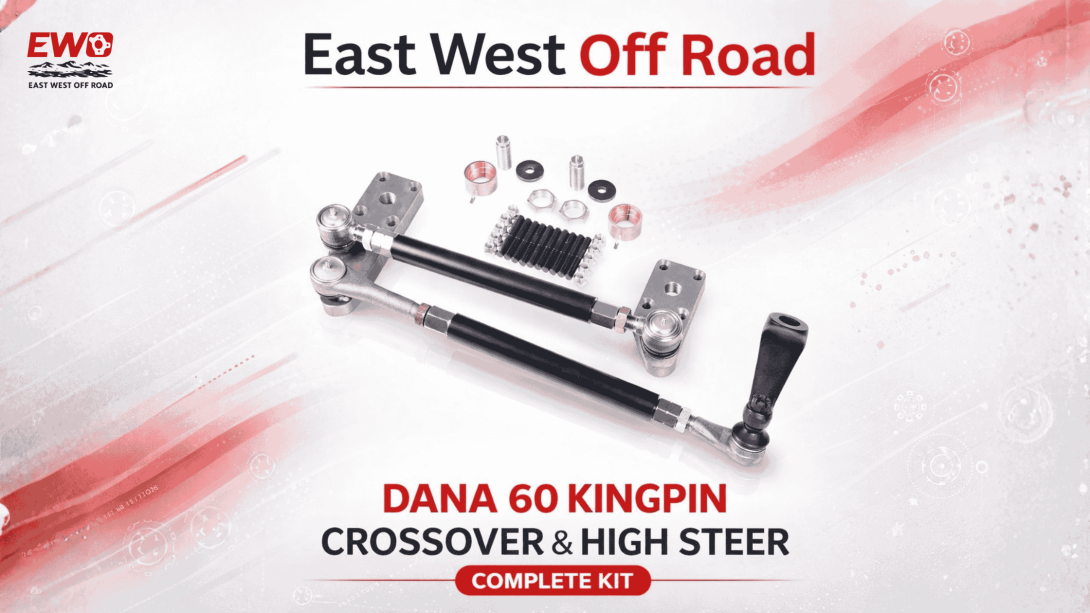
Buy Now: COMPLETE DANA 60 KINGPIN CROSSOVER & HIGH STEER STEERING KIT WITH DOM TUBING | MADE IN USA
There are two ways to build a Dana 60 steering system. The first is the piecemeal approach: source arms from one vendor, bushings from another, hope the stud kit you found on a forum classifieds ad has the right thread pitch, and spend three weekends chasing down weld bungs that actually match your DOM tubing. The second way is to open one box that contains every single component — arms, bushings, studs, tubing, rod ends, bungs, jam nuts, and grease fittings — matched and ready to assemble. That second approach is what a billet Dana 60 high steer complete kit delivers, and it's the approach East West Off Road built their reputation on. This isn't a starter kit that leaves you halfway through a conversion with a missing part and a dead phone battery. It's a complete steering system machined from domestic billet in the USA, with every piece selected to handle the loads that 40-inch tires and hydraulic assist generate.
What Is a Billet Dana 60 High Steer Complete Kit?
A billet Dana 60 high steer complete kit is a comprehensive steering conversion package for kingpin Dana 60 front axles where every major structural component is machined from billet steel rather than cast or forged. "Complete" in this context means the kit includes everything required to convert a stock Dana 60 from its factory inverted-Y steering configuration to a crossover high-steer system: driver and passenger high-steer arms, kingpin bushings, mounting studs and hardware, DOM tubing for the drag link and tie rod, weld bungs, jam nuts, and all four rod ends.
The "billet" distinction matters because it describes the manufacturing process used to produce the steering arms — the most structurally critical components in the entire steering system. Billet steel starts as a solid piece of rolled material with known alloy composition and grain structure. The arms are machined from that solid piece, removing material to create the final shape while preserving the original grain flow. This is fundamentally different from casting, where molten steel is poured into a mold and cooled. Cast parts can contain porosity, inclusions, and inconsistent grain structure that create failure points under the cyclic loading that steering components experience.
East West Off Road's complete kit goes further than just billet arms. It includes bronze kingpin bushings to replace the factory plastic units, 180,000 PSI fine-thread studs that exceed standard Grade 8 hardware specs, 1.50-inch OD DOM tubing with .250-inch wall thickness for fabricating the links, and ES-series rod ends that are sealed, greaseable, and available at any parts store. Nothing is omitted. Nothing requires a separate order. The kit is designed so that a builder with welding capability and mechanical experience can complete the entire steering conversion from one shipment.
Key Features and Specs of the East West Off Road Billet Complete Kit
Domestic Billet Steel Arms: 1.25 Inches Thick, 5-Hole Pattern
The arms are the centerpiece of any high-steer conversion, and East West Off Road machines both the driver and passenger arms from 1.25-inch domestic billet steel plate. At 1.25 inches thick, the arms provide the cross-sectional area needed to resist bending and torsional deflection under the combined loads of a hydraulic assist ram and a bound-up tire at full steering lock. Thinner arms — 3/4-inch or 1-inch — can flex enough to change toe at the worst possible moment. The billet machining process eliminates the internal defects that can plague cast arms, and the domestic material source means the alloy composition is documented and traceable.
The 5-hole bolt pattern on each arm accommodates the knuckle stud layouts used across the full range of Dana 60 kingpin applications. Ford used one pattern on their 1978–1991 F-350 axles. GM used a different pattern on the 1975–1988 K30 axles. Dodge had variations within their own production. Rather than forcing the builder to source specific knuckles or drill the arms on-site — which introduces stress concentrations and alignment challenges — the 5-hole design accepts whatever kingpin knuckles your axle has. This compatibility is the result of East West Off Road cataloging knuckle variations across decades of Dana 60 production and designing the arms to accommodate all of them.
Complete Kingpin Bushing Replacement with Bronze
Factory Dana 60 kingpin axles use nylon or plastic bushings at the kingpin pivot. These bushings work adequately under stock loads with stock tires. Once the vehicle is lifted, running 37-inch or larger tires with offset wheels, the lateral loading on the kingpin exceeds what plastic bushings can handle without deforming. Deformed bushings create knuckle play that no amount of preload adjustment can eliminate, and that play translates directly to steering slop.
The East West Off Road kit includes a full set of bronze kingpin bushings — two per knuckle — to replace the factory plastic. Bronze resists the compression set and cold-flow deformation that plastic experiences under sustained load. It handles heat cycling without dimensional change. It's self-lubricating to a degree, though the included grease fittings should be used on a regular maintenance schedule. The result is a kingpin pivot that stays tight and smooth through seasons of use that would send a stock bushing setup back to the press.
180,000 PSI Fine-Thread Studs and Tapered Nuts
The 10 studs that clamp the billet arms to the knuckles carry every pound of steering force from the steering box and any hydraulic assist ram. East West Off Road specs 1/2-inch fine-thread studs rated at 180,000 PSI tensile strength, paired with tapered nuts that self-center in the arm counterbores. Fine threads generate more clamping force at a given torque value than coarse threads because the shallower helix angle converts a higher percentage of rotational input into axial tension. The 180,000 PSI rating provides a meaningful margin above common Grade 8 fasteners, which typically land around 150,000 PSI. That margin matters when a hydro-assist ram at full system pressure is trying to peel the arm off the knuckle.
DOM Tubing: 1.50" OD x .250" Wall, Two Lengths Included
The kit ships with two raw lengths of DOM tubing — 54 inches and 43 inches — both measuring 1.50 inches outside diameter with .250-inch wall thickness and 1.00-inch inside diameter. DOM is seamless and cold-drawn, which means it lacks the longitudinal weld seam found in ERW tube and offers consistent wall thickness end to end. For steering links that will be cut, fitted, and welded to threaded bungs, DOM's uniformity provides predictable weld penetration and consistent strength along the entire link length.
The .250-inch wall provides enough material thickness for full-penetration fillet welds at the bung interface without burn-through risk, and it resists denting and bending from rock strikes that would fold a thinner-wall link. At 1.50 inches OD, the tubing clears spring perches, link mounts, and frame rails at full steering lock on most configurations.
ES-Series Rod Ends: Serviceable and Sealed
The drag link uses ES2026R and ES2027L ends. The tie rod uses ES2234L and ES2234R ends. These are sealed, greaseable, OEM-style rod ends with tapered studs, rubber boots, and full hardware. The tapered stud design seats into the billet arm bores with full surface contact, distributing steering loads through the arm's thickness. The rubber boots keep dirt, water, and grit out of the ball socket — a real advantage for rigs that see mud, creek crossings, and road salt.
Because these ends cross-reference to standard Moog chassis parts, a replacement is available at virtually any auto parts store in North America. For a vehicle that drives to the trail, runs it, and drives home, that parts availability is not a convenience — it's a recovery plan.
7/8-18 Weld Bungs and Jam Nuts
The kit includes left-hand and right-hand 7/8-18 threaded weld bungs with matching jam nuts for both the drag link and tie rod circuits. The opposing threads enable on-vehicle toe adjustment: loosen the jam nuts, rotate the DOM tube with a pipe wrench, and both rod ends extend or retract simultaneously. Tighten the jam nuts, and the assembly locks. The 7/8-18 thread size is overbuilt for the steering loads a Dana 60 transmits, eliminating galling and thread deformation as failure modes.
Who Is This Product Built For?
The Dana 60 Kingpin High Steer Kit with billet arms and a complete component set is designed for builders who want a single-box solution for converting a kingpin Dana 60 to crossover high-steer configuration. The specific audience includes:
- Ford F-350 owners (1978–1991) converting from factory leaf-spring steering to a crossover system compatible with link suspension conversions
- Chevrolet and GMC K30/C30 builders (1975–1988) refreshing worn steering on trucks repurposed for trail duty
- Dodge W-series enthusiasts running Dana 60 kingpin front ends
- Jeep Wrangler and Toyota pickup builders who've swapped in a kingpin Dana 60 and need steering links fabricated to match non-stock chassis dimensions
- Custom buggy and Ultra4 fabricators who want a complete, matched steering component package
The kit requires welding capability for the DOM tubing links and mechanical competence for the kingpin bushing replacement and arm installation. It's not a bolt-on solution for a stock truck — it's a conversion kit for a lifted, modified vehicle where the factory steering geometry no longer works. Minimum practical lift height is approximately 4 inches, which provides adequate clearance between the high-steer tie rod and the frame at full compression.
Installation Overview: What a Complete Kit Actually Requires
Installing a Crossover Steering Dana 60 complete kit follows a logical sequence: disassemble the knuckles, replace the kingpin bushings, mount the billet arms, fabricate the steering links, and assemble the system.
The knuckles come off to access the kingpin bushings. The old plastic bushings press out — a hydraulic press is the correct tool, though a bushing driver and patience will work. The bronze bushings press in, and kingpin preload is set to specification. This preload adjustment is the most technically sensitive step in the installation. Too little preload and the knuckle develops play. Too much and the steering binds. The included instructions provide the correct specification.
The billet arms bolt to the top of the knuckles with the supplied studs and tapered nuts. Torque values are critical — use a calibrated torque wrench and follow the included specs. Some knuckle castings, particularly early Ford units, may need minor clearancing for the arms to sit flush. This is a normal accommodation for 40-year-old castings that were never designed with billet high-steer arms in mind.
Link fabrication involves measuring the distance between rod end centers on the installed arms and pitman arm at ride height, subtracting the rod end lengths and bung depths to determine the DOM tube cut length, cutting the tube square, and welding the bungs into the tube ends. The welds must achieve full penetration on .250-inch wall material. A 220V MIG welder is recommended; a 110V machine can work with multiple passes and careful heat management.
Post-installation, the truck requires a full alignment with emphasis on toe setting. The crossover geometry should bring the drag link and track bar close to parallel at ride height, which is the geometric condition that minimizes bump steer.
Why Choose East West Off Road Over Competitors?
The Dana 60 High Steer Arms Billet complete kit from East West Off Road competes in a market with options at every price point. The differences come down to material quality, kit completeness, and design details that affect long-term reliability.
The arms are domestic billet, machined in the USA from traceable steel. Competing kits at lower prices often use cast arms from overseas foundries where material certification is inconsistent. A cast arm can look identical to a billet arm online and hide porosity or inclusions that become crack initiation points under load. Billet machining costs more. It also produces a stronger, more predictable component. For a steering part that your safety depends on, that cost difference is justified.
The kit is genuinely complete. Several products marketed as "complete steering kits" omit the kingpin bushings, sell the stud kit separately, or ship without the DOM tubing and weld bungs. East West Off Road includes everything — arms, bushings, studs, tapered nuts, tubing, rod ends, bungs, jam nuts, grease fittings, and spacers — under one part number. There is no supplemental order required to finish the conversion.
The ES-series rod end specification prioritizes longevity and parts availability over the short-term precision of heim joints. Heims have their place on dedicated competition vehicles. For a dual-purpose rig that accumulates street miles and sits outside between trips, sealed OEM-style ends survive dirt, water, and weather far better than exposed spherical bearings.
The 5-hole arm pattern reflects hands-on experience with the full range of Dana 60 kingpin knuckle castings. Ford, GM, and Dodge each used different bolt patterns. Rather than forcing builders into specific knuckles or requiring on-site drilling, East West Off Road machined the arms to accept them all.
Real-World Performance: Billet Where It Counts
The value of a billet Dana 60 high steer complete kit is most apparent when the steering system is operating at its limits. A cast arm with an internal defect might survive years of moderate use and fail catastrophically during a single high-load event — a bound tire at full lock on an obstacle, with a hydro-assist ram pushing at full system pressure. A billet arm machined from certified domestic steel eliminates the internal defect variable entirely. The strength is predictable because the material is consistent.
Builders running the East West Off Road system on rigs with 40- to 44-inch tires and hydraulic assist consistently report that the arms maintain their bolt torque and structural integrity through multiple seasons of hard rock crawling. The 180,000 PSI studs don't loosen. The bronze kingpin bushings don't develop play. The DOM links survive rock contact that would fold a thinner-wall tube.
In one representative build, a 1985 Chevrolet K30 running a Dana 60 kingpin front axle with 42-inch tires and a PSC hydro-assist system used the East West Off Road complete kit to replace a failing cast-arm steering setup. The previous arms had developed cracks at the rod end bores after two seasons. The billet replacements, inspected at 30,000 miles, showed no signs of cracking, no elongation at the tapered bores, and no loss of stud torque. The builder credited the arm thickness and billet material for the improvement.
Another builder with a 1990 Ford F-350 converted to a four-link front suspension and 40-inch tires reported that the crossover high-steer geometry corrected a bump-steer condition that three alignments and two different track bar configurations had failed to resolve. The drag link and track bar ended up within 1.5 degrees of parallel at ride height — close enough that bump steer was undetectable throughout the suspension cycle. The bronze kingpin bushings, greased at 3,000-mile intervals, showed negligible wear at 20,000 miles.
Conclusion
A billet Dana 60 high steer complete kit is the answer for builders who want to convert their kingpin Dana 60 to crossover high-steer configuration without the frustration of sourcing components from multiple vendors and discovering mid-installation that a critical piece is missing. East West Off Road's kit delivers domestic billet arms at 1.25 inches thick, bronze kingpin bushings, .250-inch wall DOM tubing, 180,000 PSI studs, ES-series rod ends, and every nut, bung, and fitting required to finish the job — all in one box, all made in the USA.
The geometry correction eliminates bump steer and raises the steering linkage above the rock strike zone. The billet construction eliminates the internal defect risk that cast arms carry. The kit completeness eliminates the project-killing parts chase. For a Dana 60 kingpin axle that's going to see hard trail use, this is the steering system it deserves.
Ready to build your steering right the first time? See the complete Dana 60 Kingpin High Steer Kit at East West Off Road.
Frequently Asked Questions About Billet Dana 60 High Steer Complete Kits
What makes billet steering arms better than cast arms?
Billet arms are machined from a solid piece of rolled steel with known alloy composition and consistent grain structure. Cast arms are poured into a mold and can contain porosity, inclusions, and inconsistent grain flow that act as crack initiation points under cyclic steering loads. Billet machining eliminates these internal defects.
Is welding experience required for a complete billet Dana 60 high steer kit?
Yes, the DOM tubing must be cut to length and welded to the included 7/8-18 threaded bungs. A 220V MIG welder with .030 or .035 wire is recommended for full penetration on .250-inch wall material. If you don't weld, a fabrication shop can handle the link assembly in under an hour.
How long do the bronze kingpin bushings last compared to stock?
Bronze bushings typically outlast factory nylon bushings by a factor of three to five times under equivalent off-road use. Bronze resists the compression deformation that causes plastic bushings to egg-out the bore under sustained side loading. Regular greasing through the included fittings extends service life further.
Can I run this kit on a ball-joint Dana 60?
No. This kit is designed specifically for kingpin-style Dana 60 knuckles. Ball-joint Dana 60 axles use a completely different knuckle attachment design and require a different steering arm configuration.
What's the minimum tire size to justify a billet high steer complete kit?
There's no minimum tire size, but the practical threshold is around 37 inches. Smaller tires generate lower steering loads that factory components can handle. The high-steer geometry and raised linkage become increasingly valuable as tire size and suspension lift increase beyond what the factory steering was designed to accommodate.
Do I need a drop pitman arm with this kit?
It depends on your steering box location relative to the high-steer arm position. The goal is to make the drag link parallel to the track bar. Measure your specific setup at ride height. A drop pitman arm may be necessary if your steering box is mounted high relative to the passenger arm.
Are replacement rod ends easy to find?
Yes. The ES2026R, ES2027L, ES2234L, and ES2234R ends cross-reference to standard Moog chassis parts available at most auto parts stores. This is a deliberate design choice that ensures serviceability on the road and on the trail.