

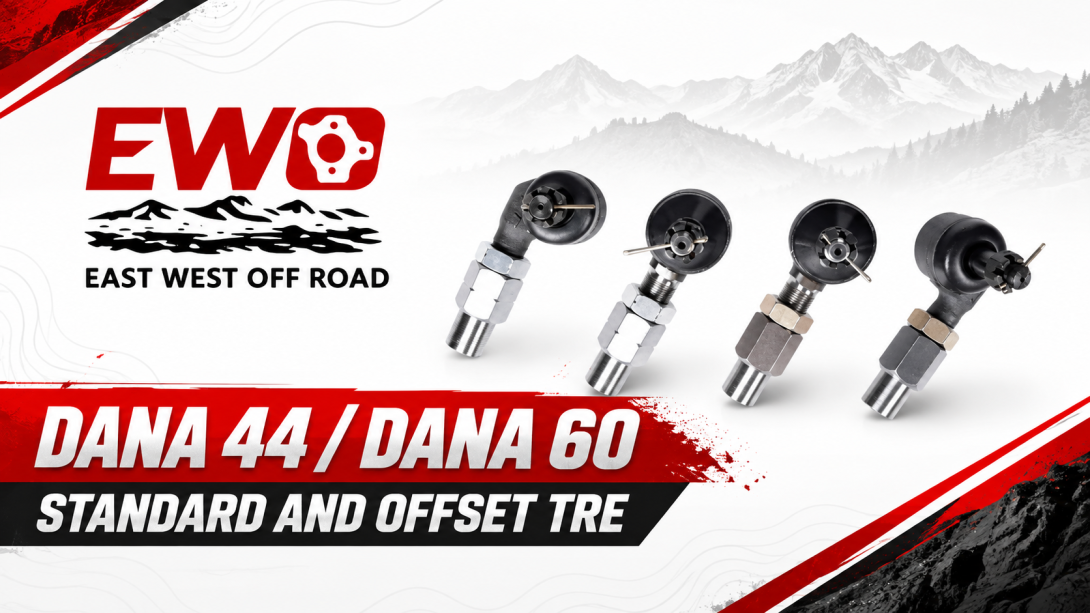
Buy Now: https://www.eastwestoffroad.com/product/dana-44-dana-60-standard-and-offset-tre
7/8-18 tie rod ends are often searched as if one category name can answer every steering question, but the real decision depends on the exact parts and interfaces in the vehicle. For E90063, the useful starting point is the verified package identity: standard ES2234R/ES2234L ends, offset ES23434R/ES23434L ends, and matching 7/8-18 left- and right-hand threaded hardware. This guide focuses on left-hand versus right-hand thread selection. It keeps the discussion at the product-selection and professional-planning level so buyers can compare the package without assuming universal fitment or turning aftermarket terminology into unsupported performance claims.
Short answer: Left-hand and right-hand in a 7/8-18 steering package describe thread direction, not a guaranteed driver-side or passenger-side location. E90063 lists both thread hands in its adapters, jam nuts, and steering-end mix. The correct hand must match the threaded component being used and the layout documented for the specific steering link.
Understand Left-Hand and Right-Hand Threads
E90063 includes both left-hand and right-hand threaded components. In this context, left-hand and right-hand identify thread direction. They do not automatically mean driver side and passenger side. That distinction is easy to miss when a catalog description uses RH and LH near a steering part number.
A right hand offset tie rod end must mate with compatible right-hand threaded hardware, while a left hand offset tie rod end requires the corresponding left-hand hardware. The same logic applies to the standard ends. Recording thread direction next to the full part number is more useful than relying on memory or physical appearance, especially when a custom steering link uses opposing thread directions for adjustment.
Separate the 7/8-18 Thread From the Steering Taper
The phrase 7/8-18 describes a threaded connection: a nominal 7/8-inch diameter with 18 threads per inch. E90063 uses that thread family in its listed adapters and jam nuts. That information is valuable when matching threaded hardware, but a 7/8-18 tie rod end thread is not the same thing as the stud taper that seats into a steering arm or knuckle.
Two steering ends can share the same thread size and still differ in thread hand, taper, housing geometry, offset, articulation, or intended position. For that reason, a buyer should never treat 7/8-18 as a universal-fit code. Confirm the mating adapter or tube insert, the correct jam nut, the thread direction, and the non-threaded steering interface separately.
Know What the Tube Adapters and Jam Nuts Contribute
E90063 includes the threaded hardware that supports a 7/8-18 steering-link build: two left-hand tube adapters, two right-hand tube adapters, two left-hand jam nuts, and two right-hand jam nuts. That is why searches for a tie rod end kit with tube adapters or tie rod end kit with jam nuts are relevant to this package.
The adapters provide the threaded interface between compatible tubing or a fabricated link and the steering ends, while jam nuts secure the adjusted threaded relationship in the finished system. The product brief does not provide a fabrication procedure, torque value, or welding method, so those details belong with the qualified professional responsible for the steering assembly.
The assigned supporting terms for this angle describe related buyer questions rather than new fitment claims. In practical language, the discussion may touch on 7/8-18 offset tie rod ends, 7/8-18 tie rod end kit, right hand offset tie rod end, left hand offset tie rod end, and 7/8-18 tie rod end thread. Each phrase should be read in the context of the verified E90063 scope: four listed steering ends plus 7/8-18 threaded adapters and jam nuts. Where a phrase sounds broader than the product evidence, the article treats it as a question to verify instead of an automatic specification.
Keep the Part Numbers Exact
Part-number accuracy is central to E90063. The standard ends are ES2234R and ES2234L. The offset ends are ES23434R and ES23434L. The additional digit in ES23434 is not cosmetic. It distinguishes the offset family named in this product brief. A search for ES2234 vs ES23434 tie rod ends should therefore be answered by preserving the complete identifiers instead of shortening them into a generic 2234 label.
Part numbers also help separate replacement questions from system-design questions. If a vehicle already has an identifiable ES2234R, that is stronger evidence than an assumption based on axle model. If the installed part is an ES23434R, the offset geometry becomes part of the replacement question. A visual resemblance or common thread size is not enough to establish interchangeability.
Use a Pre-Order Compatibility Brief
Before purchasing 7/8-18 tie rod ends, write down the minimum facts that need to match. Start with the exact existing or planned part numbers. Add thread size and thread direction, the taper or mating steering interface, whether the position requires standard or offset geometry, and what nearby components define the clearance envelope. Then compare that list with the current E90063 product page.
If any of those items are unknown, that is the moment to ask the seller or a qualified steering professional. It is better to resolve one unanswered fitment question before ordering than to rely on a broad axle or “1 ton” label. The objective is a documented compatibility decision, not a guess based on a photo.
Where E90063 Fits in the Buying Decision
For shoppers whose verified parts list matches this component scope, review the E90063 Dana 44 / Dana 60 Standard and Offset TRE package and compare the current listing with the project notes. The page is the correct place to confirm current commercial details such as availability or price, which should not be frozen into evergreen technical content.
Keep the buying decision tied to the physical steering system. Confirm the four end identities, the required thread hands, the adapter and jam-nut needs, and the fact that tubing and a reamer are separate. If the project calls for a different bundle scope, move to the appropriate Y-link product rather than stretching E90063 beyond what it lists.
Keep Final Steering Fitment With a Qualified Professional
Steering components are safety-critical, and a product-selection article should not substitute for an installation plan. The useful role of this guide is to help a buyer ask better questions about 7/8-18 tie rod ends: what part number is present, what thread hand is required, what interface it mates with, and what clearance problem is actually being solved.
Any cutting, welding, reaming, torque setting, alignment work, or redesign of steering geometry should be handled according to the vehicle, parts, and professional procedures that apply to that build. E90063 can supply the listed ends and threaded hardware, but the finished steering system still has to be assessed as a complete mechanical system.
Quick Compatibility Checklist
Thread item
E90063 listing
LH adapters
2
RH adapters
2
LH jam nuts
2
RH jam nuts
2
Frequently Asked Questions
What does left-hand thread mean on a tie rod end?
It means the threaded shank advances in the opposite rotational direction from a conventional right-hand thread. It is a thread specification, not a vehicle-side label.
Why use both left- and right-hand threaded components in a steering link?
Opposing thread directions are commonly used in adjustable link designs, but the exact design and adjustment method belong with the professional responsible for the steering system.
Does E90063 include both thread hands in adapters and jam nuts?
Yes. The listed hardware includes two left-hand and two right-hand adapters and the same split in jam nuts.
Can I identify thread hand from the axle side?
No. Do not assume driver side equals one thread hand and passenger side equals the other. Confirm the actual component or documentation.
Does 7/8-18 describe both thread hand and taper?
No. It describes nominal thread diameter and threads per inch. Thread hand is an additional detail, and the steering taper is a separate interface.
Conclusion
The best answer to 7/8-18 tie rod ends: left-hand versus right-hand thread selection is to work from exact component identity and the real steering layout. E90063 supplies a defined mix of standard and offset ends with 7/8-18 adapters and jam nuts, but it does not replace fitment confirmation, fabrication planning, or professional steering assessment. If the project notes match the package scope, review the current E90063 product page and confirm any remaining compatibility question before ordering. That approach keeps the purchase tied to documented interfaces rather than a broad axle name, a “1 ton” label, or appearance alone.
Tie Rod End Kit vs Y-Link Packages: Know What You Are Buying
Buy Now: https://www.eastwestoffroad.com/product/dana-44-dana-60-standard-and-offset-tre
tie rod end kit are often searched as if one category name can answer every steering question, but the real decision depends on the exact parts and interfaces in the vehicle. For E90063, the useful starting point is the verified package identity: standard ES2234R/ES2234L ends, offset ES23434R/ES23434L ends, and matching 7/8-18 left- and right-hand threaded hardware. This guide focuses on choosing the package scope. It keeps the discussion at the product-selection and professional-planning level so buyers can compare the package without assuming universal fitment or turning aftermarket terminology into unsupported performance claims.
Short answer: Choose among E90063, E90065, and E90215 by package scope, not by similar steering terminology. E90063 centers on standard and offset ends plus threaded adapters and jam nuts. E90065 is the Y-link product with tubing, while E90215 is the Y-link component bundle that includes a reamer. Verify the current listing before ordering.
Compare E90063 With the Two Y-Link Packages by Scope
East West Off Road has three related pages that can appear similar in search because they share GM-style steering terminology. E90063 is the standard-and-offset tie rod end package. E90065 is the Y-link steering product that includes tubing. E90215 is the Y-link component bundle that includes a reamer. Those differences are more useful than trying to decide from the words “1 ton” or “Dana 44/60” alone.
For a buyer who needs only the E90063 component scope, the standard and offset TRE package is the relevant shopping page. If the project actually needs the Y-link tube package or the reamer bundle, use the exact related product page and verify its current contents instead of assuming E90063 includes those items.
Start With the E90063 Package Scope
For this topic, the most important reference point is the actual E90063 inventory. East West Off Road lists one ES2234R standard right-hand tie rod end, one ES2234L standard left-hand tie rod end, one ES23434R offset right-hand tie rod end, and one ES23434L offset left-hand tie rod end. The package also lists two 7/8-18 left-hand tube adapters, two 7/8-18 right-hand tube adapters, two left-hand jam nuts, and two right-hand jam nuts. That makes it a steering-end and threaded-hardware package rather than a complete linkage.
That scope matters when researching tie rod end kit. Similar search terms can lead to complete steering systems, individual replacement ends, or bundles with tubing and reamers. E90063 does not list DOM tubing, a reamer, ES2233L, ES2026R, ES2027L, steering knuckles, high-steer arms, a pitman arm, or a steering box. Buyers comparing Dana 44 Dana 60 tie rod end kit, standard and offset TRE kit should keep those boundaries clear so they do not budget around parts that are not actually included.
Know What the Tube Adapters and Jam Nuts Contribute
E90063 includes the threaded hardware that supports a 7/8-18 steering-link build: two left-hand tube adapters, two right-hand tube adapters, two left-hand jam nuts, and two right-hand jam nuts. That is why searches for a tie rod end kit with tube adapters or tie rod end kit with jam nuts are relevant to this package.
The adapters provide the threaded interface between compatible tubing or a fabricated link and the steering ends, while jam nuts secure the adjusted threaded relationship in the finished system. The product brief does not provide a fabrication procedure, torque value, or welding method, so those details belong with the qualified professional responsible for the steering assembly.
The assigned supporting terms for this angle describe related buyer questions rather than new fitment claims. In practical language, the discussion may touch on Dana 44 Dana 60 tie rod end kit, standard and offset TRE kit, GM 1 ton standard and offset tie rod kit, tie rod end kit with tube adapters, and tie rod end kit with jam nuts. Each phrase should be read in the context of the verified E90063 scope: four listed steering ends plus 7/8-18 threaded adapters and jam nuts. Where a phrase sounds broader than the product evidence, the article treats it as a question to verify instead of an automatic specification.
A Mixed Package Does Not Dictate a Universal Layout
Because E90063 includes standard and offset pairs, it is tempting to infer a single installation pattern. The source block does not support that inference. One project may need offset geometry at a clearance-sensitive connection and standard geometry elsewhere; another may use only part of the bundle in a configuration designed by a professional. The package contents provide options, not a vehicle-specific diagram.
That point is especially important when comparing right- and left-hand components. Thread hand can be part of an adjustable-link strategy, but it should not be converted into a driver-side/passenger-side rule without product-specific evidence. The actual steering design should determine where each component belongs.
Use a Pre-Order Compatibility Brief
Before purchasing tie rod end kit, write down the minimum facts that need to match. Start with the exact existing or planned part numbers. Add thread size and thread direction, the taper or mating steering interface, whether the position requires standard or offset geometry, and what nearby components define the clearance envelope. Then compare that list with the current E90063 product page.
If any of those items are unknown, that is the moment to ask the seller or a qualified steering professional. It is better to resolve one unanswered fitment question before ordering than to rely on a broad axle or “1 ton” label. The objective is a documented compatibility decision, not a guess based on a photo.
Where E90063 Fits in the Buying Decision
For shoppers whose verified parts list matches this component scope, review the E90063 Dana 44 / Dana 60 Standard and Offset TRE package and compare the current listing with the project notes. The page is the correct place to confirm current commercial details such as availability or price, which should not be frozen into evergreen technical content.
Keep the buying decision tied to the physical steering system. Confirm the four end identities, the required thread hands, the adapter and jam-nut needs, and the fact that tubing and a reamer are separate. If the project calls for a different bundle scope, move to the appropriate Y-link product rather than stretching E90063 beyond what it lists.
Keep Final Steering Fitment With a Qualified Professional
Steering components are safety-critical, and a product-selection article should not substitute for an installation plan. The useful role of this guide is to help a buyer ask better questions about tie rod end kit: what part number is present, what thread hand is required, what interface it mates with, and what clearance problem is actually being solved.
Any cutting, welding, reaming, torque setting, alignment work, or redesign of steering geometry should be handled according to the vehicle, parts, and professional procedures that apply to that build. E90063 can supply the listed ends and threaded hardware, but the finished steering system still has to be assessed as a complete mechanical system.
Quick Compatibility Checklist
SKU
Scope distinction
E90063
Standard/offset ends + threaded hardware
E90065
Y-link product with tubing
E90215
Y-link component bundle with reamer
Decision rule
Buy by verified package scope
Frequently Asked Questions
What is the main difference between E90063 and E90065?
E90063 is the standard-and-offset steering-end package with threaded adapters and jam nuts. E90065 is the related Y-link steering product that includes tubing, based on the supplied cluster ownership rules and current page identity.
What is the main difference between E90063 and E90215?
E90215 is the related Y-link component bundle that includes a reamer, while E90063 does not include a reamer and focuses on standard and offset steering ends plus threaded hardware.
Which package should I buy if I already have the correct tubing?
That depends on the rest of the design. E90063 may match a project needing the listed mixed-end and hardware scope, but confirm the exact components and interfaces before choosing by package size alone.
Can I combine facts from the three product pages?
Only when the article clearly identifies which fact belongs to which SKU. Do not transfer tubing, reamer, or Y-link branch components into E90063 just because the products share steering terminology.
Why is package scope important for budgeting?
It prevents buyers from assuming a bundle contains major pieces that must actually be sourced separately. Knowing whether tubing or a reamer is included changes both the parts list and the professional planning required.
Conclusion
The best answer to tie rod end kit versus a y-link kit with tubes or reamer: choosing the package scope is to work from exact component identity and the real steering layout. E90063 supplies a defined mix of standard and offset ends with 7/8-18 adapters and jam nuts, but it does not replace fitment confirmation, fabrication planning, or professional steering assessment. If the project notes match the package scope, review the current E90063 product page and confirm any remaining compatibility question before ordering. That approach keeps the purchase tied to documented interfaces rather than a broad axle name, a “1 ton” label, or appearance alone.