

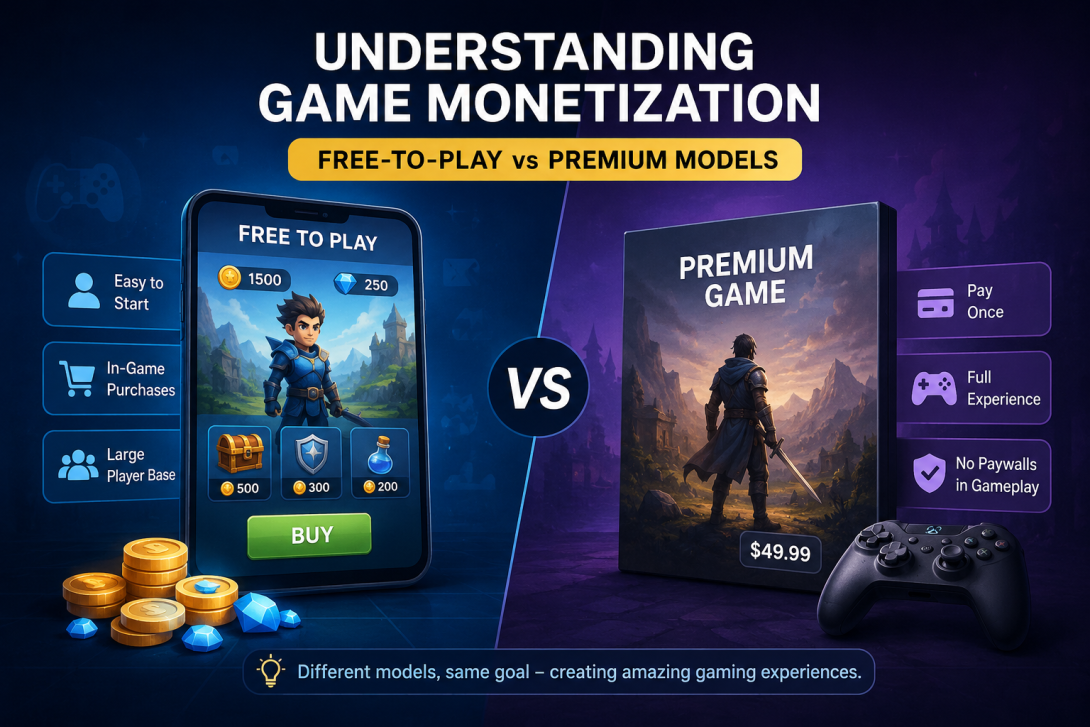
A game can be brilliant, beautifully designed, and genuinely fun — but if the business model behind it doesn't work, keeping that game alive becomes difficult. That's where game monetization comes in.
Think about the games you play casually. Maybe you downloaded one for free, played for a few minutes, and then encountered an extra-life offer, a cosmetic item, or a premium upgrade. Another game might have asked you to pay upfront before you could play a single level. Both approaches can work, but they create very different experiences for players and very different challenges for developers.
The two most common approaches are free-to-play and premium gaming. Understanding how they work helps explain why some games rely heavily on purchases made inside the game, while others simply charge once at the beginning.
What Does Game Monetization Mean?
Game monetization is simply the way a game generates revenue.
Creating a game involves much more than the initial development. Developers have to pay for servers, updates, customer support, marketing, new content, security, and a long list of other expenses. Monetization gives a game the financial support it needs to continue operating.
The interesting part is that players don't always want to feel like they're being sold something. A good monetization strategy should fit naturally into the game rather than constantly interrupting the experience.
That's why choosing between free-to-play and premium isn't just a financial decision. It also shapes how the game feels.
How the Free-to-Play Model Works
Free-to-play, often shortened to F2P, removes the biggest barrier to entry: the upfront price.
Players can download and start playing without paying. Revenue is usually generated later through optional purchases, advertising, subscriptions, virtual currency, downloadable content, or other in-game features.
Mobile games are a familiar example. You might start playing without spending anything, then decide to purchase a character skin, unlock additional content, or buy something that saves time.
The advantage for developers is reach. When there's no purchase required at the beginning, more people are willing to try the game. Even if only a portion of those players eventually spend money, a large active audience can create a sustainable business.
For players, the attraction is obvious: try first, pay later — or don't pay at all.
The Catch With Free-to-Play
Free doesn't always mean completely frictionless.
Some games use energy systems, waiting periods, advertisements, or limited progression to encourage purchases. When these mechanics are carefully balanced, they can provide optional ways for players to spend. When they're too aggressive, players can feel as though the game is constantly reaching into their pockets.
This is where trust matters.
A player should be able to understand what they're buying and why. Cosmetic purchases, for example, can be easier to accept than purchases that give one player a major competitive advantage over another.
The best free-to-play games usually make spending feel like a choice rather than a requirement.
What Is the Premium Model?
Premium games take the more traditional route: the player pays before gaining access to the full game.
This might be a one-time purchase for a PC or console title, or a paid download on another platform. The player knows the price from the beginning and generally expects the purchase to provide the complete core experience.
This model has a simple appeal. There's no need to wonder whether a certain feature is locked behind another payment or whether progress will be slowed unless you spend money.
Premium games can also put developers in a different creative position. Since revenue isn't necessarily tied to repeated in-game purchases, the design can focus more directly on delivering a satisfying overall experience.
Free-to-Play vs Premium: The Main Difference
The biggest difference is when and how the player pays.
Feature
Free-to-Play
Premium
Initial cost
Usually free
Paid upfront
Main revenue
In-game purchases, ads, subscriptions
Game sales and optional add-ons
Player entry barrier
Low
Higher
Potential audience
Very broad
Generally smaller
Ongoing monetization
Common
Less central
Common examples
Mobile and multiplayer games
Console, PC and major single-player titles
Neither model is automatically better. It depends on the type of game, its audience, development costs, and how the monetization is implemented.
Gaming Online Has Changed the Equation
The growth of gaming online has made monetization more flexible than it once was.
Online games can continue evolving long after their original release. Developers can introduce seasonal content, new maps, cosmetic items, events, expansions, and other additions. Players, meanwhile, can keep returning to a game instead of treating it as something they finish once and put away.
This has created a kind of ongoing relationship between a game and its audience.
A platform such as 10sports.club sits within a broader digital gaming environment where accessibility and engagement can influence how people discover and interact with online entertainment. The important lesson for any gaming platform is that monetization works best when it supports the overall user experience instead of overwhelming it.
Which Model Is Better for Players?
That depends on what you value.
If you like experimenting with games before spending money, free-to-play can be attractive. You can explore the experience without committing financially. It's particularly convenient for casual players who may only play occasionally.
Premium games make more sense for someone who prefers a straightforward purchase. Pay once, download the game, and concentrate on playing rather than deciding whether another purchase is worthwhile.
There is also a middle ground. Some games combine an upfront price with optional expansions, cosmetic purchases, or subscriptions. The industry has become much less black-and-white than the old "buy a game once" model.
What Makes Monetization Feel Fair?
Good monetization isn't necessarily about charging less. It's about making the value clear.
A player is far more likely to accept a purchase when they understand what they're getting. Cosmetic items, additional story content, meaningful expansions, and optional memberships can all work when they're presented honestly.
Problems usually begin when monetization interferes with the basic enjoyment of the game.
If someone can enjoy the game without spending, understands the available purchases, and doesn't feel pressured every few minutes, the relationship between player and developer becomes much healthier.
The Future of Game Monetization
The gaming industry is unlikely to settle on one universal business model. Different games attract different audiences, and developers have plenty of reasons to experiment.
Free-to-play will remain useful for games that depend on large communities and frequent engagement. Premium models will continue to appeal to players looking for polished, self-contained experiences. Hybrid approaches will probably become even more common as developers look for ways to combine accessibility with dependable revenue.
At the end of the day, monetization is part of the game design itself. The smartest approach isn't necessarily the one that extracts the most money from a player. It's the one that gives players enough value to want to keep coming back.
When that balance is right, paying feels less like a transaction and more like supporting something you genuinely enjoy.