

Global Synthetic Leather Market Overview
The global synthetic leather market was valued at USD 38.98 billion in 2023 and is expected to grow to USD 66.24 billion by 2030, registering a compound annual growth rate (CAGR) of 7.87% from 2024 to 2030. A significant driver of this growth is the steadily increasing global demand from the footwear industry, which continues to be a major consumer of synthetic leather materials.
Another crucial factor fueling market expansion is the high cost of natural leather, prompting manufacturers and consumers to seek cost-effective alternatives. PVC leather has gained substantial traction due to its broad range of applications such as shopping bags, cosmetic pouches, wallets, suitcases, purses, and travel bags.
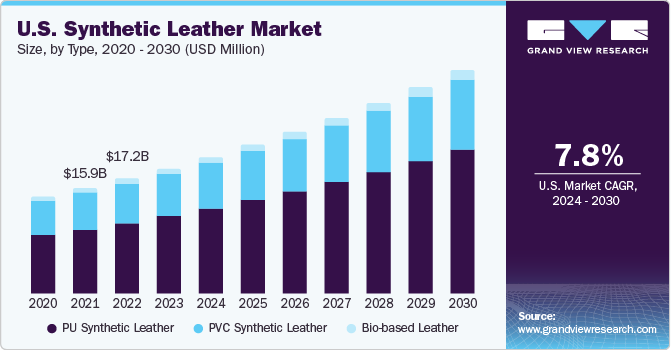
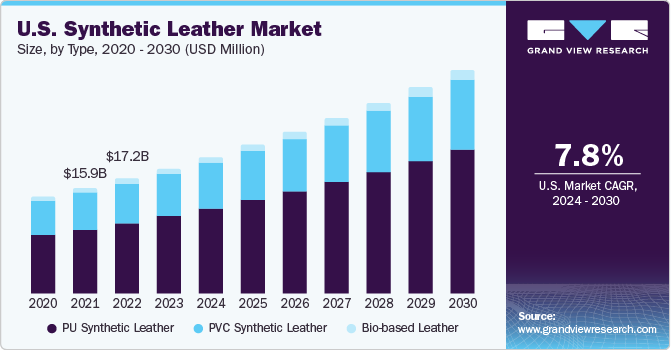
In the United States, the synthetic leather market has seen a notable uptick in consumption, a trend expected to continue over the coming years. The rising demand for automotive synthetic leather upholstery is anticipated to further bolster market growth in the region. Additionally, various supply chain enhancements are projected to support and streamline the industry during the forecast period. Key U.S.-based manufacturers include Uniroyal Engineered Products LLC, Coaters Inc. Leather, and Textileather Corporation. Major automobile manufacturers like General Motors, Fiat Chrysler, and Ford are among the primary consumers of synthetic leather for vehicle interiors.
Order a free sample PDF of the Synthetic Leather Market Intelligence Study, published by Grand View Research.
Key Market Trends and Insights
- By Type: The polyurethane (PU) synthetic leather segment dominated the market in 2023, accounting for over 60.0% of total revenue. PU leather continues to improve in terms of quality, product diversity, and manufacturing efficiency. Compared to genuine leather, it offers advantages such as being waterproof, lightweight, softer, and easier to dry-clean.
- By Application: The footwear sector led the market by application in 2023, contributing over 33.0% of the revenue share. Synthetic leather usage in footwear is becoming increasingly comparable to that of real leather and is also replacing it in other applications such as handbags, briefcases, automotive interiors, and apparel.
Market Size and Forecast
- Market Size in 2023: USD 38.98 Billion
- Projected Market Size in 2030: USD 66.24 Billion
- CAGR (2024–2030): 7.87%
- Largest Regional Market in 2023: Asia Pacific
Leading Companies and Market Share Insights
Key players in the synthetic leather market include Teijin Limited and Alfatex Italia SRL.
- In April 2023, General Silicones Co., Ltd. launched a new vegan silicone leather product line under the Compo-SiL brand, targeting applications in shoes, belts, bags, covers, and bookbindings.
- Teijin Limited, a leading synthetic fiber producer in Japan, operates through 150 subsidiaries and affiliates globally. The company has diversified offerings in electronics, safety, environment, and healthcare, with its materials segment focusing on advanced fibers, composites, and performance polymers.
- Alfatex Italia SRL specializes in upholstered furniture manufacturing and provides various materials including artificial leather, bonding fabrics, velvet, and webbing. Their products are used across residential, marine, automotive furniture, and safety gear like shoes and helmets.
Major Companies in the Global Synthetic Leather Market:
- Kuraray Co., Ltd.
- H.R. Polycoats Pvt. Ltd.
- Alfatex Italia SRL
- Filwel Co., Ltd.
- Yantai Wanhua Synthetic Leather Group Co., Ltd.
- San Fang Chemical Industry Co., Ltd.
- Mayur Uniquoters Limited
- Teijin Limited
- Nan Ya Plastics Corporation
Explore Horizon Databook – The world's most expansive market intelligence platform developed by Grand View Research.
Conclusion
The synthetic leather market is witnessing robust global growth, primarily driven by rising demand from the footwear and automotive sectors, along with increasing adoption due to the high cost of natural leather. PU leather remains the dominant material choice due to its superior properties and growing product versatility. The Asia Pacific region leads the market, while North America, particularly the U.S., shows strong growth potential due to automotive industry demand and ongoing supply chain improvements. Strategic innovations and sustainability-focused product launches—like vegan and silicone leather—are likely to play a key role in shaping the future of this dynamic market.