
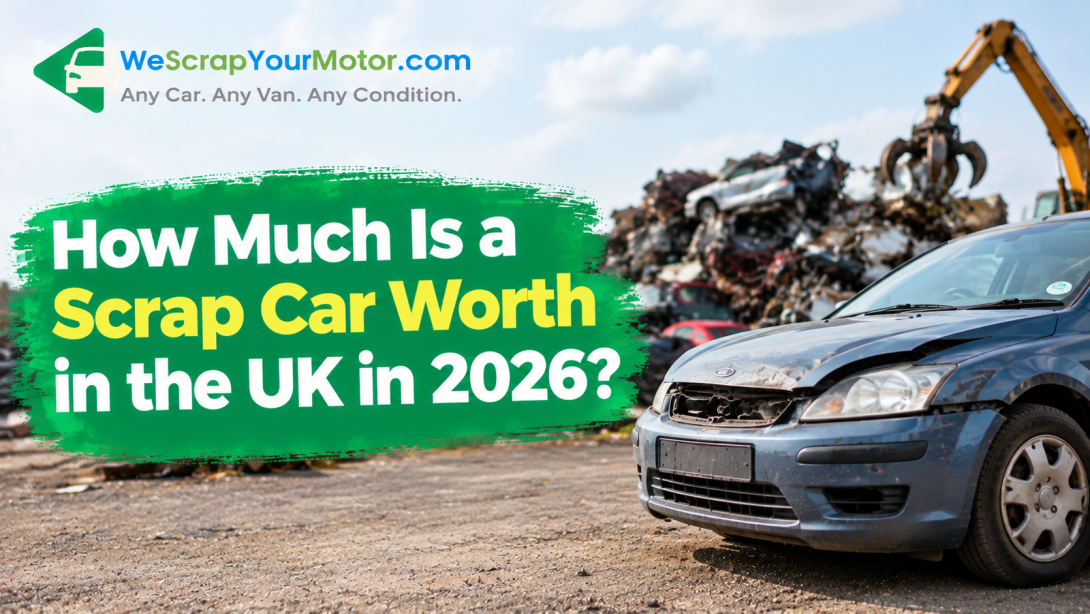
If you have a tired old car sitting outside your house, you have probably asked the same question as thousands of other drivers: what would somebody actually pay for it? The answer can feel surprisingly mysterious. Two vehicles of a similar age may receive different offers, and the figure quoted online may be different from what you had imagined after seeing a neighbour sell their car.
For motorists in Reading and the wider Thames Valley, it helps to understand what a genuine scrap valuation measures. The price is not based simply on registration year, and there is no single reliable UK-wide rate that applies to every old vehicle throughout 2026. Metal markets, usable components, the car's condition and the cost of collecting it all play a role. Knowing how these factors fit together can help you secure a fair offer without falling for an unrealistic promise.
Why there is no fixed price for scrapping a car
A roadworthy used car is often valued according to its model, mileage, service history and demand among drivers. A vehicle nearing the end of its life is assessed differently. Some of its value may lie in recoverable metal, while another portion may come from parts that can be safely checked and reused. A car that will need costly transportation or special handling may attract a different offer from a similar vehicle that is easy to collect.
This means a statement such as 'every scrap car is worth £400' should immediately raise questions. It ignores differences between a small hatchback, an estate car, an SUV and a van. It also ignores whether the car is complete, has accident damage or contains parts with some residual demand. Prices quoted by scrap businesses can change as market conditions and operational costs change.
That uncertainty is not necessarily a sign of poor practice. A reputable service should be able to explain which details are needed, what the offer covers and whether collection is included. Transparency matters more than an eye-catching headline price.
Vehicle weight: the obvious factor that is often misunderstood
Metal recovery is one of the foundations of end-of-life vehicle valuation. A heavier car normally contains more recoverable material than a very small car, but the relationship is not perfectly linear. The actual mix of steel, aluminium, plastics, glass and other materials varies, and removing hazardous substances takes labour and specialist processes. A large vehicle that is missing major parts may not be as valuable as a smaller but complete one.
The figure printed in a manufacturer's specification sheet is not a guaranteed payout formula. Even the same vehicle model may exist in different engine and body configurations. Rather than multiplying a guessed weight by a metal price found on social media, provide the registration number so the buyer can identify the correct vehicle, then describe any substantial modifications or missing components.
If you are comparing offers, ask whether the buyer is valuing the car as a complete end-of-life vehicle or as a damaged vehicle with salvage potential. Those can be different commercial assessments, and neither label alone guarantees a better result.
The make, model and usable parts can change the offer
An old car does not necessarily have to be crushed in its entirety. Where it is lawful and practical, reusable components may be recovered, tested and sold into the repair market before the remaining materials are recycled. Popular models sometimes have more demand for replacement body panels, wheels, lighting units or mechanical components than unusual models with fewer vehicles still on the road.
That does not mean a particular badge always brings a premium. A component must be compatible, in suitable condition and worth recovering. Parts demand can change, and modern vehicles have complex electronics that may limit straightforward reuse. Valuable-looking equipment is not an invitation to remove items yourself before requesting a quote: incomplete vehicles may attract less money, and dismantling can create safety and environmental risks.
For an accurate assessment, declare the vehicle as it stands. Mention whether it still has its engine, gearbox, wheels and other major components. If you have already removed something, say so before collection day. A realistic description protects both sides from a last-minute dispute.
Does the car need to start or have an MOT?
No. A car can retain scrap or salvage value even if its MOT has expired, its engine will not start or it has suffered serious mechanical damage. A non-runner is simply more complex to move, so access and recovery arrangements become important. A locked steering wheel, flat tyres or a cramped parking space can affect the equipment needed for a safe collection.
A current MOT may make the car easier to sell as a usable vehicle, potentially increasing its value above scrap. It does not automatically raise the underlying value of its recyclable materials. Before accepting an end-of-life quote, consider whether the car could still be sold honestly as a roadworthy vehicle or a repair project. The right outcome is not always scrapping.
Likewise, an MOT failure does not by itself tell you how much the car is worth. A failure caused by one manageable fault differs considerably from widespread corrosion, engine trouble and recurring electrical faults. Give enough detail for the quotation to reflect the real condition rather than an assumption.
Why location matters around Reading
Collection logistics affect the economics of a scrap-car offer. In Reading, a car may be parked on a residential street, outside a flat, in a commercial unit or at a garage. Each setting creates different access considerations. A recovery vehicle might need enough room to turn, load safely and operate without obstructing other road users. If the vehicle is stored on private property, make sure the collection team has permission to enter.
Drivers in Caversham, Tilehurst, Woodley, Earley and other parts of the Reading area should describe the actual collection address, not simply provide an RG postcode. The difference between an accessible driveway and an underground car park can matter more than a short difference in distance.
We Scrap Your Motor advertises online quotations and local collection services for people looking to scrap my car in Reading. Its location page describes collection of damaged and unwanted vehicles, but owners should confirm the precise availability, access requirements and final terms for their own vehicle. That is more useful than assuming every collection follows exactly the same timetable.
A sensible way to compare two scrap quotations
Imagine two hypothetical quotations for the same non-running hatchback. Provider A offers £320 including collection; Provider B advertises £360 but wants to deduct £65 for recovery from the owner's address. The headline figures suggest B is better, while the amount the owner would actually receive points the other way. These are illustrative numbers, not current quotes from any company.
Use a simple like-for-like checklist when comparing prices. Ask whether the amount is guaranteed subject to an accurate description, whether recovery is included, how quickly the vehicle can be collected and whether the buyer needs proof of identity. Clarify whether payment will be made before or at collection and when it should appear in your bank account.
Do not accept a vague statement such as 'we will sort the paperwork' as sufficient. You still need to know who will notify DVLA, what receipt you will receive, and whether the vehicle is destined for complete scrapping or potential repair and resale. Those distinctions matter long after the tow truck has left.
The legal difference between scrapping and selling for salvage
When a vehicle has reached the end of its useful life and is to be destroyed, it must go to an authorised treatment facility (ATF). This is the lawful route for dealing with oils, coolant, batteries and other materials that should not be released into the environment. The official guidance on approved scrapping facilities explains that the ATF may decide to scrap a vehicle or repair and resell it, and that the paperwork differs accordingly.
If a car or light van is fully scrapped, the relevant authorised facility should issue a Certificate of Destruction within seven days. If it is repaired and sold on, a Certificate of Destruction will not be issued because the vehicle has not been destroyed. Ask about the intended route so you know what to expect.
There is also an important payment rule: cash payment for a scrapped vehicle is illegal in England and Wales. The lawful options given in the government's scrappage guidance are bank transfer or cheque. This rule applies in Reading just as it does in Swansea or Plymouth. An advert promising 'cash in hand for scrap' is not a sensible basis for choosing a service.
What to prepare before requesting a valuation
A few minutes of preparation can make the quoting process faster and more accurate. Have the registration number and postcode ready, and record the car's approximate mileage. If possible, note the make, model and whether it is petrol, diesel, hybrid or electric. Describe obvious damage, the reason it is off the road, missing parts, and whether all four wheels are fitted.
Clear photographs can help when the condition is unusual, especially after a collision or where access looks difficult. Photograph the exterior, any affected panels and the parked position, without putting yourself in danger. Do not attempt to dismantle a damaged battery, handle leaked fluids or remove mechanical components simply to improve the valuation.
You should also check whether the vehicle belongs to you to dispose of. If finance remains outstanding, you cannot simply treat it as yours to scrap without dealing with the lender's rights and the relevant agreement. If the vehicle belonged to someone who has died or is held by a business, establish the appropriate authority to act before arranging collection.
How to avoid a last-minute reduction
The most common sources of disagreement are avoidable: inaccurate descriptions, missing parts, collection access and confusing payment terms. Tell the buyer if the car has no catalytic converter, if it cannot roll freely or if it has significant collision damage. If it has been stationary for a long time, say so. Do not rely on a form that marks the vehicle as 'running' simply because that option produces a higher preliminary number.
Save the written quotation or confirmation message. Check whether it specifies the registration, condition and collection terms. If the buyer changes the offer on arrival, ask for a clear reason before agreeing. You are entitled to understand the difference; you do not have to accept a sudden reduction simply because the recovery vehicle is already there.
A digital service marketed under the phrase Scrap My Car can be useful when you want an initial benchmark without advertising the vehicle to numerous private buyers. We Scrap Your Motor states that it offers no-obligation valuations and collection for unwanted cars and vans. Still, compare the written terms rather than treating the first online number as automatically final for every possible condition.
Do you need the V5C logbook?
The V5C is helpful because it contains information about the vehicle and registered keeper, but it is not a document of legal ownership by itself. Some collection providers may be able to discuss alternative documentation if it is missing, subject to identity and entitlement checks. Do not invent details or proceed with a vehicle you are not authorised to dispose of.
When scrapping through an ATF, follow the applicable V5C procedure, including retaining the relevant yellow section when instructed, and tell DVLA that the vehicle has been taken for scrapping. The GOV.UK step-by-step scrappage guide makes clear that failing to notify DVLA may lead to a fine. Keep copies of confirmations and any Certificate of Destruction.
If there are unused full months of vehicle tax, you may receive a refund after the DVLA record is updated. Separately, contact your insurer to change or end cover as appropriate. Make sure any parking permit, automatic payment account or vehicle-related subscription is dealt with, too.
Is it ever worth waiting for scrap prices to rise?
Metal values move, but an owner usually does not know where they will be next month. Waiting may make sense if you are under no pressure and the car can be stored safely and legally on private property. On the other hand, a vehicle that occupies paid parking, creates an obstruction or continues to incur costs may be more expensive to keep than any speculative increase in scrap value.
For most private owners, the meaningful comparison is between two or three valid quotes received within a similar period, not between today's real offer and a hoped-for figure in the future. A few pounds of possible upside should be weighed against collection convenience and a well-documented transaction.
Frequently asked questions
Can a car with a seized engine still be collected?
Often yes, but you must explain that it cannot be driven or moved under its own power. The collector will need to confirm whether its equipment and access arrangements are suitable.
Will removing parts increase the money I receive?
Not necessarily. Missing major components can reduce a quote, and dismantling creates risks. Get separate advice before doing anything to the vehicle.
Does a newer car always get a better scrap price?
No. Age is only one factor. Weight, condition, demand for components and collection arrangements may be more influential.
Can the collection driver pay me cash?
Not for a vehicle being scrapped in England or Wales. The official rule requires a bank transfer or cheque.
The bottom line for Reading motorists
A fair scrap-car valuation is not a mystery once you know the questions to ask. Give accurate details, compare the amount you will actually receive, check the collection arrangements and insist on the correct legal route for an end-of-life vehicle. Whether your old car is parked outside a Reading terrace or has been left at a repair garage, the best offer is one that combines a sensible price with clear documentation and no unpleasant surprises.