

There was a time when playing a new game meant checking your PC specs, clearing enough storage, or wondering whether your console could actually handle it. Now, that whole process is starting to feel a little old-fashioned.
Cloud gaming is changing that.
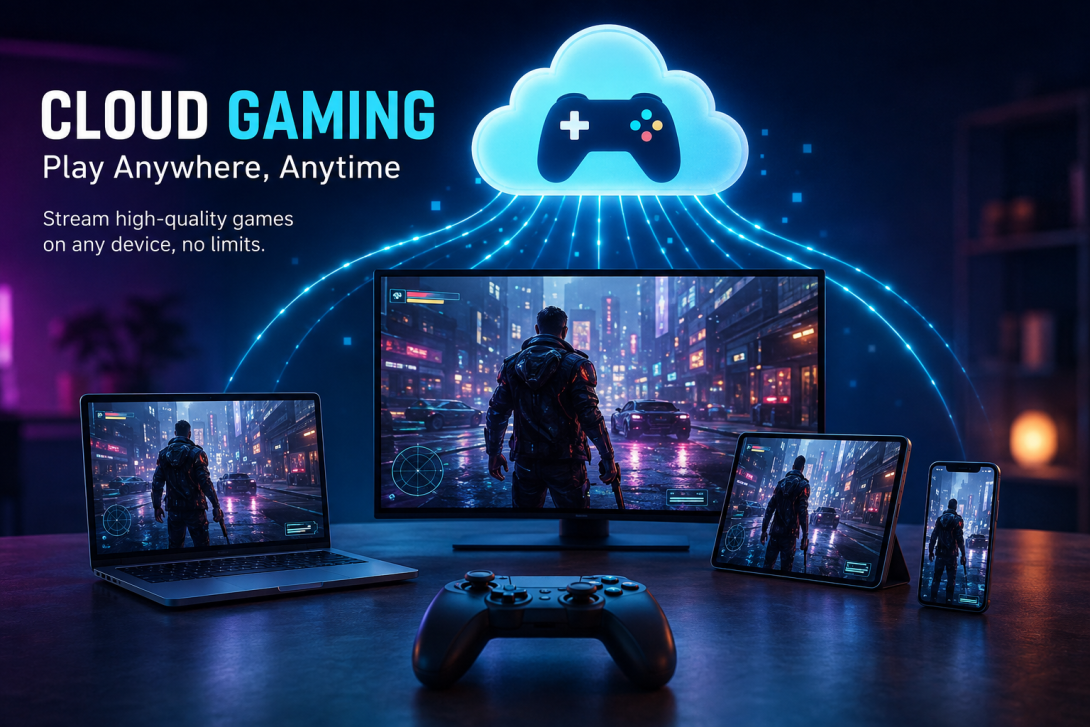
Instead of relying entirely on the hardware sitting in front of you, cloud gaming lets powerful remote servers handle much of the heavy work. The game is processed elsewhere and streamed to your device, much like watching a movie online. The difference is that you are controlling what happens on screen in real time.
That simple idea is opening the door to a very different gaming experience.
What Exactly Is Cloud Gaming?
Cloud gaming works by running a game on a remote server and sending the gameplay to your device over the internet. Your controller, keyboard, mouse, or touchscreen sends your actions back to the server, which processes them and streams the result to you.
You don't necessarily need an expensive gaming PC or the latest console to access demanding titles. A compatible phone, tablet, laptop, smart TV, or other supported device may be enough, provided the internet connection is reliable.
Think of it like borrowing a high-end gaming machine that happens to live in a data centre somewhere else.
This also explains why the quality of your internet connection matters so much. A slow or unstable connection can lead to lag, blurry visuals, or delayed controls. For games where timing is everything, even a small delay can be frustrating.
Gaming Without the Hardware Headache
One of the biggest attractions of cloud gaming is convenience.
Traditionally, gamers have had to spend a significant amount of money upgrading graphics cards, processors, RAM and storage to keep up with newer releases. Console players face a similar issue when a new generation arrives.
Cloud gaming takes some of that pressure away.
Instead of constantly asking, "Can my device run this game?", players can focus more on whether the service supports the game they want to play.
It's particularly appealing to casual players who don't want to build a gaming setup but still want access to more demanding titles. Someone who mostly uses a laptop for work, for example, may not see much value in spending a fortune on a dedicated gaming PC.
Your Games Can Follow You
Another interesting change is where gaming can happen.
Imagine starting a game at home on a larger screen and later continuing it on a laptop while travelling. With the right service and a strong connection, the device becomes less important than it used to be.
This flexibility fits neatly into how people already use technology. We stream music while commuting, watch shows across different screens and store photographs in the cloud. Gaming is gradually moving in the same direction.
Even platforms and gaming websites such as lotus365.cc reflect how online entertainment is becoming increasingly accessible through connected devices. The broader idea is simple: gaming online no longer has to mean being tied to one particular machine.
A New Approach to Gaming Online
Cloud technology is also changing expectations around gaming online.
Players increasingly want quick access rather than lengthy downloads, installations and updates. Cloud-based services can reduce some of those barriers because the game itself is hosted remotely.
That doesn't mean every cloud gaming experience is instant or flawless. Large games still depend on server availability, internet speeds and the technology used by the provider. But the basic attraction remains strong: less time managing hardware and more time actually playing.
For someone who only gets an hour or two to relax after work, that difference can be surprisingly valuable.
The Internet Becomes Part of the Gaming Setup
There is, however, a trade-off.
With traditional gaming, once the game is installed, you can often play without worrying too much about your internet connection, depending on the title. Cloud gaming is different. Your connection becomes part of the gaming hardware.
Latency is especially important. In a slow-paced game, a little delay might barely be noticeable. In a competitive shooter, racing game or fighting game, it can completely change the experience.
This is why cloud gaming is likely to work best as internet infrastructure continues improving. Faster connections and better network coverage can make streamed gameplay feel increasingly close to playing locally.
What This Means for Game Developers
Cloud gaming isn't only changing the player's side of the equation.
Developers and publishers also have new possibilities to consider. Games can potentially reach a wider audience because players don't always need powerful local hardware. This could make ambitious games accessible to people who previously couldn't run them.
It may also influence how games are designed, distributed and updated.
Instead of thinking primarily about individual machines, developers can increasingly think about a connected ecosystem where processing, storage and gameplay services are spread across powerful servers.
That's a fairly significant shift in the background, even if the player simply sees a game loading on a screen.
Is Cloud Gaming Going to Replace Consoles and PCs?
Probably not anytime soon.
Dedicated gaming hardware still has major advantages. A powerful PC offers control, high performance and the ability to customise almost everything. Consoles provide predictable performance and a straightforward experience. For serious gamers, owning the hardware can also be part of the enjoyment.
Cloud gaming is better viewed as another option rather than a complete replacement.
Some players may use it as their primary way to play. Others may use it when travelling, testing games, playing casually or accessing titles their current hardware cannot handle.
That flexibility could ultimately be its biggest strength.
The Way We Play Is Becoming More Flexible
Gaming has always adapted to new technology. We moved from cartridges to discs, from physical games to downloads, and from local multiplayer to enormous online communities.
Cloud gaming feels like another step in that progression.
It removes some of the boundaries between a game and the machine running it. The hardware still matters, but increasingly, the connection matters just as much.
There will still be debates about latency, pricing, ownership and internet reliability. Those questions aren't going away. But the underlying idea is already changing what players expect from gaming online: less waiting, fewer hardware limitations and more freedom over where a game can be played.
The interesting part is that we may only be seeing the beginning. As networks improve and cloud technology becomes more capable, the line between "playing on a device" and "playing through a service" could become almost invisible.