
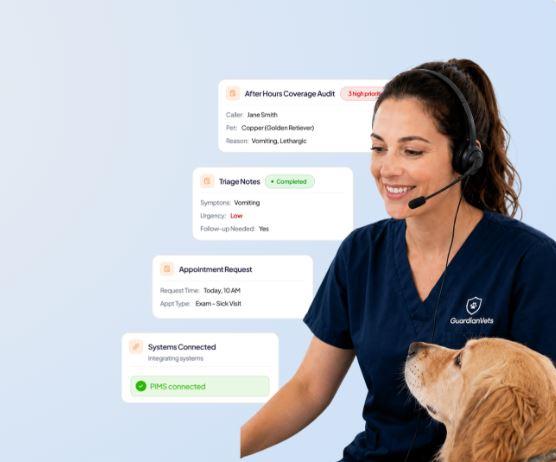
When a practice closes, the phone does not stop ringing. What happens to those calls decides whether a client books with you the next morning, drives to an emergency hospital, or quietly moves to the clinic down the road that answered.
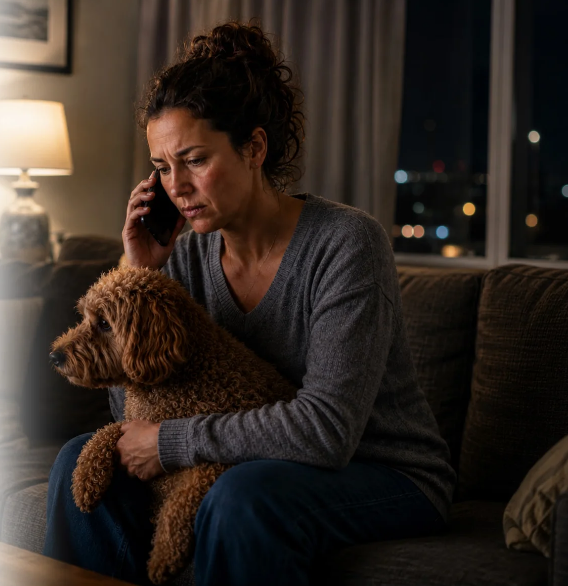
The providers below take very different approaches to that problem. Some staff call with credentialed clinical professionals, some with trained general operators, and some with veterinary-tuned AI. Each model has real trade-offs around cost, clinical judgment, and what your team sees the next morning. Here is how the main options compare.
1. VetTriage
VetTriage operates a 24/7 video telehealth platform staffed by veterinarians who triage after-hours concerns for pet owners. Sessions run from any device without an app download.
Key services: Veterinarian-led video teletriage, after-hours support for general practices, overflow and wait-time reduction for emergency hospitals, and support for rescue and foster organizations.
What sets them apart: The service is offered at no cost to the facility, with the pet owner paying a per-session fee to speak with a veterinarian. The company has also presented on equine after-hours applications with the American Association of Equine Practitioners.
Best for: Practices comfortable directing clients to a veterinarian-staffed video service and passing the session cost to the owner.
2. GuardianVets
GuardianVets is a veterinary call overflow service built specifically around clinical triage rather than message-taking. Every call is answered by a live, U.S.-based Credentialed Veterinary Technician with a minimum of three to five years of clinical experience, working from protocols configured to the individual practice.
Key services: After-hours and overflow call answering, veterinary triage, appointment booking directly onto the practice schedule, escalation to the on-call veterinarian, and documentation synced to the practice information management system.
What sets them apart: More than 2.5 million cases triaged since launch, with over 134,000 appointment requests generated in the past two years alone. Onboarding begins with a call audit and typically completes in as few as 7 days. GuardianVets performs triage only and does not diagnose, prescribe, or establish a veterinarian-client-patient relationship.
Best for: General, mixed-animal, urgent care, and equine-focused practices that want clinical judgment on the call and a clean handoff into their existing records.
3. Centratel
Centratel is a long-established telephone answering company with a dedicated veterinary division and more than four decades in the call-handling business.
Key services: 24/7/365 live answering, emergency response, after-hours coverage, and overflow support during busy daytime hours.
What sets them apart: Their CLEAN-SCREEN dispatch method texts or calls the on-call doctor directly, and messages can be delivered by email, text, alpha-pager, or fax at no extra cost. The company reported a customer-reported error rate of one error per 7,225 message transactions for the January through March 2026 period.
Best for: Practices that want reliable, accurate message capture and are comfortable with clinical decisions staying entirely in-house.
4. MAP Communications

MAP Communications provides live veterinary answering and virtual receptionist coverage on a 24/7 basis, with call handling customized to each practice's policies and procedures.
Key services: After-hours answering, virtual receptionist support, message dispatch, and bilingual coverage.
What sets them apart: English and Spanish bilingual answering is offered as standard, which matters for practices serving multilingual client bases.
Best for: Practices in markets where Spanish-language coverage is a meaningful part of the client relationship.
5. Anserve
Anserve offers 24/7 veterinary answering and emergency call handling, positioned either as a backstop to in-house staff or as the primary after-hours resource.
Key services: Around-the-clock answering, emergency call handling, and advance notification to hospital staff when an emergency case is on the way.
What sets them apart: Their operators are trained to keep panicked owners calm and can alert veterinary technicians that a case is inbound so the team is ready on arrival.
Best for: Animal hospitals that want advance warning before an emergency walks through the door.
6. Endicott Call Centers
Endicott provides veterinary call center support covering both after-hours answering and general daytime overflow.
Key services: After-hours call answering, appointment scheduling support, email inquiry response, and collection of client and patient information.
What sets them apart: Coverage extends beyond the phone into email handling and administrative support, which suits practices looking to offload front-desk work generally rather than after-hours calls specifically.
Best for: Smaller practices wanting broad administrative coverage at a lower cost than additional front-desk staffing.
7. Goodcall

Goodcall is an AI-based answering platform with a veterinary configuration, built to handle high call volume around the clock.
Key services: Automated call answering, appointment scheduling, prescription refill request capture, and routing rules for urgent cases.
What sets them apart: Because it is software rather than staffing, capacity scales without the cost curve of adding people, and the system applies configured protocols consistently on every call.
Best for: High-volume practices with well-defined routing rules that want overflow capacity and accept that judgment on unusual presentations still returns to the practice.
How to Compare These Options
Three questions separate these providers faster than any feature list.
- What are the credentials of the person or system answering at 1 am?
- Where does the resulting note end up, and does anyone on your team have to re-type it?
- And who decides when a case reaches your on-call veterinarian, you or the vendor?
Before you shortlist any veterinary call overflow service, pull 90 days of your own after-hours call data by hour and day. Knowing whether you have a coverage gap or a daytime staffing problem will save you from buying the wrong fix.