
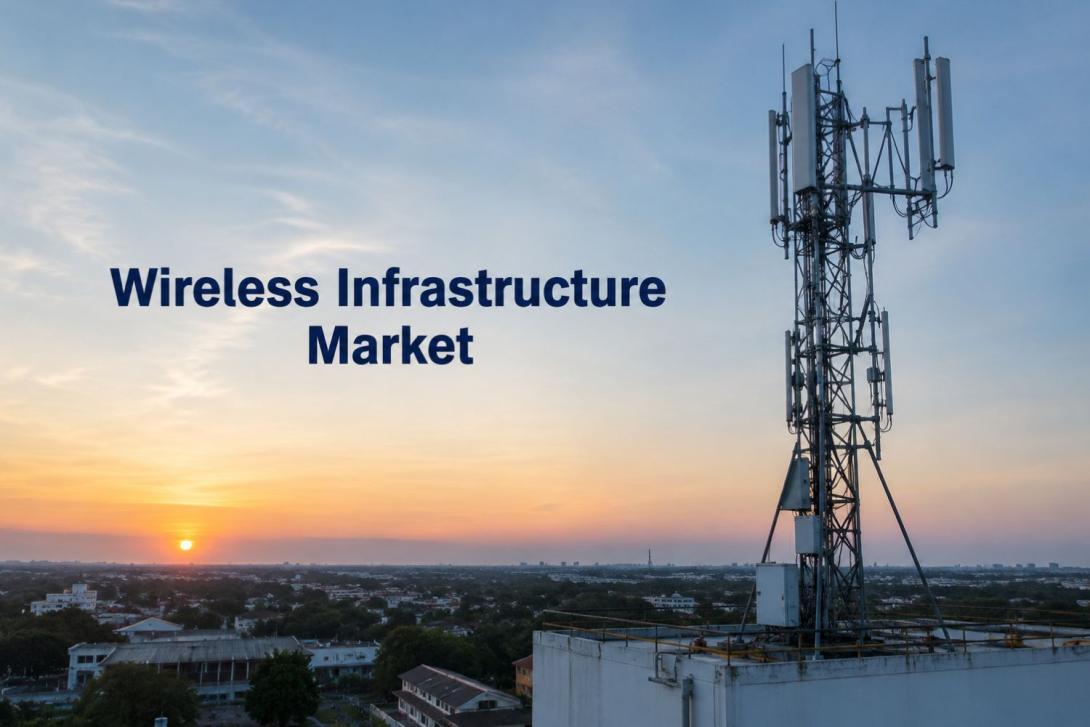
The global wireless infrastructure market size was valued at USD 280.39 billion in 2025 and is projected to grow from USD 312.32 billion in 2026 to USD 625.34 billion by 2034, exhibiting a CAGR of 9.07% during the forecast period. The market is experiencing substantial growth due to increasing global 5G deployment, rising mobile data traffic, expansion of IoT devices, and growing investments in telecom network modernization. The rapid adoption of smart devices, cloud computing, AI-powered networking technologies, and edge computing infrastructure is further accelerating market demand.
Wireless infrastructure refers to the network components, communication systems, and hardware technologies that enable wireless data transmission and connectivity across telecommunication networks. Wireless infrastructure includes cellular towers, small cells, antennas, routers, base stations, radio access networks (RAN), fiber backhaul systems, distributed antenna systems (DAS), and satellite communication infrastructure. These systems support mobile communication, broadband internet, IoT connectivity, 5G deployment, and enterprise wireless networking across industries.
Get a Free Sample PDF Brochure: https://www.fortunebusinessinsights.com/enquiry/request-sample-pdf/wireless-infrastructure-market-102741
Market Dynamics
- The wireless infrastructure market is witnessing rapid expansion due to the growing global demand for high-speed mobile connectivity and digital communication services. Telecommunications operators are increasingly investing in advanced wireless infrastructure to support rising mobile data consumption, cloud applications, video streaming, and connected devices. The deployment of 5G networks has become one of the primary drivers of infrastructure modernization worldwide.
- One of the major growth drivers is the increasing rollout of 5G technology. Telecom operators are deploying small cells, macro towers, fiber backhaul networks, and radio access infrastructure to support ultra-low latency and high-bandwidth applications. Industries such as healthcare, manufacturing, automotive, logistics, and smart cities increasingly rely on robust wireless communication networks for digital transformation initiatives. The global 5G infrastructure market is also witnessing rapid growth due to rising demand for ultra-low latency connectivity and IoT applications.
- The increasing adoption of Internet of Things (IoT) devices is another significant market driver. Smart homes, industrial automation systems, connected vehicles, wearable devices, and smart city projects require scalable and high-performance wireless networks. Telecom providers are expanding infrastructure capacity to manage the growing number of connected endpoints and rising network traffic volumes.
Market Segmentation
By Connectivity Type
- 2G/3G Infrastructure
- 4G/LTE Infrastructure
- 5G Infrastructure
- Satellite Wireless Infrastructure
- Wi-Fi Infrastructure
By Infrastructure
- Macro Cell Towers
- Small Cells
- Distributed Antenna Systems (DAS)
- Radio Access Networks (RAN)
- Fiber Backhaul Infrastructure
- Mobile Core Networks
By Platform
- Indoor Infrastructure
- Outdoor Infrastructure
- Cloud-based Wireless Infrastructure
- Edge Infrastructure
Regional Analysis
- North America dominates the wireless infrastructure market due to strong telecom investments, rapid 5G deployment, and advanced digital infrastructure. The U.S. remains the largest contributor owing to extensive investments by telecom operators such as AT&T, Verizon, and T-Mobile in fiber expansion, wireless broadband, and 5G network modernization. Increasing adoption of fixed wireless access and AI-powered telecom infrastructure is further supporting regional market growth.
- Asia Pacific is expected to be the fastest-growing region due to rapid urbanization, increasing smartphone penetration, and large-scale 5G infrastructure deployment in countries such as China, India, Japan, and South Korea. China continues to lead global 5G infrastructure deployment, while India is rapidly expanding telecom infrastructure to support digital transformation and smart city initiatives. Asia Pacific also dominates the global 5G infrastructure market with a significant market share.
- Europe represents another major market driven by increasing investments in smart infrastructure, Open RAN technologies, and fiber-optic network expansion. Countries such as Germany, the UK, and France are focusing on improving broadband connectivity and industrial automation infrastructure. The region is also emphasizing sustainable telecom infrastructure and digital sovereignty initiatives.
- Meanwhile, the Middle East is increasingly investing in advanced wireless communication infrastructure and smart city projects, while Latin America is gradually expanding telecom infrastructure modernization to improve connectivity and digital inclusion.
Key Players
- Capgemini Engineering (France)
- Ciena Corporation (U.S.)
- Cisco Systems, Inc. (U.S.)
- D-Link Corporation (Taiwan)
- Fujitsu (Japan)
- Huawei Technologies co., Ltd. (China)
- NEC Corporation (Japan)
- NXP Semiconductor (Netherlands)
- Qualcomm Technologies Inc. (U.S.)
- ZTE Corporation (China)
Key Takeaways
- The wireless infrastructure market is projected to reach USD 625.34 billion by 2034 at a CAGR of 9.07%
- 5G deployment remains the primary growth driver globally
- North America dominates the market, while Asia Pacific is the fastest-growing region
- AI-powered networking, Open RAN, and edge computing are transforming telecom infrastructure
- Fiber and wireless convergence investments are accelerating worldwide
- Smart cities, IoT expansion, and enterprise wireless networking are creating strong long-term opportunities
Key Industry Development
- May 2023 - NPPGov, a prominent cooperative purchasing organization serving public safety agencies, announced a partnership with TESSCO Technologies Incorporated, a key value-added distributor in the wireless infrastructure construction sector. Through this agreement, TESSCO provided information technology (IT) services, associated equipment, and support to NPPGov members.
- March 2023 - Cisco and the Telenor Group revealed an expansion of their partnership via the fifth iteration of their Joint Purpose Agreement (JPA). This collaboration focuses on advancing strategic priorities in the regions where both companies operate, including Environmental, Social, and Governance (ESG), automation and as-a-service innovations, multi-cloud solutions, and cybersecurity enhancements.
Get Your Customization Research Report: https://www.fortunebusinessinsights.com/enquiry/customization/wireless-infrastructure-market-102741?utm_medium=seg
About Us:
Fortune Business Insights™ delivers accurate data and innovative corporate analysis, helping organizations of all sizes make appropriate decisions. We tailor novel solutions for our clients, assisting them to address various challenges distinct to their businesses. Our aim is to empower them with holistic market intelligence, providing a granular overview of the market they are operating in.
Contact Us:
Fortune Business Insights Pvt. Ltd.
9th Floor, Icon Tower,
Baner - Mahalunge Road, Baner,
Pune-411045, Maharashtra, India.
Phone:
US: +18339092966
UK: +448085020280
APAC: +91 744 740 1245
Email: sales@fortunebusinessinsights.com