
There's a moment every operations manager recognizes. You need a signed contract from eight months ago. Someone says it's in the shared drive. Someone else says no, it was emailed to the old team. Thirty minutes later, you're still looking.
Multiply that across a company of 500 people. Multiply it across a year.
That's not a storage problem. That's an enterprise content management problem — and it costs more than most leadership teams ever sit down to calculate.
ECM Isn't What Most People Think It Is
A lot of organizations hear "enterprise content management" and picture a glorified file server. Maybe a fancier SharePoint. Something IT manages and everyone quietly ignores.
That misunderstanding is exactly why so many implementations go sideways.
Real ECM — the kind that actually changes how a business runs — isn't just about where files live. It's about what happens to them. How they're captured, classified, processed, and moved through the people and systems that need them. It's the difference between a document existing and a document working.
Document processing is where that distinction becomes concrete. When invoices come in, contracts get signed, or compliance reports get submitted, there's a chain of steps that either runs smoothly or doesn't. ECM governs that chain. Without it, each person in the chain invents their own process — and that's where things quietly break.
The Prepress Problem Nobody Talks About
Here's a specific example that illustrates this well.
In publishing, marketing production, and print media, efficient prepress processes are genuinely hard to maintain at scale. You've got designers handing off files to production teams, production teams sending proofs to clients, clients sending back feedback in six different formats, and somewhere in that chain, someone is working off version 3 when version 7 already exists.
The rework cost is real. The missed deadlines are real. And most of the time, it's not because anyone is doing a bad job — it's because the handoff system itself is broken.
ECM platforms that include workflow controls fix this not by adding more steps, but by making the existing steps visible and trackable. Files can only move forward once the right person has signed off. Versions are locked when they should be locked. The whole chain becomes something you can actually see, rather than something you're constantly chasing.
That same logic — structured handoffs, clear ownership, automated routing — applies just as directly to HR onboarding documents, vendor contracts, regulatory filings, and internal SOPs.
Instructions and Documentation Are Content Too
One thing organizations often overlook: the instructions people use to do their work are also documents that need managing.
Standard operating procedures get updated and nobody tells the team still using the old version. Compliance guidelines change and the training material doesn't. New employees get onboarded using a guide that's two reorgs out of date.
When instruction documents live inside an ECM system with proper version control, that problem largely disappears. Updates push out from one place. Old versions get archived automatically. The person doing the work always has access to the current process — not the one that was current eighteen months ago.
It sounds obvious when you say it that way. But most companies still don't do it.
What Actually Matters When You're Evaluating Systems
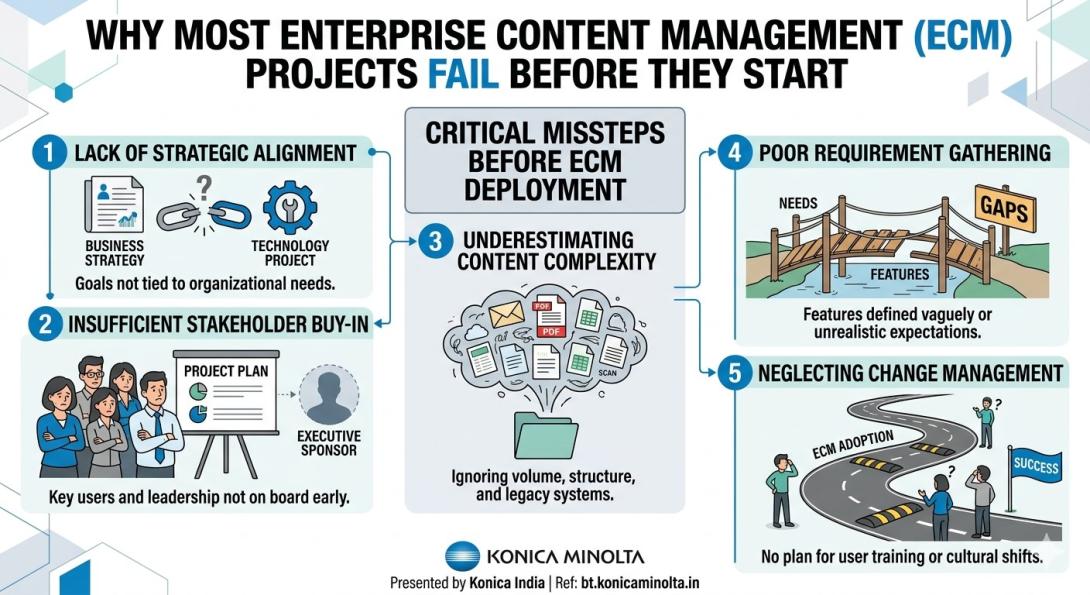
Skip the feature comparison spreadsheets for a minute. The questions that actually predict whether an ECM rollout succeeds are messier:
Will your team actually use this, or will they route around it the moment it feels like friction? Does it connect to the systems people already live in — email, ERP, CRM — or does it create a separate world they have to remember to visit? Who owns it when something breaks or needs updating?
The technology is mostly solved. The harder part is designing around how people actually behave, not how you wish they would.
FAQs
What does Enterprise Content Management actually do in the day to day ?
In all practicality, ECM manages the life of business documents from start to finish - that's capturing them as soon as they arrive, getting them to the right person in the first place , storing them with the correct version history so you can see what changed and when, and making it easy to find them when someone really needs them down the line. For most teams, day in day out, the noticeable difference ends up being way fewer "where's that file again?" drama sessions and getting documents turned around way faster than before.
How does document processing differ, then, from just shoving files onto a hard drive somewhere?
File storage is a pretty passive thing. Document processing on the other hand is where the real action happens - its the automated tagging, data pulling, and putting in the right queue that kicks in as soon as a document lands in your inbox. A top notch document processing system means an email arrives with a new invoice and suddenly its got a name, its been matched to the right vendor, and its getting sent to the right person for approval without anyone having to lift a finger to manually touch it.
Can ECM actually improve prepress and production workflows?
Yes, consistently. Efficient prepress processes depend on clear handoffs and version discipline — exactly what ECM workflow tools are built to enforce. Teams that implement this well typically see fewer revision cycles, less rework, and production timelines that hold rather than slip.