

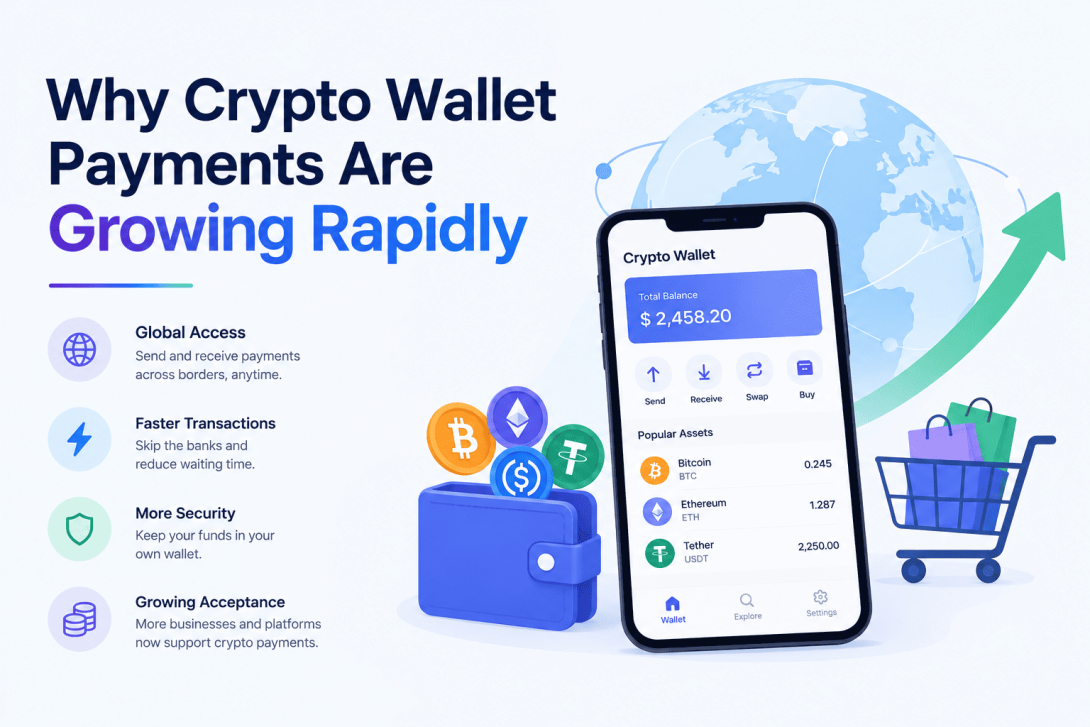
Crypto wallets were once mainly used to store digital assets and send funds between blockchain addresses. That is changing. More people are now using crypto wallets as part of their everyday payment experience, while businesses are exploring cryptocurrency as another way to accept payments.
The growth of crypto wallet payments is linked to several factors, including wider cryptocurrency adoption, international transactions, stablecoins, improved wallet apps and the development of easier payment solutions.
For users, paying from a wallet can offer another way to transfer value without relying entirely on traditional payment systems. For businesses, crypto can provide an additional payment option for customers in different markets.
What Are Crypto Wallet Payments?
A crypto wallet payment is a transaction where cryptocurrency is sent from a customer's wallet to a merchant, business or another recipient.
Instead of entering bank account details, the customer normally uses a wallet address, QR code or payment request. The transaction is then processed by the relevant blockchain network.
The process can be relatively simple, but users need to select the correct cryptocurrency and blockchain network. Sending an asset through an unsupported network can result in funds being lost.
Modern cryptocurrency wallet apps can offer more than basic transfers. Depending on the provider, users may also be able to swap assets, manage multiple networks and access payment-related features.
Why Are Crypto Wallet Payments Growing?
Several changes are contributing to the growing interest in crypto wallet payments.
1. More People Hold Cryptocurrency
As more people own cryptocurrency, they naturally become interested in using it rather than simply holding it.
Someone who receives Bitcoin, Ethereum or stablecoins may want to use those assets to pay for products and services. This creates demand for merchants and payment providers to support cryptocurrency transactions.
The more useful crypto becomes for everyday activities, the more reason users have to keep and manage it in a wallet.
2. International Payments Can Be More Flexible
Traditional international payments can involve banks, payment processors, currency conversions and different settlement times.
Crypto payments offer another way to transfer digital assets across borders. A transaction can be sent to a compatible wallet without requiring both parties to use the same traditional banking provider.
This can be particularly useful for freelancers, online businesses and customers who regularly deal with international transactions.
However, crypto payments still depend on network conditions, local regulations and the services available in each country.
3. Stablecoins Are Becoming More Popular
Stablecoins are cryptocurrencies designed to maintain a value linked to an external currency or asset, most commonly the US dollar.
They are attracting attention for payments because their value is generally less volatile than cryptocurrencies such as Bitcoin or Ethereum.
For businesses, receiving a stablecoin can make cryptocurrency payments easier to manage than accepting an asset whose price can change significantly within a short period.
Users should still check the specific stablecoin, blockchain network and service they are using before making a payment.
Crypto Wallet Providers Supporting Different Payment Experiences
The wallet market includes many providers, but users have different reasons for choosing one. Here are five providers that are relevant when exploring crypto wallet payments.
MetaMask
MetaMask is widely used for managing crypto and interacting with blockchain applications. It supports several networks and allows users to connect their wallet to compatible services.
Its strong connection with blockchain applications makes it a popular choice for users who regularly interact with decentralised services.
People considering different wallet experiences can also explore a MetaMask alternative based on their preferred features.
Trust Wallet
Trust Wallet is a multi-chain wallet that supports a broad range of cryptocurrencies and blockchain networks.
Its mobile-first experience makes it accessible to users who want to manage digital assets from their phones. It also supports interactions with blockchain applications.
Users who want to compare different approaches to wallet management and spending can look at a Trust Wallet alternative.
Coinbase Wallet
Coinbase Wallet provides a self-custody wallet that is separate from keeping cryptocurrency on a centralised exchange.
It supports multiple networks and gives users access to blockchain applications and other wallet functions. This can appeal to people who want greater control over their wallet credentials.
Phantom
Phantom is particularly well known among users of the Solana ecosystem, although it has expanded its support to other blockchain networks.
Its focus on a simple user experience makes it another wallet users may consider when comparing ways to manage and use digital assets.
Oppi Wallet
Oppi Wallet combines self-custody crypto management with features designed around using digital assets in practical situations.
Alongside wallet functionality, it offers a virtual crypto card for eligible users. A virtual crypto card can provide another way to spend supported crypto without requiring every merchant to accept a direct blockchain wallet payment.
Businesses Are Also Paying Attention
The growth of crypto wallet payments is not only driven by consumers. Businesses are also looking at cryptocurrency as an additional payment channel.
Online businesses can potentially reach customers who prefer paying with crypto. This can be particularly relevant for companies selling digital services, travel products, software and other online goods.
Crypto payments can also be useful for businesses with customers in several countries. However, companies need to consider accounting, taxation, compliance, payment processing, refunds and local regulations before accepting cryptocurrency.
The technology may make payments easier in some situations, but businesses still need appropriate processes around it.
Why Wallet Usability Matters
A payment method is only useful when people can understand and use it easily.
Wallet providers therefore have an important role in making crypto payments less complicated. Clear transaction information, network selection, fee visibility and security warnings can help users avoid common mistakes.
This is especially important for people who are new to cryptocurrency. A confusing payment screen can make a simple transaction feel much more complicated than it needs to be.
Security Remains Important
The growth of crypto payments also makes wallet security increasingly important.
Users should carefully check wallet addresses before confirming transactions. They should never share their recovery phrase or private keys with another person.
It is also important to be cautious when connecting a wallet to unfamiliar websites. A fraudulent website can attempt to trick users into approving a transaction or giving away sensitive wallet information.
Businesses accepting crypto should also use reputable payment infrastructure and establish clear procedures for handling transactions and customer support.
Will Crypto Wallet Payments Continue to Grow?
The future of crypto wallet payments will depend on several factors.
Better user experiences, wider merchant acceptance, stablecoin adoption and improved payment infrastructure could all encourage more people to use crypto for everyday transactions.
Regulation will also play an important role. Businesses and payment providers need clear rules around cryptocurrency payments, reporting and customer protection.
Crypto wallet payments are unlikely to replace every traditional payment method. Instead, they may become another option alongside bank transfers, cards and other digital payment methods.
Final Thoughts
Crypto wallet payments are growing because cryptocurrency is gradually becoming more practical beyond simple buying and holding.
Users are looking for easier ways to spend digital assets, while businesses are exploring new payment options for local and international customers. Wallet providers such as MetaMask, Trust Wallet, Coinbase Wallet, Phantom and Oppi Wallet are helping shape different parts of this growing ecosystem.
The most important factor is not simply whether a wallet supports payments. Users should also consider security, supported assets, network compatibility, fees and ease of use.
As these areas continue to improve, crypto wallets could become an increasingly familiar part of everyday digital payments.