

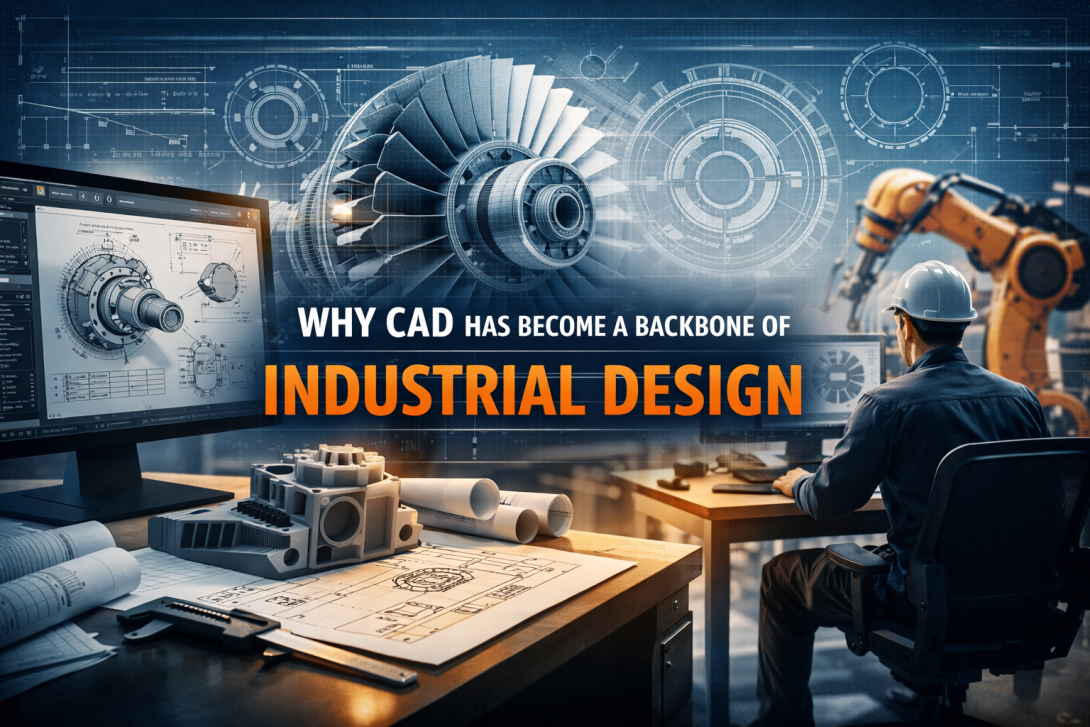
Computer-Aided Design, commonly known as CAD, has quietly become one of the most important tools in industrial design. Instead of long paragraphs, this blog breaks things down clearly and point by point, making it easier to read and understand. Each section highlights why CAD is no longer optional but essential in modern industrial design. Today, industries rely heavily on Computer-Aided Drafting to create accurate layouts, test ideas faster, and ensure smoother transitions from concept to manufacturing.
What CAD Really Means for Industrial Design
- CAD allows designers to create digital drawings and 3D models instead of manual sketches
- It supports the entire design process, from early concepts to final production files
- Designers can visualize ideas clearly before investing in physical prototypes
- It reduces dependency on hand drafting, which is slower and less flexible
Why Traditional Design Methods Are No Longer Enough
Before CAD became mainstream, designers relied on manual drafting. While this approach required skill and creativity, it also came with limitations. Making changes was time-consuming, accuracy depended on human precision, and collaboration was difficult when teams were spread across locations.
CAD changed that landscape entirely. Designers can now create, modify, and refine designs digitally with a level of speed and accuracy that traditional drafting could never offer. A small change in dimension no longer means starting over; it takes only a few clicks. This shift has helped companies reduce development time and improve product quality at the same time.
Precision and Accuracy as a Core Advantage
- CAD ensures exact dimensions and consistent measurements
- Even complex geometries can be designed with high accuracy
- Reduces manufacturing errors caused by incorrect drawings
- Helps maintain tight tolerances required in industrial products
Accuracy is one of the biggest reasons CAD has become a backbone rather than just a support tool.
Faster Design and Development Cycles
- Design changes can be made instantly without redrawing
- Multiple design variations can be tested quickly
- Reusable design templates save time on repetitive work
- Overall product development timelines become shorter
Many companies also rely on external experts to speed things up. Using professional CAD drafting services allows internal teams to focus on innovation while technical drawings are handled efficiently.
Better Collaboration Between Teams
- CAD files can be shared easily across departments
- Designers, engineers, and manufacturers work on the same data
- Feedback can be incorporated in real time
- Cloud-based CAD tools support remote collaboration
This level of coordination is essential for modern industrial projects involving global teams.
Better Visualization Through 3D Modeling
One of the strongest advantages of CAD is its ability to create realistic 3D models. These models help designers visualize how a product will look and function before it is ever built. Materials, textures, and even lighting conditions can be simulated to give a clear picture of the final product.
This visualization is valuable not only for designers but also for clients and stakeholders. Instead of interpreting flat drawings, they can see a lifelike representation of the product. This often leads to better feedback and fewer revisions later in the process.
3D CAD models help bridge the gap between imagination and reality.
Easy Integration With Manufacturing Processes
- CAD designs connect directly with manufacturing systems
- Supports CAM and CNC machining workflows
- Reduces errors during production setup
- Ensures the final product matches the design intent
This connection between design and production is explored in more detail in this article on the importance of CAD in industrial design and manufacturing, which explains how CAD supports smooth transitions from concept to factory floor.
Cost Savings Over Time
While investing in CAD software and skilled professionals may seem expensive at first, it often leads to significant cost savings in the long run. Fewer design errors mean less material waste. Faster development cycles reduce labor costs. Improved accuracy lowers the risk of product failures after launch.
By identifying potential issues early through simulations and digital testing, companies can avoid costly redesigns later. In many cases, CAD pays for itself by preventing problems before they happen.
Encouraging Innovation and Creativity
- Designers can experiment freely without physical constraints
- Complex and unconventional ideas are easier to test digitally
- Risk-taking becomes safer and more affordable
- Creativity increases because revisions are simple
Rather than limiting creativity, CAD actually expands what designers can achieve.
Flexibility Across Different Industries
- Used in automotive, aerospace, electronics, and consumer products
- Adapts to industry-specific standards and requirements
- Supports both small components and large-scale systems
- Works equally well for conceptual and detailed design stages
This adaptability makes CAD valuable across almost every industrial sector.
Supporting Sustainability and Smart Design
- Optimizes material usage through simulations
- Helps design lightweight yet strong components
- Reduces waste during prototyping and manufacturing
- Supports eco-friendly design decisions early
Sustainable design is becoming a priority, and CAD plays a quiet but powerful role in it.
Preparing Designers for the Future
As technologies like artificial intelligence, generative design, and digital twins continue to evolve, CAD remains at the center of innovation. These advanced tools often build on existing CAD systems, enhancing their capabilities rather than replacing them.
Designers who master CAD today are better prepared for the future. The software continues to evolve, but its core purpose—turning ideas into precise, functional designs—remains the same.
Final Thoughts
CAD has become the backbone of industrial design because it solves real-world problems. It improves accuracy, speeds up workflows, supports collaboration, and connects design directly with manufacturing. More importantly, it empowers designers to bring better products to life with confidence.
In a world where efficiency and innovation go hand in hand, CAD stands as a foundational tool that continues to shape how products are imagined, designed, and built.