

Introduction
Hiring talent across international markets can create significant opportunities for enterprises, but expanding into new countries also introduces complex employment, payroll, tax, benefits, and labor-law requirements.
Organizations that want to hire employees in a country where they do not have a legal entity often need a practical way to manage these responsibilities without establishing a local subsidiary. This is where Employer of Record (EoR) Solutions have become increasingly important.
An Employer of Record acts as the legal employer of workers on behalf of a client organization. It manages employment contracts, payroll, tax withholding, statutory benefits, and employment compliance while the client retains responsibility for the employee's day-to-day work and business activities.
As global hiring becomes more distributed, EoR platforms are evolving beyond basic employment administration. Modern solutions increasingly combine payroll automation, compliance intelligence, workforce analytics, benefits administration, onboarding, payments, and employee experience capabilities.
Download Sample Report Here: https://qksgroup.com/download-sample-form/spark-matrix-employer-of-record-eor-solutions-q2-2026-10413
Market / Industry Overview
Employer of Record solutions provide organizations with an employment framework for hiring and managing workers in countries where the organization does not maintain a local legal entity.
These platforms are particularly relevant to companies pursuing international expansion, remote hiring, specialized talent acquisition, and distributed workforce strategies.
A typical EoR solution can support:
- International employee onboarding
- Employment contracts and documentation
- Global payroll processing
- Tax withholding and statutory contributions
- Benefits administration
- Local labor-law compliance
- International payments
- Workforce reporting
- Employee lifecycle management
- Offboarding and termination processes
The market is expanding as businesses seek greater workforce flexibility while reducing the administrative burden associated with international employment.
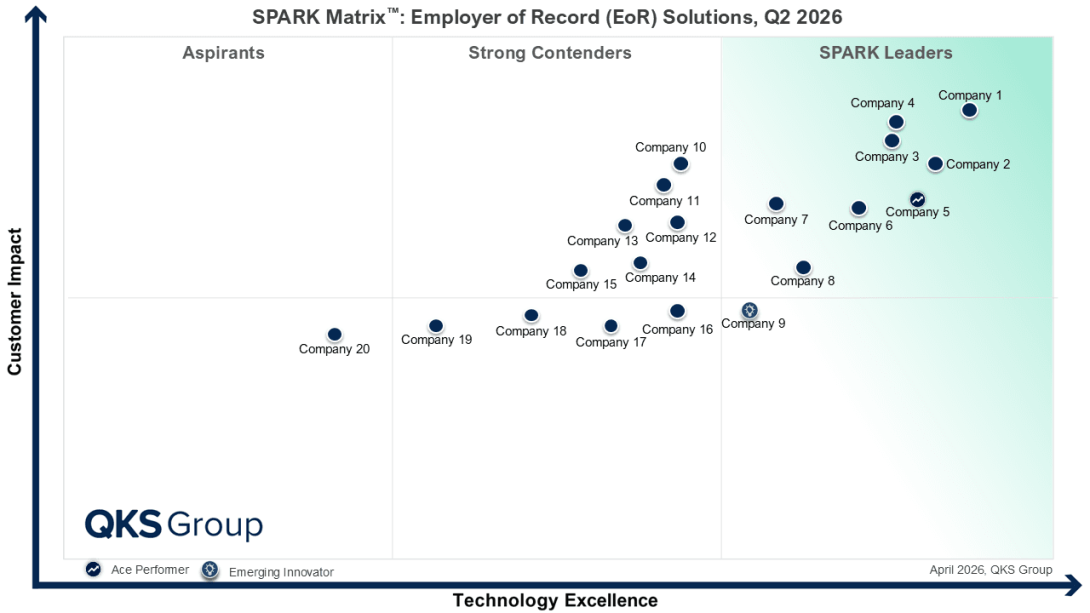
QKS Group's Employer of Record (EoR) Solutions market research provides a comprehensive analysis of emerging technology trends, market trends, competitive dynamics, and future market outlook. The research supports technology vendors in understanding market opportunities while helping enterprises assess vendor capabilities, competitive differentiation, and market positioning.
The proprietary SPARK Matrix analysis evaluates leading EoR providers with global impact, including Atlas, BIPO, CXC Global, Deel, G-P, Links International, Mauve Group, Mercans, Multiplier, Neeyamo, Oyster, Papaya Global, Payoneer Workforce Management, Pebl, Remofirst, Remote, Remote People, Remundo, Safeguard Global, and WorkMotion.
Key Challenges Businesses Face
Complex Employment Regulations
Employment regulations differ significantly between countries. Organizations must account for local requirements covering contracts, working conditions, payroll, taxes, benefits, leave, termination, and employee protections.
Keeping up with these requirements internally can become difficult as the number of hiring markets increases.
Global Payroll Complexity
Payroll calculations vary across jurisdictions. Currency conversion, taxation, statutory deductions, benefits, and reporting requirements can make international payroll administration resource-intensive.
Establishing Local Entities
Creating legal entities in every country where an organization wants to hire can require considerable time, investment, and administrative resources. EoR models provide an alternative for certain international hiring scenarios.
Compliance Risk
Non-compliance with local employment requirements can create financial, legal, and reputational consequences. Organizations therefore need reliable processes and local expertise to manage employment obligations.
Employee Experience
International employees expect efficient onboarding, accurate payroll, accessible benefits, and timely support regardless of where they are located. Fragmented processes can negatively affect the employee experience.
Check SPARK Plus Study Here: https://qksgroup.com/sparkplus?market-id=477&market-name=employer-of-record-%28eor%29-solutions
Key Trends & Innovations
AI and Intelligent Compliance
AI and automation are increasingly being incorporated into global employment platforms. Intelligent technologies can help identify potential compliance issues, automate administrative workflows, and organize large volumes of workforce information.
AI-driven capabilities can also support HR teams by surfacing relevant information and reducing repetitive administrative activities.
Automated Global Payroll
Payroll automation is becoming a central capability of modern EoR platforms. Automated calculations, payment workflows, documentation, and reporting can reduce manual intervention and improve operational consistency.
Digital Onboarding
Digital onboarding enables employees to complete contracts, documentation, tax forms, benefits selections, and other employment requirements remotely.
This is particularly valuable for organizations hiring distributed teams across multiple countries.
Global Benefits Management
EoR platforms are increasingly supporting benefits administration across different markets. Centralized benefits management can help organizations provide locally appropriate offerings while maintaining consistent workforce governance.
Workforce Analytics
Analytics provides organizations with greater visibility into global workforce costs, headcount, hiring activity, payroll expenditure, and employment trends.
As international workforces expand, these insights can support more informed workforce planning.
Integrated International Payments
Cross-border payments remain an important part of global workforce management. Modern EoR platforms increasingly integrate payroll and payment capabilities to simplify international compensation processes.
Benefits & Business Impact
Implementing Employer of Record Solutions can create business value across HR, finance, legal, and global expansion teams.
Faster International Hiring
EoR platforms can help organizations onboard employees in new countries without requiring the organization to establish its own legal entity in every market.
Reduced Administrative Complexity
Employment contracts, payroll, tax administration, benefits, and compliance processes can be coordinated through a centralized platform and service model.
Improved Compliance Management
Local employment expertise and structured processes can help organizations manage jurisdiction-specific employment requirements more effectively.
Greater Workforce Flexibility
Companies can test new markets, hire specialized talent, and build distributed teams with greater operational flexibility.
Better Employee Experience
Digital onboarding, localized benefits, payroll support, and employee self-service capabilities can contribute to a more consistent international employee experience.
Improved Workforce Visibility
Centralized reporting provides HR and business leaders with greater visibility into global headcount, employment costs, and workforce activity.
Use Cases or Real-World Examples
Consider a technology company headquartered in the United States that wants to hire software engineers in Germany, India, Brazil, and Singapore.
Establishing separate legal entities in each country could introduce additional administrative and operational requirements. An EoR provider can act as the legal employer in applicable jurisdictions while the technology company manages the employees' daily responsibilities.
The EoR platform can support employment contracts, onboarding, payroll, statutory deductions, benefits, and compliance processes.
Other common use cases include:
- International expansion: Hiring employees before establishing local entities.
- Remote workforce management: Supporting employees working across multiple countries.
- Specialized talent acquisition: Hiring hard-to-find skills in international markets.
- Market testing: Building small teams to explore new geographic markets.
- M&A workforce integration: Supporting employees during international organizational changes.
- Distributed workforce management: Managing employment administration across multiple jurisdictions.
How Organizations Can Choose the Right Solution
Choosing an EoR provider requires more than examining the number of countries supported. Organizations should evaluate the depth of local employment capabilities and the technology supporting the employee lifecycle.
Important evaluation criteria include:
- Geographic coverage
- Local employment expertise
- Payroll capabilities
- Tax and compliance management
- Employment contract management
- Benefits administration
- Employee onboarding
- Offboarding and termination support
- Workforce analytics
- HR and payroll integrations
- Data security and privacy
- Employee and employer support
- Pricing and transparency
- Platform usability and scalability
Organizations should also examine how providers handle changes in local regulations and whether their technology can support workforce growth across multiple jurisdictions.
Future Outlook: 2025–2028
The EoR market is expected to become increasingly technology-driven between 2025 and 2028 as organizations continue to build distributed and international workforces.
AI and automation are likely to play a greater role in compliance monitoring, payroll administration, employee support, document management, and workforce analytics. EoR platforms may increasingly use intelligent systems to identify regulatory changes and help organizations respond to evolving employment requirements.
Integration will also remain important. EoR platforms are expected to become more closely connected with HRIS, payroll, finance, talent acquisition, expense management, and workforce planning systems.
At the same time, data privacy, employment compliance, cross-border data management, and transparency will remain important considerations.
The market is therefore moving toward a more integrated global employment infrastructure in which technology and local expertise work together to support international workforce management.
Click Here For More Information: https://qksgroup.com/market-research/spark-matrix-employer-of-record-eor-solutions-q2-2026-10413
Conclusion
International hiring can provide organizations with access to new talent pools and growth opportunities, but managing employment obligations across countries requires specialized expertise and strong operational processes.
Employer of Record Solutions provide a structured framework for managing international employment without requiring organizations to establish a local legal entity in every market. By combining employment administration, payroll, benefits, compliance, onboarding, payments, and workforce reporting, EoR platforms can simplify global workforce management.
As organizations continue to embrace distributed teams and international hiring, EoR technology is becoming increasingly important to global workforce strategies. Vendors that combine strong local expertise with automation, analytics, compliance intelligence, and seamless employee experiences will be positioned to address the evolving requirements of global employers.
1. What is an Employer of Record (EoR)?
An Employer of Record is a third-party organization that legally employs workers on behalf of another company in a country where the client may not have its own legal entity. The EoR typically manages employment contracts, payroll, taxes, benefits, and local employment compliance.
2. Why do companies use EoR solutions?
Companies use EoR solutions to simplify international hiring and employment administration. They can help organizations hire workers in new countries while reducing the need to establish and manage separate legal entities for every market.
3. What services do EoR platforms typically provide?
EoR platforms commonly support employee onboarding, employment contracts, payroll, tax administration, statutory benefits, compliance, international payments, workforce reporting, benefits administration, and employee offboarding.
4. How do EoR solutions support global compliance?
EoR providers manage employment processes according to applicable local requirements. Their capabilities may include localized contracts, payroll regulations, statutory benefits, tax administration, documentation, and employment compliance processes.
5. What should organizations consider when selecting an EoR provider?
Organizations should consider geographic coverage, local employment expertise, payroll capabilities, compliance management, benefits, technology integrations, data security, employee support, platform usability, scalability, and pricing transparency when evaluating an EoR provider.