
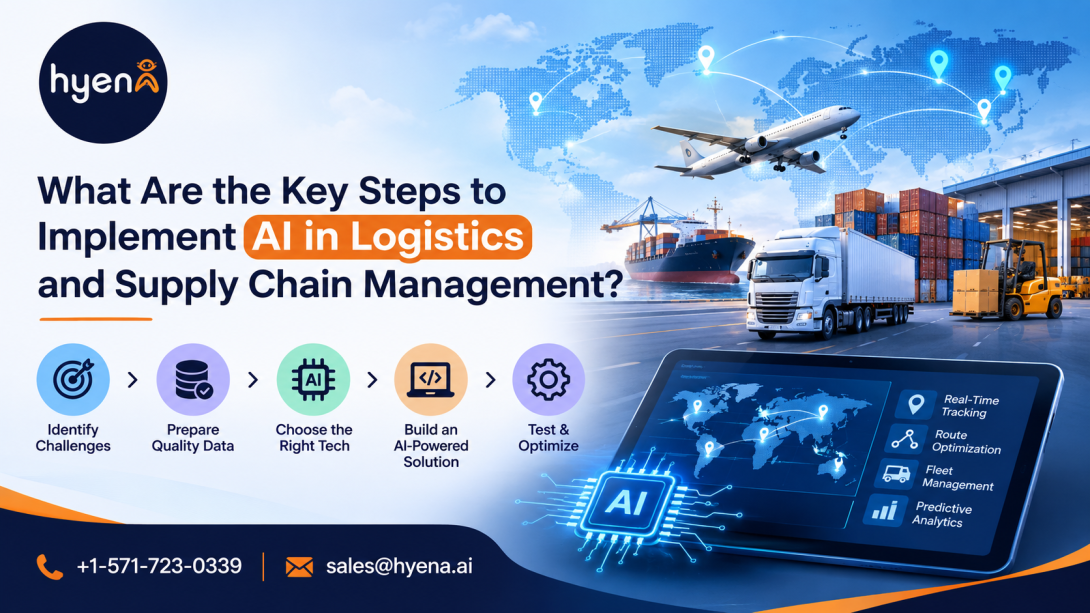
The application of Artificial Intelligence (AI) technologies in logistics and supply chain management helps to enhance the speed of delivery, optimize operational costs, forecast demand, and efficiently manage the transportation of goods. The effective integration of AI in Logistics begins with the identification of business challenges, collection of quality data, choice of appropriate AI technologies, and integration of intelligent solutions in existing business processes.
Most logistics companies have moved beyond traditional tracking systems and are adopting AI-powered tools to make swift decisions, optimize fleet performance, and enhance customer experience. However, the key to successful implementation is having a defined strategy and the right development partner.
Identify the Logistics Business Challenges
Prior to the adoption of AI solutions, logistics companies need to identify business challenges. These can include delays in order fulfillment, inefficient fleet utilization, high operational costs, and/or poor inventory visibility. For each of these, AI can be implemented in several ways.
- Predictive analytics can be utilized to prevent delays in order fulfillment.
- Analyzing vehicle performance, fuel consumption, and driver behavior can increase the efficiency of a fleet.
- AI can be utilized to predict consumer demand to eliminate stock outs.
- Automating mundane tasks can reduce operational costs.
Implementing AI is beneficial for logistics companies that experience growing order volumes. For example, a logistics company that manages hundreds of shipments daily can incorporate AI to predict delivery windows based on traffic conditions.
Collect and Organize Relevant Data
Logistics businesses collect data through customer orders, GPS devices, and sensors embedded on vehicles. AI systems are only as good as the data they are trained on.
Before creating an AI solution, you will need to collect and structure the information mentioned below.
You will need to collect:
- Where the vehicles have been.
- Schedules and details of the orders being delivered.
- Fuel usage and maintenance.
- What is in the warehouse and where it is going.
- What customers have said and how customers have ordered.
Connecting these data sources allows AI to find patterns and generate better predictions. Old or inadequate information can result in bad recommendations.
3. Pick the Right AI Technology
Not all logistics companies need the same AI solution. The technology must meet the size and requirements of your business, as well as your goals for the future.
Some examples of positive impact technology are:
- ML: Anticipate customer demands and optimize inventory and delivery windows.
- Predictive Analytics: Predict vehicle breakdowns and disruptions in the supply chain.
- CV: Improve WMS (Warehouse Management Systems).
- NLP: Automate customer support and shipping documents.
- Generative and Agentic AI: Assist in planning and controlling workflow.
When a technology is positive impact, it should be focused on operational problems in a business rather than a business adopting technology for trending's sake.
4. Create an AI-Powered Logistics Solution
After selecting the technology, the next step is creating the solution.
This solution helps integrate various logistics activities in a single platform.
A few features of the solution include:
- Real-Time GPS Tracking: Know the location of vehicles and shipments.
- Smart Route Optimization: Using traffic, distance, and delivery priorities, create intelligent routes.
- Predictive Fleet Maintenance: Identify potential issues before they lead to unexpected downtime.
- Automated Notifications: Automatically notify customers about their shipments.
- Analytics Dashboard: Analyze and report key performance indicators including delivery, expense and fleet usage.
During Logistics App Development, take into consideration the needs of drivers, fleet managers, warehouse employees, and customers. Provide a simple interface to access features relevant to them.
Designing such systems in conjunction with an experienced logistic app development company like Hyena Information Technologies will help improve and streamline your logistic processes.
5. Integrate AI with your Current Systems
The AI solution should be able to work with the systems your business uses. Avoid an unnecessary expense to replace all systems.
Also, integrate AI capabilities with your current ERP, WMS, TMS, GPS and payment solutions.
For instance, as a new customer order comes in, an integrated AI system should be able to verify inventory and recommend a delivery vehicle, and also determine the estimated time of delivery and notify the operations team.
This connectivity reduces the need for employees to coordinate with one another for making a decision.
6. Conduct a Pilot Test
Deploying AI across different departments at the same time increases business risk. Instead, conduct a small scale, focused project to test AI implementation.
Select one operational area to test, such as planning delivery routes or anticipatory vehicle maintenance. Create a controlled test environment and input actual business data. Assess how the system performs in comparison to your current processes.
Important variables to track could be:
- Time-in-transit and on-time delivery rates
- Fuel consumption and costs
- Vehicle maintenance and downtime
- Order processing times
- Customer satisfaction
BCG’s analysis of the logistics industry for March 2026 states that only 10% of surveyed logistics providers reported a measurable financial impact from the use of AI. This shows that providers should evaluate actual results and not assume that the adoption of AI automatically leads to ROI.
7. Performance and Gradual Scaling
The use and enhancement of AI systems should be monitored over time, in addition to consistent updates to business data.
Begin expanding the use of successful AI systems in other business units to achieve similar results.
Gartner’s 2026 supply chain trends focus on the growing importance of agentic AI, intelligent simulation, physical AI, and decision governance.
Human supervision is necessary, especially if AI is recommending actions related to delivery commitments, inventory decisions, or vehicle safety.
How Much Does Logistics App Development Cost?
The cost to develop a logistics app is determined by the complexity of the application, the AI features, integrations with third-party systems, the platform on which it is built, and development time.
Businesses should account for the following factors when making their investment estimations:
- Complexity of User Interface and User Experience (UI/UX) design and application
- Artificial Intelligence (AI) model development and integration
- GPS tracking and mapping
- Backend development and cloud
- Security, testing, and ongoing maintenance
Working with the right Mobile App Development Company enables businesses to prioritize the essential features of their app, stay within their development budget, and create a solution which aids the growth of their business.
Conclusion: Build Smarter Logistics Operations with AI
Adopting AI in logistics is an evolutionary process which involves appropriate planning, trustworthy data, adequate technologies, and perpetual improvement. From optimized route planning to preventive maintenance, AI helps enterprises improve their supply chain operations.
At Hyena Information Technologies, we help our clients build intelligent digital solutions using AI App Development, and Logistics and Custom Apps Development. Our team has the expertise to build flexible, scalable logistics platforms and fleet management applications, customized to meet our clients' business needs.
Want to intelligent your logistics? Contact us to learn how AI can improve your supply chain.