
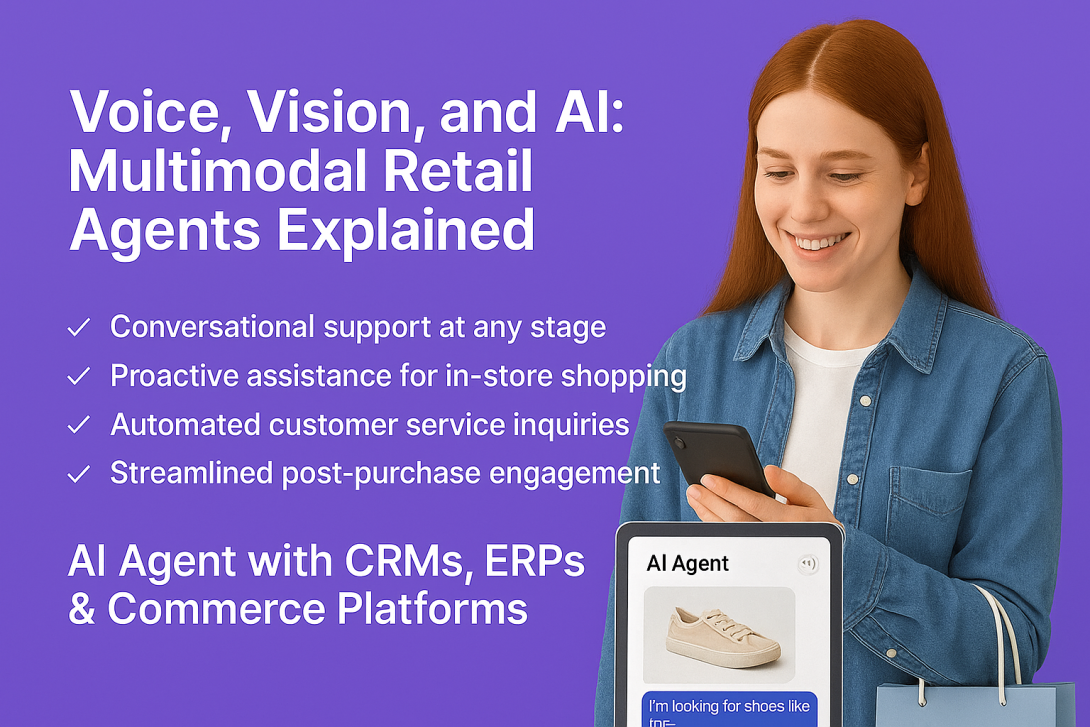
In the fast-evolving world of digital commerce, the retail landscape is undergoing a profound transformation. At the forefront of this revolution are multimodal AI agents, powered by voice recognition, visual intelligence, and contextual understanding. These AI agents are not just digital assistants—they are intelligent, adaptive interfaces that redefine customer experiences across the entire retail journey.
This article explores the emergence of multimodal AI agents, their integration in modern commerce, and why embracing a AI agent for retail and ecommerce strategy is becoming essential for competitive brands.
What Are Multimodal AI Agents?
Multimodal AI agents are systems that understand and process multiple types of input—such as voice, images, text, and even gestures—to interact with users. Unlike traditional bots that rely solely on text or predefined scripts, these advanced agents use a combination of:
- Voice recognition (for spoken commands and conversations)
- Computer vision (to interpret images and visual inputs)
- Natural Language Processing (NLP) (to understand and generate text)
- Contextual learning (to adapt responses based on user behavior and environment)
Together, these modalities allow for more intuitive, human-like interactions.
Why Multimodal AI Matters in Retail and Ecommerce
In retail, customer touchpoints are no longer limited to websites or mobile apps. Consumers engage through smart speakers, visual searches, AR experiences, and voice assistants. An AI agent for retail and ecommerce that can bridge these interfaces and respond intelligently across formats offers unmatched engagement potential.
Consider these scenarios:
- A customer uses voice to ask for "red running shoes under $100."
- They upload a photo of a product they saw in a magazine.
- They switch to chat to ask about sizes and delivery.
A multimodal AI agent handles all these interactions seamlessly—understanding intent, processing visual input, and delivering consistent results.
Voice: Conversational Commerce Takes Center Stage
Voice-based commerce is on the rise, driven by smart home devices, in-car assistants, and wearable tech. Customers are growing comfortable with speaking to devices to shop, ask questions, or track orders.
An AI agent integrated with voice capabilities allows users to:
- Search products hands-free
- Ask about availability or offers
- Reorder items based on history
- Navigate product categories
- Receive personalized recommendations via spoken conversation
For retailers, this not only streamlines support but also opens up new revenue opportunities from voice commerce.
Vision: Visual Search and Image Recognition in Action
Computer vision enables AI agents to understand and respond to images. This is a game-changer in retail, where visual appeal drives decision-making.
With vision-enabled AI agents:
- Users can upload a photo to find similar products
- Agents recognize logos, packaging, and objects in user images
- Virtual try-on features become more interactive
- Real-time camera feeds assist with in-store navigation or product location
This is particularly useful for fashion, furniture, beauty, and lifestyle brands where visual context enhances shopping experiences.
Combining Modalities: Real Use Cases
The true power of multimodal AI agents comes when voice, vision, and text are combined.
Use Case 1 – Voice + Vision + NLP
A user tells a retail app, "Show me sunglasses like these," while uploading a beach photo with someone wearing sunglasses. The AI agent analyzes the image, identifies the sunglasses style, and pulls similar results—speaking back the top matches and offering to add one to the cart.
Use Case 2 – In-Store AR + Voice Assistant
In a smart retail store, a customer scans a QR code next to a jacket. The AI agent pops up with a voice assistant that gives details on fabric, availability in other sizes/colors, and even styling tips. The customer asks, “Do you have this in medium in black?” and the AI checks real-time inventory.
Benefits of Multimodal AI Agents in Retail and Ecommerce
- Seamless User Experience: Multimodal agents adapt to how customers prefer to engage—whether speaking, typing, or showing.
- Accessibility: Voice and visual interfaces help users with limited mobility or literacy.
- Context-Awareness: They remember customer preferences and behavioral cues.
- Higher Conversion Rates: Personalized, faster interactions reduce friction and boost trust.
- Scalability: A single AI agent for retail and ecommerce handles thousands of customers across multiple input channels.
Building Your Multimodal AI Strategy
To implement a multimodal AI agent, retailers should:
- Choose the Right Tech Stack: Use platforms that support voice (like Google Dialogflow or Amazon Lex), vision (like OpenAI's vision models or AWS Rekognition), and NLP.
- Integrate Across Channels: Connect the AI agent to mobile apps, websites, smart devices, and POS systems.
- Design for Flow: Plan how customers might switch between modes—e.g., from visual search to voice queries.
- Train the Agent Continuously: Feed real-world data to refine the agent’s accuracy and contextual responses.
- Ensure Data Privacy: Protect user inputs—especially voice and images—with encryption and transparent consent.
Challenges and Considerations
- Latency: Processing voice and vision simultaneously can slow responses—optimize backend infrastructure.
- Privacy Concerns: Transparent policies and opt-ins are critical for voice recordings and image uploads.
- Cost: High development and processing costs for multimodal AI can deter small businesses—start with phased adoption.
The Future: AI Agents as Shopping Companions
Looking ahead, multimodal AI agents will evolve into full-fledged shopping companions. They’ll know preferences, offer styling advice, guide purchases, process returns, and act as the face of your brand across platforms. These agents will not only drive conversions but foster long-term brand loyalty.
Retailers that leverage a multimodal AI agent for retail and ecommerce position themselves as innovators—delivering rich, immersive, and intelligent shopping journeys.
Conclusion
The convergence of voice, vision, and AI represents a new chapter in customer engagement. By deploying multimodal AI agents, retailers aren’t just automating responses—they're creating meaningful, human-like interactions that align with how today’s consumers communicate.
Whether it's through a voice command, a visual upload, or a typed query, shoppers expect quick, intuitive answers. The AI agent for retail and ecommerce of the future is one that sees, listens, understands—and reacts—instantly.
Now is the time to reimagine customer experience, not as a series of touchpoints, but as one fluid, intelligent conversation across every channel and device.