
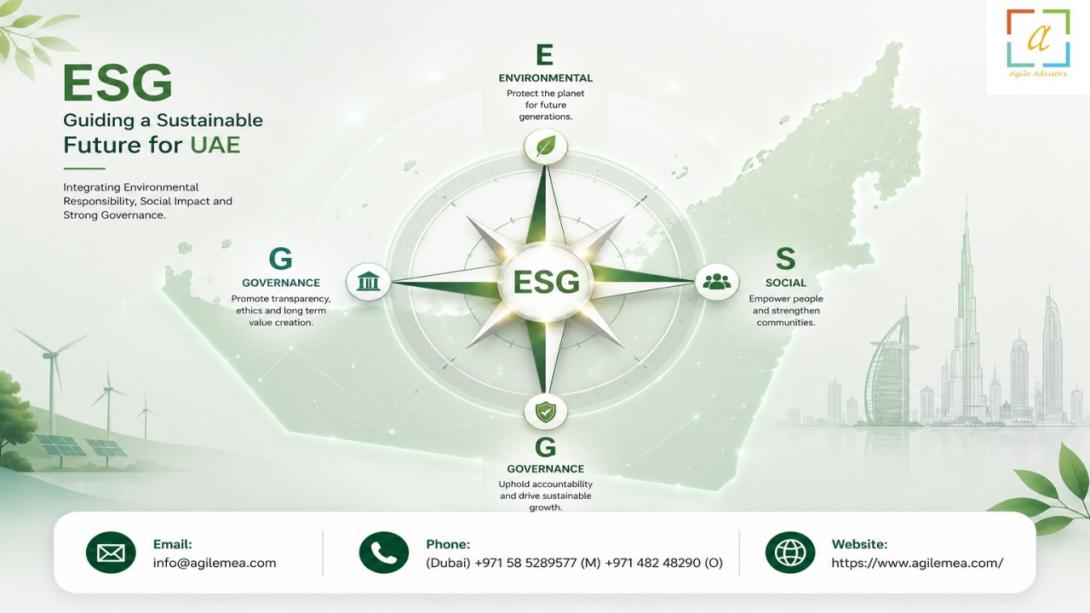
The regulatory landscape for environmental, social, and governance disclosure in the United Arab Emirates has undergone a fundamental transformation. What was once a voluntary exercise driven by investor expectations has become a binding legal obligation. Federal Decree-Law No. 11 of 2024 on the Reduction of Climate Change Effects has established the first mandatory climate framework in the MENA region, fundamentally reshaping how businesses approach ESG and sustainability reporting.
Understanding UAE ESG Reporting Requirements
The scope of mandatory UAE ESG reporting is comprehensive. The Climate Change Law applies to all public and private sector entities whose operations or activities result in the release of greenhouse gases, including those operating in free zones. There is no exemption for small and medium-sized enterprises, and there is no de minimis emissions threshold.
Beyond the federal climate law, additional reporting obligations apply depending on your company type, listing status, and jurisdiction. Companies listed on the Abu Dhabi Securities Exchange or the Dubai Financial Markets are subject to Securities and Commodities Authority requirements, including the Public Joint Stock Companies Governance Manual. The DFM ESG Reporting Guide sets out a defined set of 32 ESG metrics as a benchmark.
ESG and Sustainability Reporting: Building a Comprehensive Approach
Effective ESG and sustainability reporting requires organizations to look beyond mere compliance and embrace a strategic approach to disclosure. The UAE's regulatory framework demands that businesses measure and report on greenhouse gas emissions, maintain inventories, retain data for five years, and submit decarbonization plans aligned with the national Net Zero 2050 strategy.
Organizations must address all three pillars of ESG in their reporting:
1. Environmental criteria, including energy consumption, GHG emissions, waste generation, and natural resource management
2. Social criteria covering community welfare, labor relations, diversity and inclusion, human rights, and consumer protection
3. Governance practices, including internal controls, compliance procedures, and stakeholder engagement
Navigating ESG Reporting Frameworks in the UAE
There is no single ESG reporting framework mandated across the UAE. Instead, organizations must navigate a complex landscape of internationally recognized standards and local requirements. The Securities and Commodities Authority requires listed companies to align with Global Reporting Initiative standards, while the Dubai Financial Market's ESG Guide endorses GRI for comprehensive reporting and SASB for industry metrics.
Key ESG reporting frameworks relevant to UAE businesses include
l Global Reporting Initiative Standards for comprehensive sustainability disclosure
l Sustainability Accounting Standards Board for industry-specific metrics
l Task Force on Climate-Related Financial Disclosures for climate risk reporting
l IFRS S1 and S2 for global sustainability and climate disclosure standards
The Abu Dhabi Global Market explicitly references TCFD, SASB, and GRI as acceptable frameworks. Many organizations are now aligning with multiple frameworks to meet both regulatory requirements and investor expectations.
The Role of Professional ESG Consultancy
Navigating this complex and evolving regulatory environment requires specialized expertise. Professional ESG consultancy provides the strategic guidance needed to meet mandatory disclosure requirements while building long-term organizational resilience. Expert consultants help organizations establish robust data collection systems, align with appropriate frameworks, prepare for independent verification, and develop credible decarbonization strategies.
The Agile Advisors Advantage
Agile Advisors stands as a leading ESG and sustainability consulting firm in the UAE, helping organizations build transparent, impactful, and future-ready sustainability strategies. Our team of expert consultants supports businesses in aligning with global ESG standards while addressing local regulatory and stakeholder expectations. With offices across the UAE, Oman, Saudi Arabia, the UK, and India, and a track record of over 200 diverse projects, Agile Advisors brings both global perspective and local expertise to every engagement.
Our key services include sustainability advisory, ESG reporting, carbon footprint development, green building certification, business continuity, and training and capability development. As an ESG consultant, we conduct ESG gap analysis, assessment, and due diligence and develop ESG reports for clients across multiple sectors.
Conclusion
UAE ESG reporting has moved decisively from voluntary practice to mandatory legal obligation. Federal Decree-Law No. 11, combined with stock exchange requirements and financial center frameworks, has created a complex regulatory environment that demands professional expertise. Organizations that engage expert ESG consultancy services gain the knowledge and support needed to navigate this landscape with confidence, ensuring compliance while building competitive advantage in an increasingly sustainability-conscious marketplace.
Agile Advisors is ready to guide your organization through every step of the ESG reporting journey. From ESG strategy development to framework alignment and report production, our team delivers practical, framework-aligned solutions that meet both regulatory requirements and stakeholder expectations.