

Security cameras have become an essential part of protecting commercial properties, offices, warehouses, retail outlets, residential developments, and other facilities across Dubai. However, installing a few cameras is not enough. Businesses need a surveillance system that is properly planned, professionally installed, reliable in daily operation, and aligned with applicable security requirements.
Working with a SIRA Approved CCTV Company Dubai helps businesses approach CCTV installation with compliance, coverage, system performance, and long-term maintenance in mind.
Proswift Security Solutions, established in 2010, provides security and IT solutions for businesses in Dubai and the wider UAE. With more than 15 years of industry experience, the company supports organizations that require professionally planned CCTV surveillance, access control, networking, and related technology infrastructure.
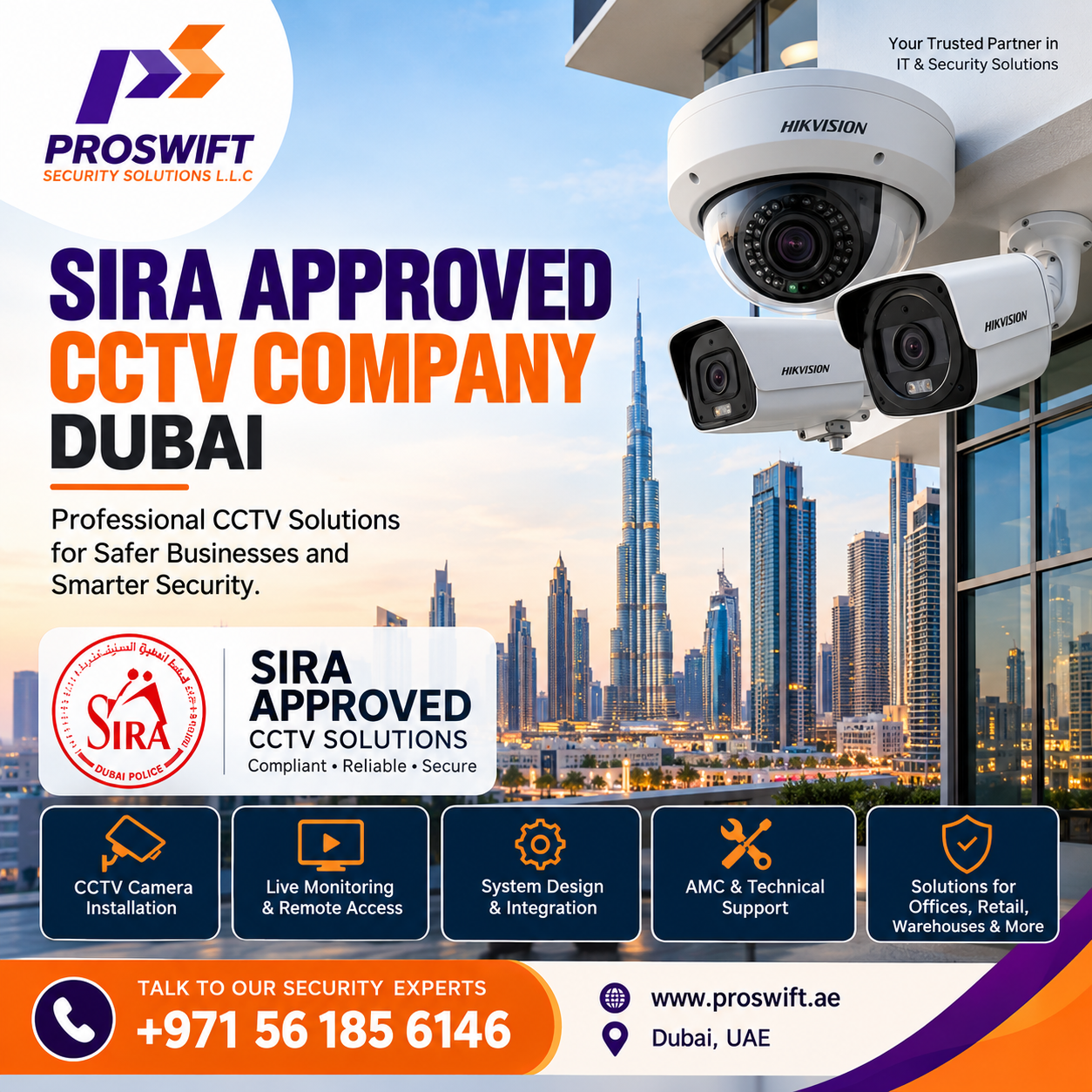
What Is a SIRA Approved CCTV Company in Dubai?
A SIRA CCTV company provides CCTV and security system services in accordance with applicable Security Industry Regulatory Agency requirements in Dubai.
For a business owner, facility manager, or IT administrator, this is important because CCTV installation involves much more than selecting cameras. A professionally designed system must consider where cameras are required, what each camera needs to capture, recording requirements, network capacity, storage, monitoring, equipment compatibility, and ongoing maintenance.
A SIRA certified CCTV company can help organizations understand these considerations and develop a surveillance solution appropriate for their premises and operational requirements.
Why Does SIRA Compliance Matter for CCTV Installation?
CCTV is often treated as a straightforward technology purchase. In practice, surveillance performance depends heavily on how the entire system is designed.
A high-resolution camera positioned incorrectly may provide less useful evidence than a correctly selected camera installed at an appropriate location.
This is why compliance-oriented planning matters.
Depending on the type of property and applicable requirements, CCTV planning may need to consider:
- Camera locations and coverage
- Entry and exit monitoring
- Critical operational areas
- Image quality
- Recording and storage
- System accessibility
- Equipment reliability
- Network infrastructure
- Maintenance and system health
Choosing an experienced provider for SIRA approved CCTV Dubai requirements helps businesses address these factors before installation rather than discovering coverage or performance problems after the system has been deployed.
Start With the Property, Not the Camera Catalogue
One of the most important lessons in professional surveillance design is simple: start with the site.
Every property has a different risk profile.
A retail shop may prioritize entrances, exits, transaction areas, stock rooms, and customer movement. A warehouse may require surveillance around loading bays, storage zones, gates, and restricted sections. An office may focus on reception areas, access points, common spaces, and critical infrastructure areas.
Before recommending equipment, an experienced CCTV provider should understand questions such as:
What needs to be monitored?
Which areas are operationally important?
Where are the potential blind spots?
What happens during low-light conditions?
How long does footage need to remain available?
Who needs authorized access to the system?
These questions lead to a much more useful solution than simply deciding how many cameras to install.
Choosing the Right CCTV Cameras for Dubai Properties
Not every surveillance environment requires the same type of camera.
Camera selection should be based on the purpose of each surveillance point. Resolution, lens characteristics, viewing angle, lighting, installation environment, and recording requirements all influence the final choice.
Dome Cameras
Dome-style cameras are commonly considered for indoor environments where a compact installation is preferred. They can be suitable for offices, retail environments, reception areas, and other commercial interiors depending on surveillance requirements.
Bullet Cameras
Bullet-style cameras can be useful where a clearly directed field of view is required. Depending on the model and environmental rating, they may be considered for external areas, building perimeters, parking locations, and access routes.
PTZ Cameras
Pan-Tilt-Zoom cameras provide the ability to change viewing direction and zoom into selected areas. They can be useful in larger environments where active monitoring is required.
Low-Light and Night Surveillance
Security incidents do not happen only during business hours. Lighting conditions therefore need to be assessed carefully.
A professional CCTV installation company in Dubai should evaluate nighttime visibility rather than relying exclusively on daytime site conditions.
Camera Placement Can Be More Important Than Camera Count
Installing more cameras does not automatically create better security.
A properly designed system aims to achieve useful coverage while reducing blind spots and unnecessary overlap.
Entrances and exits are obvious locations, but CCTV planning may also consider corridors, loading zones, cash-handling areas, stock rooms, reception spaces, server rooms, parking areas, gates, and other operationally sensitive locations.
Camera height and angle matter as well.
A camera positioned too high may capture a broad scene without providing the detail required for useful review. A camera positioned poorly may also suffer from glare, backlighting, physical obstruction, or an ineffective viewing angle.
This is where professional surveillance design adds significant value.
Recording and Storage Are Part of the Security System
Cameras receive much of the attention during a CCTV project, but recorded footage is often what businesses ultimately depend on.
Storage planning should account for factors such as:
- Number of cameras
- Camera resolution
- Recording settings
- Frame rate
- Retention requirements
- Recording schedules
- Available storage capacity
These variables can substantially affect the amount of storage a surveillance system requires.
A knowledgeable SIRA CCTV company should therefore design cameras, recording equipment, and storage as parts of one system rather than independent products.
CCTV and Network Infrastructure
Modern IP surveillance systems depend heavily on network performance.
Network design can influence camera connectivity, data transmission, remote access, reliability, and system scalability. Businesses planning larger surveillance deployments should therefore consider switching infrastructure, bandwidth, network segmentation, cabling, and power requirements.
For organizations developing broader IT infrastructure, integrating CCTV planning with suitable networking solutions can simplify deployment and future expansion.
This becomes particularly important for multi-camera environments such as warehouses, corporate offices, commercial buildings, and multi-floor facilities.
CCTV Solutions for Different Business Environments
A professional surveillance design should reflect how a property actually operates.
Offices
Office CCTV systems may be designed around reception areas, entrances, exits, shared areas, parking facilities, and selected operational zones.
Surveillance can also work alongside access control and time attendance systems to create a more integrated approach to workplace security.
Retail Businesses
Retail surveillance often needs to address customer-facing spaces, entrances, checkout areas, stock rooms, and other important zones.
Good camera placement can help management review incidents without unnecessarily complicating everyday operations.
Warehouses
Warehouses present different challenges because of their scale.
Loading bays, vehicle movement, high storage racks, entrances, dispatch areas, and changing layouts can all affect surveillance coverage.
A site assessment is particularly valuable in these environments.
Commercial Buildings
Commercial properties may require coordinated surveillance across entrances, common areas, parking facilities, reception spaces, and other designated locations.
Scalability becomes important when multiple floors or building sections need to be monitored through a centralized system.
Why Professional CCTV Installation Matters
Even excellent surveillance equipment can perform poorly when installation quality is inadequate.
Professional CCTV installation addresses physical placement, cabling, network connectivity, camera configuration, recording settings, testing, and documentation.
Testing is particularly important.
Before a system is treated as operational, camera views should be reviewed under realistic conditions. Installers should check image quality, recording functionality, connectivity, timestamps, playback, and other critical functions.
This reduces the possibility of discovering a problem only after footage is needed.
CCTV Maintenance Should Not Be an Afterthought
A surveillance system is an operational asset, not a one-time installation.
Dust, environmental exposure, storage issues, network changes, hardware problems, configuration changes, and physical movement can gradually affect system performance.
Periodic maintenance can include:
- Checking camera image quality
- Inspecting camera positioning
- Confirming recording functionality
- Reviewing storage health
- Checking network connectivity
- Inspecting cabling and connections
- Testing authorized system access
Businesses that already rely on broader technology infrastructure can also consider coordinating surveillance support with IT AMC services in Dubai to improve ongoing system management.
Integrating CCTV With Access Control
CCTV becomes even more valuable when considered as part of a broader security strategy.
For example, access control determines who is permitted to enter selected areas, while CCTV provides visual monitoring of activity around those locations.
When properly designed, these systems can complement one another.
Organizations may also integrate surveillance with time-attendance systems, network infrastructure, and centralized security management depending on their operational needs.
The objective should not be to add technology simply because it is available. Each component should solve a defined security or operational requirement.
How to Choose a SIRA Certified CCTV Company in Dubai
Selecting a CCTV provider should involve more than comparing equipment prices.
Businesses should assess whether the provider understands both surveillance technology and the practical requirements of commercial environments.
Important considerations include:
Relevant Experience
A provider with substantial industry experience is more likely to understand the practical problems that arise during CCTV design, installation, integration, and maintenance.
Site Assessment
Recommendations should be based on the property rather than a generic camera package.
Technical Knowledge
The provider should be able to explain camera selection, storage, recording, networking, positioning, and system scalability in clear terms.
Compliance Awareness
The company should understand applicable Dubai security requirements and determine how they affect the proposed project.
Ongoing Support
CCTV systems need maintenance. Businesses should consider what happens after installation if a camera, recorder, storage device, connection, or configuration develops a problem.
Why Businesses Work With Proswift Security Solutions
Proswift Security Solutions has been operating since 2010 and brings more than 15 years of experience across security and IT solutions in Dubai.
The approach is particularly useful for organizations that need CCTV to work as part of a wider technology environment rather than as an isolated installation.
Alongside surveillance solutions, businesses may require access control and time attendance, network infrastructure such as Cisco switches in UAE, managed IT support, and cloud productivity solutions such as Microsoft Office 365.
Bringing these technologies together with appropriate planning can reduce compatibility issues and make the overall infrastructure easier to manage.
Frequently Asked Questions
What does SIRA mean for CCTV installation in Dubai?
SIRA refers to Dubai's Security Industry Regulatory Agency. Applicable requirements can influence how security and surveillance systems are planned and implemented. Businesses should confirm the requirements relevant to their particular premises and activity before proceeding with a project.
Why should I choose a SIRA approved CCTV company in Dubai?
A qualified provider can help plan CCTV coverage, select appropriate equipment, install and configure the system, and address applicable compliance considerations rather than treating CCTV as a simple camera purchase.
How many CCTV cameras does my business need?
There is no universal number. Camera requirements depend on the size and layout of the premises, entry and exit points, operationally important areas, lighting, security objectives, and applicable requirements.
Which CCTV camera is best for a commercial property?
The appropriate camera depends on its intended location and purpose. Resolution, lens, viewing angle, lighting, environmental conditions, and required image detail should all be considered.
Does a CCTV system require regular maintenance?
Yes. Regular checks can identify issues involving camera alignment, image quality, recording, storage, connectivity, cabling, and system access before they affect surveillance reliability.
Can CCTV work with access control systems?
Yes. CCTV and access control can complement each other when correctly planned. CCTV provides visual monitoring, while access control manages entry to designated locations.
Should networking be considered when installing IP CCTV?
Yes. IP cameras depend on network infrastructure. Switching capacity, bandwidth, cabling, power availability, network configuration, and scalability can all influence system reliability.
Building a CCTV System for Long-Term Security Value
The most effective CCTV project is not necessarily the one with the highest number of cameras or the most expensive equipment. It is the system that provides useful coverage, dependable recording, appropriate storage, reliable connectivity, and practical day-to-day operation.
For businesses evaluating a SIRA Approved CCTV Company Dubai, the priority should be to work with professionals who understand surveillance design, installation, networking, compliance considerations, and ongoing support.
Proswift Security Solutions combines more than 15 years of security and IT industry experience with solutions designed around the operational requirements of businesses in Dubai.
For professional CCTV and security solution enquiries:
Phone: +971 56 185 6146
Website: https://proswift.ae
Product Page: https://proswift.ae/solutions/sira-approved-cctv-company-in-dubai/
Social media links—
https://www.facebook.com/proswiftsecuritysolutions
https://www.instagram.com/proswiftsecuritysolutions
https://www.youtube.com/@proswiftsecuritysolutions
https://www.pinterest.com/proswiftsecuritysolutions
https://www.linkedin.com/company/proswift-security-solutions