

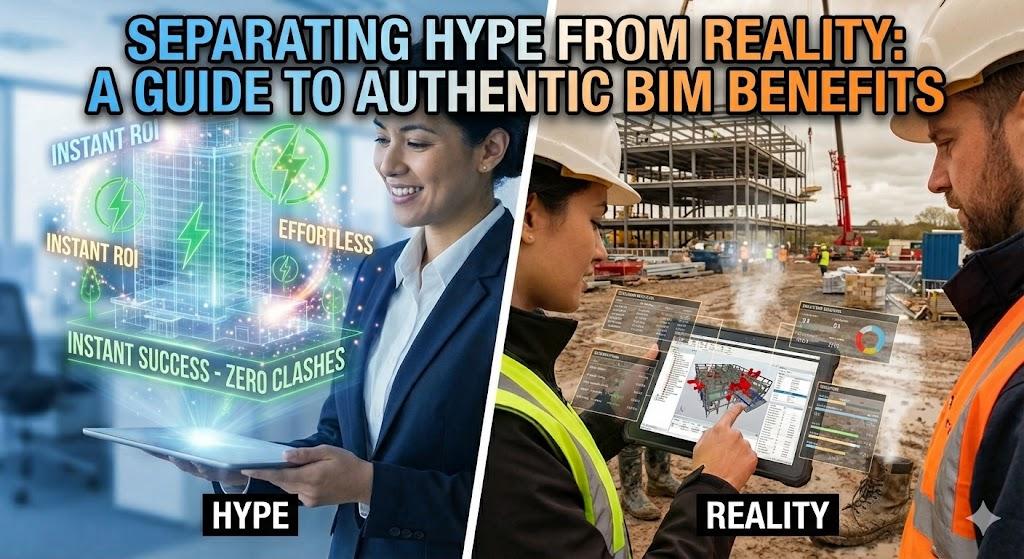
Let’s be honest for a second. In the AEC industry, "BIM" has become one of those buzzwords that gets thrown around in every meeting until it starts losing its meaning. If you believed all the marketing brochures, you’d think installing Revit on a laptop instantly solves every construction delay and magically cuts your budget in half.
Spoiler alert: It doesn’t work like that.
But here is the good news. Once you strip away the shiny marketing fluff, the authentic benefits of Building Information Modeling are actually far more impressive than the hype. It’s just that they aren’t magic tricks—they are practical, data-driven wins that require real work.
So, what is the reality?
The reality is that BIM isn’t just about making pretty 3D models to impress a client (though, let’s admit, that helps). The true power lies in the "I" of BIM—Information.
- It’s the clash detection that saves you $50,000 because you spotted a duct running through a beam six months before construction started.
- It’s the accurate quantity take-off that ensures you aren’t ordering 20% more steel than you actually need.
- It’s the collaboration that stops the architect and the structural engineer from playing a game of telephone with outdated PDF drawings.
However, getting to these wins requires navigating a minefield of misunderstandings. Many firms struggle because they treat BIM as just "CAD on steroids" rather than a new process. We see this happen so often that we actually put together a deep dive into the common myths about BIM that need to be debunked to help teams reset their expectations. If you are wondering why your adoption feels rocky, those misconceptions are usually the culprit.
Authentic BIM isn’t about software; it’s about certainty. It’s the difference between hoping a building comes together and knowing it will.
When you stop looking for a magic wand and start using the tool for better coordination and data management, the hype fades away. And what you are left with is simply a better way to build.