

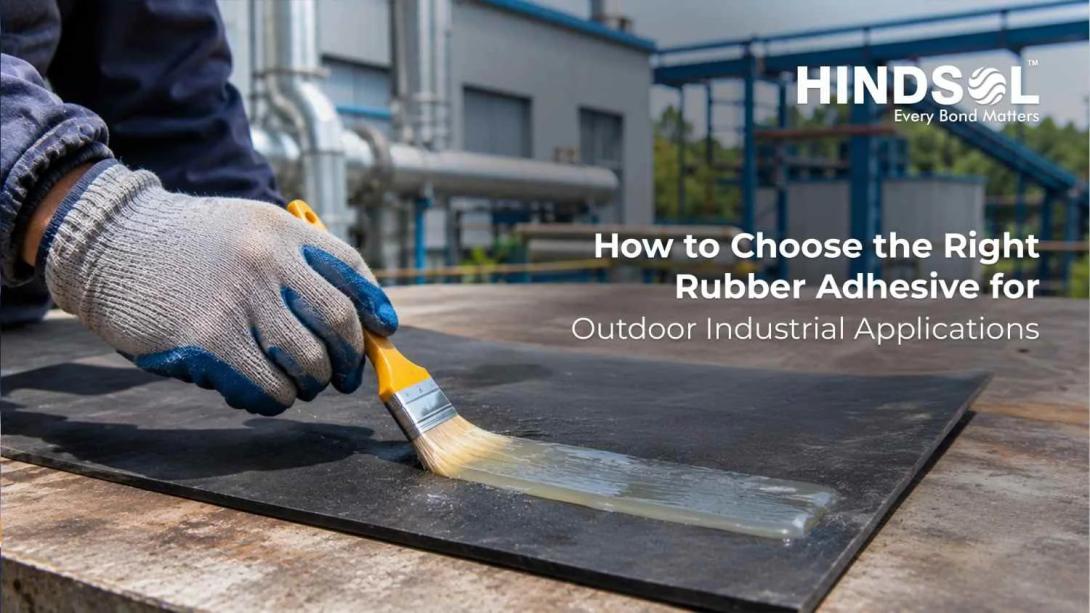
Choosing the right rubber adhesive for outdoor industrial applications is essential for bonding components exposed to moisture, sunlight, temperature changes, vibration and mechanical stress.
The correct adhesive depends on the rubber compound, bonding surface, operating environment and application method. A product suitable for rubber-to-rubber bonding may not be suitable for rubber-to-metal or rubber-to-fabric applications.
Learn how to choose rubber adhesive for outdoor industrial applications, including rubber-to-metal bonding and conveyor belt repair.
What Is an Industrial Rubber Adhesive?
An industrial rubber adhesive is a bonding material used to join rubber with compatible surfaces such as metal, fabric, PVC, urethane, fiberglass, concrete or other rubber materials.
Depending on its formulation, it may be used in applications such as:
- Conveyor belt repair and jointing
- Rubber-to-metal bonding
- Industrial rollers and pulleys
- Rubber lining
- Rubber sheet bonding
- Machinery maintenance
The adhesive must be compatible with the materials and the conditions in which the bonded components will operate.
Why Does Outdoor Rubber Bonding Require Special Attention?
Outdoor industrial equipment can experience environmental and mechanical conditions that affect bond performance.
- Moisture and water: Rain, humidity and water contact may affect bonding if the adhesive is not suitable for the exposure.
- Temperature changes: Repeated heating and cooling can create stress between bonded materials.
- UV exposure: Prolonged sunlight may affect exposed adhesive and rubber surfaces, depending on their formulation.
- Vibration and movement: Repeated movement can place stress on bonded joints.
- Abrasion and impact: Industrial operations may expose bonded components to friction, impact and surface wear.
For this reason, do not select an adhesive based on one property alone. Evaluate the complete operating environment.
6 Factors to Consider When Choosing Rubber Adhesive for Outdoor Industrial Use
1. Identify the Rubber Type and Bonding Surface
Start by identifying the exact rubber compound. Common industrial rubber types include Natural Rubber (NR), Styrene-Butadiene Rubber (SBR), Nitrile Rubber (NBR), Neoprene (CR) and EPDM.
Next, identify the second surface being bonded, such as:
- Rubber to rubber
- Rubber to metal
- Rubber to fabric
- Rubber to PVC
Different rubber compounds and surface combinations have different bonding requirements. Confirm compatibility through the adhesive manufacturer's Technical Data Sheet (TDS).
2. Evaluate Moisture, Water and Chemical Exposure
Determine how the bonded component will be exposed to water or chemicals.
For example, occasional rain exposure is different from continuous water contact or immersion. Industrial cleaning agents and chemicals may also affect the bonded joint.
Check the product documentation for the specific moisture and chemical resistance required by your application.
3. Check Operating Temperature and UV Exposure
Consider the minimum and maximum operating temperatures, temperature fluctuations and heat generated by the equipment.
If the bonded component is exposed to direct sunlight, check its UV and weathering suitability separately. Heat resistance alone does not confirm UV resistance.
4. Understand Rubber-to-Metal Bonding Requirements
Rubber-to-metal bonding is common in industrial rollers, pulleys, machinery components and rubber-lined equipment.
Surface preparation is important because oil, grease, rust, dust and loose particles can interfere with adhesion.
Depending on the bonding system, preparation may involve cleaning, degreasing or mechanical surface treatment. Follow the selected adhesive manufacturer's instructions.
5. Consider Mechanical Stress, Vibration and Abrasion
Industrial joints may experience repeated movement, vibration, impact and friction. Consider these performance requirements:
- Peel strength: Resistance to forces that separate the edges of a bonded joint.
- Shear strength: Resistance to forces acting parallel to the bonded surface.
- Flexibility: Important when bonded components bend or move.
- Abrasion resistance: Relevant when surfaces experience repeated wear.
Select an adhesive system according to the actual mechanical demands of the application.
6. Review Application and Curing Requirements
Some industrial rubber adhesives are two-component systems that require a separate hardener or crosslinker.
Before selecting a product, check:
- Mixing ratio and component compatibility
- Application method
- Drying and assembly time
- Curing conditions
- Site temperature and humidity
- Time required before equipment returns to service
Always follow the product label and latest technical documentation.
HindSol Cold Vulcanizing Cement for Industrial Rubber Bonding
HindSol offers cold vulcanizing cement solutions for specified industrial rubber bonding applications. These are two-component systems designed to cure at room temperature when used with the specified crosslinker or hardener.
1. HindSol CV Kit R77 / CL77
HindSol CV Kit R77 / CL77 is a two-component, room-temperature-curing, chloroprene-based rubber adhesive system used with the specified crosslinker.
The product is listed for bonding:
- Rubber to rubber
- Rubber to fabric
- Rubber to steel
- Rubber to PVC
- Urethane, fiberglass and concrete
It is available as a brushing-viscosity liquid.
Explore HindSol CV Kit R77 / CL77
2. HindSol CV Kit RT1904 / CL1904
HindSol CV Kit RT1904 / CL1904 is a two-component, room-temperature-curing vulcanizing cement used with the specified hardener.
It is supplied as a brushing-viscosity liquid. Consult its product documentation for the recommended substrates, mixing instructions and application requirements.
Explore HindSol CV Kit RT1904 / CL1904
Important: Outdoor suitability depends on the actual exposure and application. Before selecting either product for outdoor use, confirm the required UV, moisture, temperature and chemical resistance with HindSol's technical team.
Best Practices for Reliable Industrial Rubber Bonding
Follow these steps to support consistent bonding:
- Verify material compatibility: Identify the exact rubber compound and the second bonding surface.
- Prepare the surfaces: Remove contaminants and follow the product-specific surface preparation procedure.
- Mix correctly: Use the specified components and mixing ratio for two-component systems.
- Follow curing instructions: Respect the recommended drying, assembly and curing conditions.
- Check technical documentation: Review the latest TDS, product label and Safety Data Sheet (SDS) before use.
Frequently Asked Questions
1. What is rubber adhesive used for in industrial applications?
Industrial rubber adhesives are used to bond rubber with compatible materials such as metal, fabric, PVC and other rubber surfaces. Applications include conveyor belt repair, rubber lining, rollers and machinery maintenance.
2. How do I choose rubber adhesive for outdoor industrial applications?
Identify the rubber type and bonding surface first. Then evaluate moisture, UV exposure, operating temperature, chemicals and mechanical stress. Confirm the adhesive's suitability through its TDS.
3. Which adhesive is suitable for rubber-to-metal bonding?
The suitable adhesive depends on the rubber compound, metal surface, preparation method and operating conditions. Certain cold vulcanizing cement systems are designed for rubber-to-metal bonding.
4. Are all rubber adhesives suitable for outdoor use?
No. Outdoor suitability depends on the adhesive formulation and its documented resistance to moisture, UV exposure, temperature changes and other environmental conditions.
5. What is cold vulcanizing cement?
Cold vulcanizing cement is an adhesive system used for specified rubber bonding applications that cure at room temperature without heat-based vulcanization.
6. Why is surface preparation important for rubber bonding?
Oil, grease, dust, rust and other contaminants can interfere with adhesion. Proper surface preparation helps create suitable conditions for bonding.
Find the Right Rubber Adhesive for Your Industrial Application
Choosing an industrial rubber adhesive requires more than checking its bonding strength. Rubber compatibility, surface preparation, environmental exposure and curing requirements all matter.
HindSol offers cold vulcanizing cement solutions, including R77 / CL77 and RT1904 / CL1904, for specified industrial rubber bonding applications.
Contact HindSol to discuss your rubber-to-rubber, rubber-to-metal, conveyor belt or other industrial bonding requirements.