

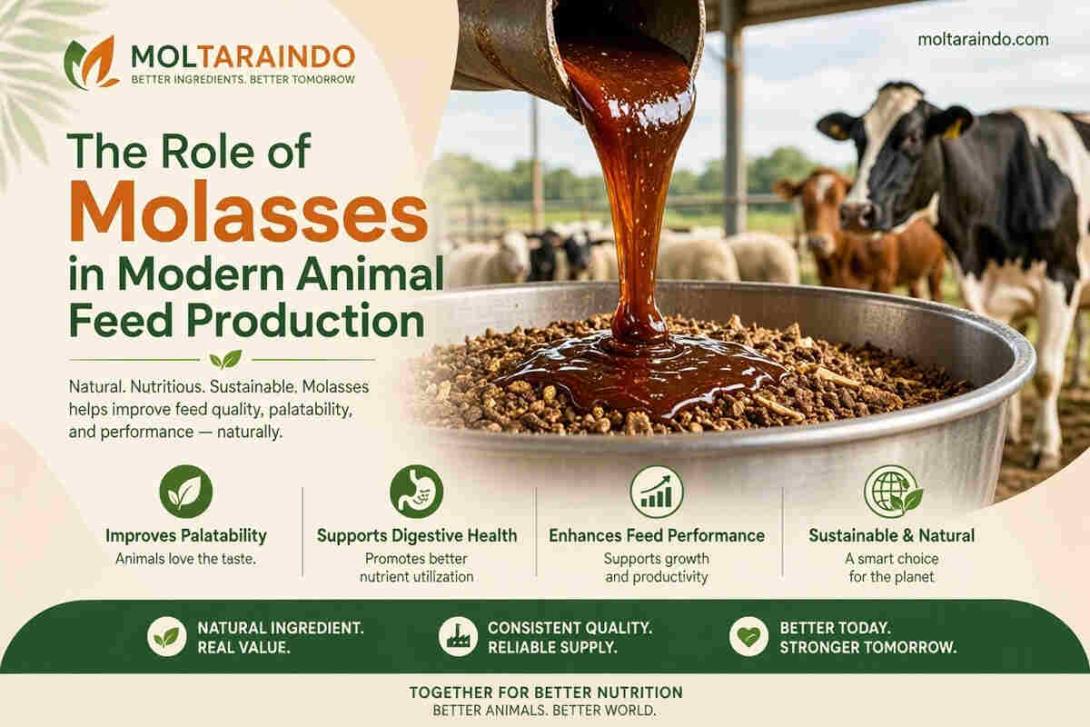
The livestock industry continues to seek feed ingredients that support animal nutrition, improve feed palatability, and help manufacturers maintain efficient production. Among the various ingredients used in commercial feed formulations, sugarcane molasses remains a valuable resource. Produced during sugar manufacturing, molasses contains residual sugars, minerals, and other compounds that make it useful in several animal feeding applications.
Although molasses is often recognized as a sugar industry byproduct, its value extends beyond its origin. When properly incorporated into feed formulations, it can contribute to energy supply, improve feed acceptance, reduce dust, and support the handling characteristics of certain feed products.
What Is Sugarcane Molasses?
Sugarcane molasses is a thick, dark liquid obtained during the processing of sugarcane into crystalline sugar. After sugar crystals are separated from the processing liquid, the remaining syrup contains residual sugars and other soluble components.
Its composition varies depending on sugarcane quality, processing conditions, and the stage at which molasses is collected. Commercial buyers commonly evaluate molasses based on characteristics such as Brix, sugar composition, moisture, ash, viscosity, and other relevant quality parameters.
Because of its relatively high sugar content, molasses can serve as an energy-contributing ingredient in animal feed. However, its nutritional contribution must be evaluated alongside the complete feed formulation and the requirements of the target livestock species.
Improving Feed Palatability
Feed acceptance is an important consideration in livestock production. Animals may respond differently to feed depending on its taste, smell, texture, and physical characteristics. Molasses has a naturally sweet taste and distinctive aroma that can make certain feed formulations more attractive.
Feed manufacturers may incorporate molasses into rations to improve palatability, particularly when formulations contain ingredients that animals find less appealing. This can be useful when developing balanced feeds from different raw materials.
The appropriate inclusion level depends on the animal species, production stage, other ingredients, moisture content, and nutritional objectives. Excessive molasses may create formulation challenges, so feed producers should evaluate its use carefully rather than relying on sweetness alone.
An Energy-Contributing Feed Ingredient
Molasses contains sugars that can provide readily available energy. This characteristic makes it relevant to feed formulation, especially where energy balance is an important nutritional consideration.
In ruminant diets, carbohydrate sources interact with rumen microorganisms and the overall composition of the ration. The amount and type of carbohydrate supplied should therefore be considered together with forage quality, fiber, protein, minerals, and feeding management.
Molasses is not a complete feed or a replacement for balanced nutrition. Instead, it functions as one ingredient that may contribute to a ration when used in accordance with nutritional guidelines and formulation requirements.
Supporting Feed Manufacturing and Handling
Beyond nutritional considerations, molasses can provide practical benefits during feed production. Its liquid consistency and binding characteristics may help reduce dust in certain feed mixtures and assist with the incorporation of fine ingredients.
In selected formulations, molasses can improve ingredient cohesion and contribute to the physical characteristics of feed pellets or mixtures. This may help manufacturers manage handling, storage, and transportation, although results depend on equipment, formulation design, and processing conditions.
Feed producers should also consider molasses viscosity, temperature, mixing systems, and storage arrangements. These factors can influence pumping, dosing, blending, and consistency during manufacturing.
Applications Across Livestock Production
Molasses is used in various feed applications, particularly for ruminant livestock such as cattle. Its role may differ between beef cattle, dairy animals, and other livestock depending on nutritional requirements and production goals.
For beef cattle, molasses may be incorporated into supplementary feed formulations designed to provide energy alongside forage and other ingredients. In dairy production, feed formulation must account for milk production, animal condition, and the overall balance of nutrients.
Other feed applications may include molasses-based mixtures, liquid supplements, and selected commercial feed products. Every application requires appropriate formulation, quality evaluation, and feeding guidance.
Quality and Supplier Selection
Feed manufacturers should assess molasses quality before purchasing commercial quantities. Important considerations may include product specifications, consistency between shipments, available quality documentation, packaging or bulk delivery options, and supplier reliability.
A Certificate of Analysis (COA) can help buyers review relevant product parameters. Buyers should also clarify storage conditions, transportation arrangements, order quantities, and the suitability of the product for their intended feed application.
Working with a dependable sugarcane molasses supplier can support more predictable procurement and production planning, particularly for businesses that use molasses regularly.
Conclusion
Sugarcane molasses continues to play a practical role in modern animal feed production. Its sugar content, palatability characteristics, and potential processing benefits make it a useful ingredient for selected livestock feed formulations.
With proper nutritional evaluation, quality control, and responsible sourcing, molasses can contribute to feed manufacturing efficiency and ingredient flexibility. For feed producers seeking consistent raw materials, understanding molasses specifications and choosing an appropriate supplier are important steps toward maintaining dependable production.
Businesses looking for feed grade molasses and bulk supply options can explore product information and sourcing opportunities through MoltaraIndo sugarcane molasses supplier serving industrial and agricultural markets.