
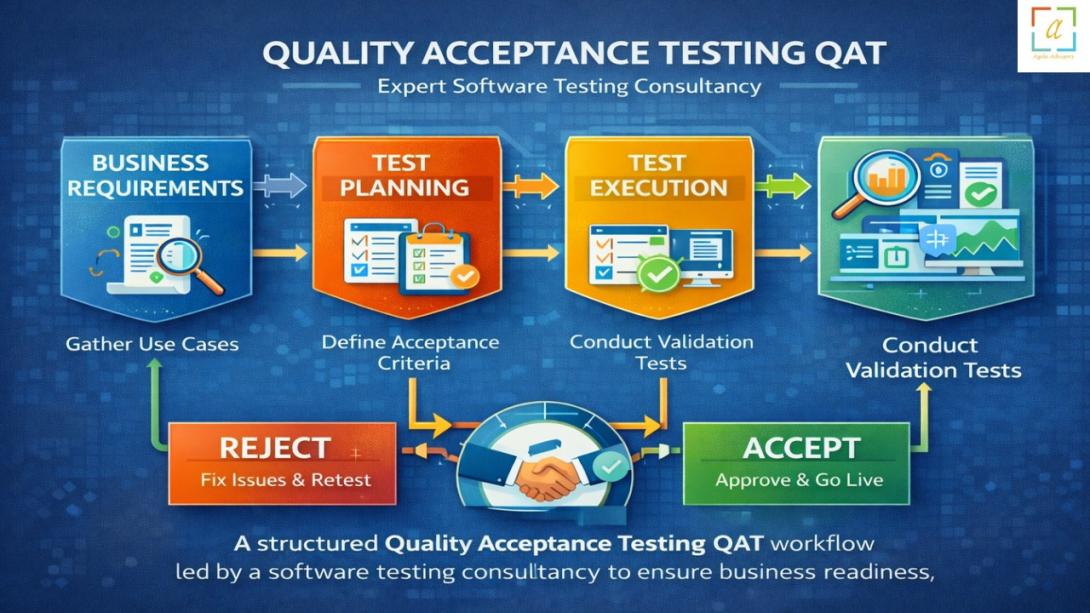
In today’s competitive digital environment, software quality is no longer optional. Businesses depend on stable, secure, and high-performing applications to serve customers and scale operations. This is where Quality Acceptance Testing (QAT), combined with a professional software testing consultancy, becomes essential. By applying structured testing frameworks, expert validation processes, and real-world acceptance criteria, organizations can confidently release software that meets both business and user expectations.
What Is Quality Acceptance Testing QAT
Quality Acceptance Testing (QAT) is the final validation stage before software is approved for release. It ensures that the application fully aligns with defined requirements, business goals, and end-user expectations. Unlike basic testing approaches, QAT focuses on real usage scenarios, acceptance criteria, and risk-based validation.
Key objectives of Quality Acceptance Testing (QAT) include
Confirming functional readiness of the application
Validating business workflows and data accuracy
Ensuring compliance with quality benchmarks
Reducing post-release defects and failures
Role of a Software Testing Consultancy
A software testing consultancy brings independent expertise, advanced tools, and industry best practices to the testing lifecycle. Rather than relying solely on internal teams, organizations gain access to specialists who understand multiple domains, technologies, and testing methodologies.
A professional software testing consultancy supports businesses by
Designing comprehensive test strategies
Executing manual and automated testing
Providing unbiased quality assessments
Optimizing testing costs and timelines
When combined with Quality Acceptance Testing (QAT), consultancy-driven testing delivers higher confidence and measurable quality outcomes.
Why Combine Quality Acceptance Testing QAT With Software Testing Consultancy
Using QAT without expert guidance can lead to gaps in coverage. Using consultancy without structured acceptance testing can miss business-critical validation. Together, they create a powerful quality framework.
Benefits of combining Quality Acceptance Testing (QAT) and software testing consultancy include
Clear acceptance criteria aligned with business needs
Early detection of high risk defects
Improved stakeholder confidence
Faster and smoother go-live decisions
Industries That Benefit From QAT and Software Testing Consultancy
This combined approach is ideal for
Enterprise software platforms
Banking and financial applications
Healthcare and insurance systems
Ecommerce and digital marketplaces
Government and regulatory-driven solutions
Any organization where reliability, security, and performance are critical can benefit from structured Quality Acceptance Testing (QAT) supported by a software testing consultancy.
Choosing the Right Testing Partner
When selecting a software testing consultancy for Quality Acceptance Testing (QAT), organizations should consider
Experience across industries and technologies
Clear testing methodologies and reporting
Strong communication with business stakeholders
Proven track record of successful releases
The right partner acts as an extension of your team, rather than just a service provider.
Conclusion
Quality Acceptance Testing (QAT) is the foundation of confident software releases. When delivered through an experienced software testing consultancy, it ensures applications are not only functional but also aligned with real business needs. This combination minimizes risk, improves user satisfaction, and protects long-term digital investments.