
The Product Information Management (PIM) landscape continues to evolve as global enterprises seek to transform product data into a strategic business asset. QKS Group defines Product Information Management as “a platform that helps collect, integrate and centralize product data into a single source of truth and assists organizations in managing, enriching, and syndicating product information across various sales and marketing channels. The PIM platform facilitates efficient handling of product information, including descriptions, specifications, images, videos, pricing, and other relevant attributes, while ensuring consistency, accuracy, compliance, and completeness of the data.” As organizations expand digital commerce operations, PIM solutions are increasingly becoming core investments for improving data governance, operational efficiency, omni-channel readiness, and customer experience.
QKS Group’s Product Information Management market research comprises a comprehensive global assessment of leading industry vendors, focusing on product capabilities, technology differentiators, competitive positioning, and platform maturity. The research enables technology vendors to refine their product strategies, identify competitive advantages, and align offerings with evolving market expectations.
Market Dynamics and Overview
Market Definition
PIM solutions serve as centralized platforms designed to manage and maintain accurate, structured, enriched, and consistent product data across diverse enterprise systems and digital touchpoints. Beyond product catalog management, modern PIM platforms support omnichannel commerce, compliance management, digital shelf optimization, and AI-powered enrichment workflows.
Market Overview
The global Product Information Management market is experiencing rapid transformation due to digitization, cross-border e-commerce, data privacy regulations, and the rising need for unified product content delivery. Businesses require scalable and intelligent platforms to manage increasing volumes and varieties of product data across physical, digital, distribution, and marketplace channels. Market demand is driven by needs for real-time syndication, reduced manual dependencies, faster time-to-market, and agile product lifecycle management.
Modern PIM solutions are adopting cloud-native, microservices, and headless architectures with robust API-based integrations to support diverse enterprise ecosystems. Vendors are embedding AI-driven data quality engines, automated content enrichment, workflow orchestration, Digital Shelf Analytics (DSA), and compliance-ready frameworks to meet evolving regulations, including Digital Product Passports (DPP) across the EU region.
Key Product Information Management Capabilities
Centralized Master Product Repository for structured, unstructured, and multimedia product assets
Omnichannel Content Syndication to eCommerce platforms, ERPs, CRMs, PLM systems, marketplaces, and social commerce channels
Data Governance, Quality & Validation Engines powered by AI/ML-based anomaly detection and enrichment suggestions
Workflow & Collaboration Management for content teams, suppliers, and channel partners
Scalable, Cloud-Native & API-Driven Architecture with microservices, connectors, and integrations
Compliance & Standardization aligned with GS1, regional labeling regulations, and sustainability disclosures
Analytics & Digital Shelf Insights to measure product visibility, performance, and conversion
Competition Landscape and Analysis
Competitive Overview and Analysis
QKS Group’s competitive assessment evaluates leading PIM vendors across technology excellence, product capabilities, go-to-market strength, scalability, user experience, and innovation focus. Vendors are differentiated based on integration maturity, workflow automation, extensibility, metadata management, AI adoption, analytics, and industry-specific customizations.
Factors and Technology Differentiators
Key differentiating areas include:
AI-powered data automation and enrichment
Real-time syndication and connectors
Industry-ready domain and taxonomy templates
Cloud-native extensibility and low-code configurability
Marketplace and retail media integrations
Embedded analytics and DSA capabilities
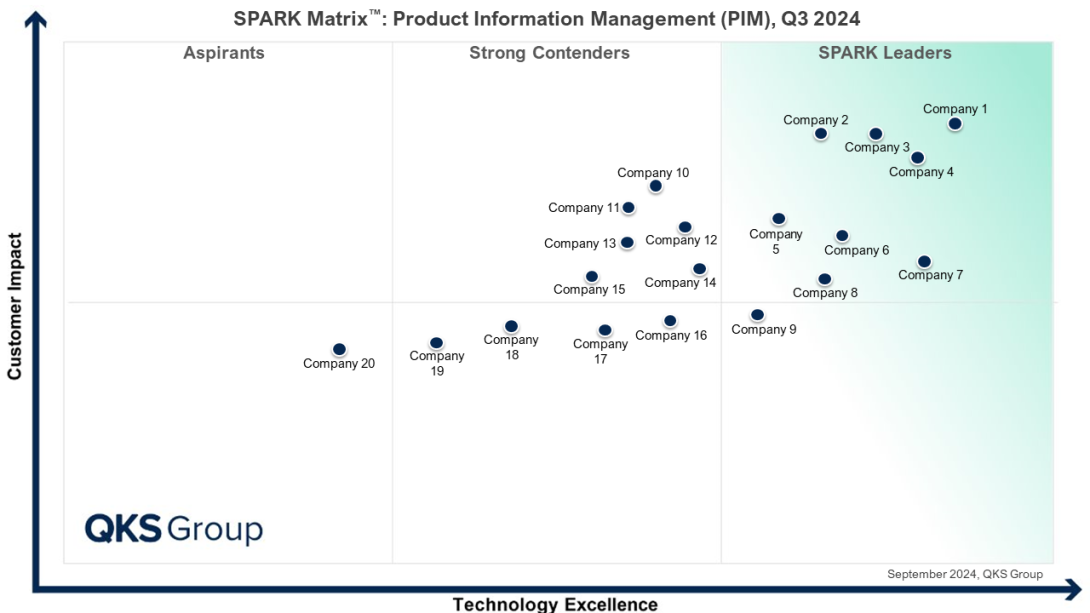
SPARK Matrix™: Product Information Management, Q3 2024
QKS Group’s proprietary SPARK Matrix™ presents a graphical competitive analysis, ranking, and positioning of global PIM vendors based on technology excellence and customer impact. The 2024 SPARK Matrix™ includes evaluation of leading solution providers such as Akeneo, Bluestone PIM, Censhare, Contentserv, IBM, Informatica, inriver, Netcore Unbxd, Pimberly, Pimcore, Plytix, Precisely, Productsup, Sales Layer, Salsify, Stibo Systems, Syndigo, TrueCommerce, Viamedici, and Vinculum Solutions.
Vendor Profiles
The research includes comprehensive vendor profiles highlighting market positioning, product strengths, deployment models, partnership ecosystems, customer segments, and future-roadmap vision. Each vendor assessment offers actionable insights for product leaders, CIOs, and decision-makers exploring PIM investments.