

"Executive Summary Plant-based Food Colors Market :

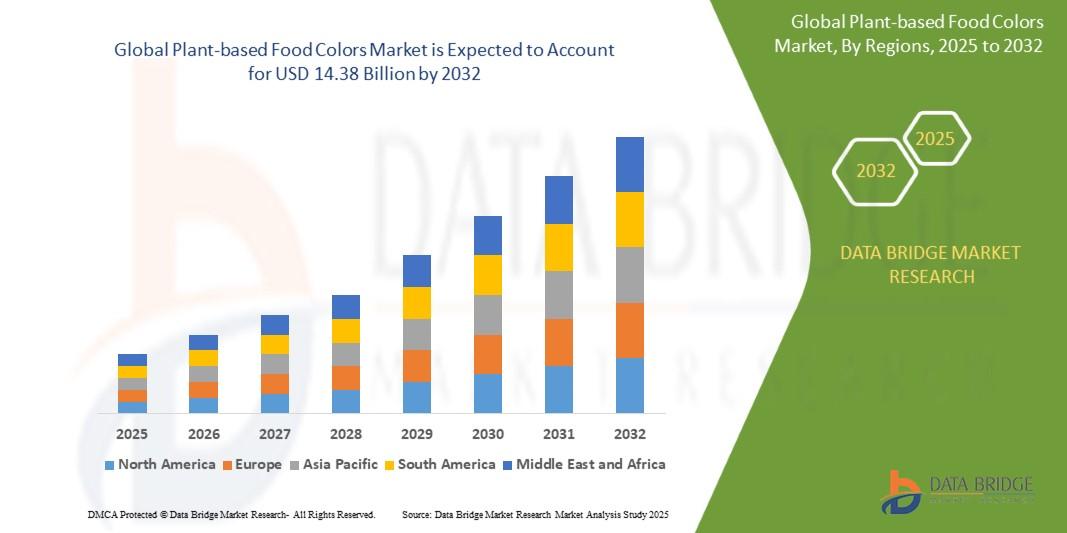
The global plant-based food colors market size was valued at USD 9.37 billion in 2024 and is projected to reach USD 14.38 billion by 2032, with a CAGR of 5.50% during the forecast period of 2025 to 2032
Plant-based Food Colors Market report provides the market potential for each geographical region based on the growth rate, macroeconomic parameters, consumer buying patterns, and market demand and supply scenarios. The report focuses on the top players in North America, Europe, Asia-Pacific, South America, and Middle East & Africa. Plant-based Food Colors Market document delivers an extensive research on the current conditions of the industry, potential of the market in the present and the future prospects from various points of views. The numerical and statistical data has been denoted in the graphical format for a clear understanding of facts and figures.
The analysis covered in the global Plant-based Food Colors Market report gives an assessment of various segments that are relied upon to witness the quickest development amid the approximated forecast frame. The market study encompasses a market attractiveness analysis, wherein each segment is benchmarked based on its market size, growth rate, and general attractiveness. All the information, facts, and statistics covered in the report lead to actionable ideas, improved decision-making and better deciding business strategies. Plant-based Food Colors Market report contains historic data, present market trends, environment, technological innovation, upcoming technologies and the technical progress in the related industry.
Discover the latest trends, growth opportunities, and strategic insights in our comprehensive Plant-based Food Colors Market report. Download Full Report: https://www.databridgemarketresearch.com/reports/global-plant-based-food-colors-market
Plant-based Food Colors Market Overview
**Segments**
- By Type
- Carotenoids
- Anthocyanins
- Chlorophyll
- Curcumin
- Spirulina Extracts
- Others
- By Form
- Liquid
- Powder
- By Application
- Beverages
- Dairy Products
- Bakery & Confectionery
- Oils
- Spices & Seasonings
- Others
The global plant-based food colors market is segmented based on type, form, and application. In terms of type, the market can be divided into carotenoids, anthocyanins, chlorophyll, curcumin, spirulina extracts, and others. Carotenoids are natural pigments responsible for the red, orange, and yellow colors in many fruits and vegetables. Anthocyanins are plant pigments that give red, blue, and purple hues to foods. Chlorophyll provides the green color found in leafy greens, and curcumin is a bright yellow pigment from turmeric. Spirulina extracts offer a natural blue color option. The market segments based on form include liquid and powder, while applications encompass beverages, dairy products, bakery & confectionery, oils, spices & seasonings, and others.
**Market Players**
- Chr. Hansen Holding A/S
- Naturex (Givaudan)
- Archer Daniels Midland Company
- Symrise
- Sensient Technologies Corporation
- D.D. Williamson & Co., Inc.
- Dohler
- FMC Corporation
- BASF SE
- Kalsec Inc.
- ROHA Dyechem Pvt. Ltd.
- Other Key Players
Key players in the global plant-based food colors market include Chr. Hansen Holding A/S, Naturex (Givaudan), Archer Daniels Midland Company, Symrise, Sensient Technologies Corporation, D.D. Williamson & Co., Inc., Dohler, FMC Corporation, BASF SE, Kalsec Inc., ROHA Dyechem Pvt. Ltd., and other significant market participants. These companies are actively involved in developing innovative plant-based food color solutions to cater to the growing demand for natural and clean-label ingredients in the food and beverage industry. Through strategic initiatives such as mergers and acquisitions, product launches, collaborations, and expansions, these market players aim to strengthen their market position and capitalize on emerging opportunities in the plant-based food color sector.
https://www.databridgemarketresearch.com/reports/global-plant-based-foo… Plant-based food colors have gained significant traction in the food and beverage industry due to the increasing consumer demand for natural and clean-label products. One of the key trends in the market is the shift towards plant-based alternatives to synthetic food colors, driven by rising health consciousness among consumers and their preference for products free from artificial additives. This trend is particularly prominent in developed regions such as North America and Europe, where stricter regulations on food additives have prompted manufacturers to explore natural color alternatives.
Another noteworthy development in the plant-based food colors market is the growing adoption of advanced extraction technologies to enhance the quality and stability of colorants derived from plant sources. Techniques such as supercritical fluid extraction, membrane filtration, and enzymatic extraction are being increasingly utilized to extract pigments efficiently while maintaining their nutritional profile and color stability. This focus on technological advancements is aimed at addressing the challenges associated with plant-based colorants, such as limited stability and susceptibility to degradation under varying pH and temperature conditions.
Moreover, the plant-based food colors market is witnessing a surge in product innovations aimed at expanding the application scope of natural colorants in various food and beverage products. Manufacturers are investing in research and development to introduce new plant-based color solutions that offer vibrant hues, improved solubility, and longer shelf life. Apart from traditional applications in beverages, dairy products, and bakery items, plant-based food colors are finding new avenues in health supplements, plant-based meat alternatives, and functional foods targeting specific consumer preferences such as organic, vegan, and gluten-free.
Furthermore, sustainability and ethical sourcing practices are emerging as key differentiators for companies operating in the plant-based food colors market. Consumers are increasingly concerned about the environmental impact and social responsibility of food manufacturers, leading to a growing demand for plant-based colorants sourced from sustainable agricultural practices. Market players are emphasizing transparency in their supply chains, ensuring traceability of raw materials, and promoting fair trade practices to align with the evolving sustainability trends in the food industry.
Overall, the global plant-based food colors market is poised for significant growth opportunities driven by the increasing consumer inclination towards natural ingredients, regulatory support for clean-label products, technological advancements in extraction methods, and a shift towards sustainable practices in food production. Market players are expected to focus on product differentiation, quality assurance, and strategic partnerships to capitalize on these trends and establish a competitive edge in the evolving landscape of plant-based food colors.The global plant-based food colors market is witnessing a paradigm shift towards natural and clean-label ingredients driven by the increasing consumer demand for healthier food products. This growing trend is fueled by factors such as health consciousness, concerns over synthetic additives, and regulatory pressures for clean-label formulations. Manufacturers are responding to this demand by leveraging plant-based colorants such as carotenoids, anthocyanins, chlorophyll, curcumin, spirulina extracts, and others to cater to consumer preferences for vibrant, natural hues in food and beverages.
Key market players are actively engaging in strategic initiatives to capitalize on the burgeoning opportunities in the plant-based food colors market. Through investments in research and development, mergers and acquisitions, and collaborations, companies are focusing on expanding their product portfolios, enhancing their technological capabilities, and strengthening their market presence. These efforts are geared towards meeting the evolving needs of consumers for sustainable, ethically sourced, and high-quality plant-based color solutions across diverse applications in the food and beverage industry.
One of the significant trends shaping the plant-based food colors market is the increasing adoption of advanced extraction technologies to improve the quality and stability of colorants derived from plant sources. Techniques such as supercritical fluid extraction and enzymatic extraction are being employed to enhance the efficiency and consistency of color extraction, addressing challenges related to stability and color degradation. This technological innovation is crucial in enabling manufacturers to meet the stringent quality standards and regulatory requirements associated with natural color additives.
Moreover, sustainability and ethical sourcing practices are becoming paramount considerations for consumers, prompting market players to integrate transparency and traceability into their supply chains. Companies are increasingly focusing on sustainable agricultural practices, fair trade sourcing, and environmental responsibility to align with consumer preferences for eco-friendly and socially responsible products. By emphasizing sustainability, market players are not only meeting regulatory expectations but also gaining a competitive advantage by differentiating their offerings in an increasingly crowded market.
In conclusion, the global plant-based food colors market is poised for substantial growth driven by the convergence of consumer demand for natural ingredients, regulatory support for clean-label products, technological advancements in extraction methods, and a growing emphasis on sustainability. Market players will need to continue innovating, collaborating, and differentiating their products to capitalize on these trends and maintain a competitive edge in a dynamic and evolving market landscape.
The Plant-based Food Colors Market is highly fragmented, featuring intense competition among both global and regional players striving for market share. To explore how global trends are shaping the future of the top 10 companies in the keyword market.
Learn More Now: https://www.databridgemarketresearch.com/reports/global-plant-based-food-colors-market/companies
DBMR Nucleus: Powering Insights, Strategy & Growth
DBMR Nucleus is a dynamic, AI-powered business intelligence platform designed to revolutionize the way organizations access and interpret market data. Developed by Data Bridge Market Research, Nucleus integrates cutting-edge analytics with intuitive dashboards to deliver real-time insights across industries. From tracking market trends and competitive landscapes to uncovering growth opportunities, the platform enables strategic decision-making backed by data-driven evidence. Whether you're a startup or an enterprise, DBMR Nucleus equips you with the tools to stay ahead of the curve and fuel long-term success.
What insights readers can gather from the Plant-based Food Colors Market report?
- Learn the behavior pattern of every Plant-based Food Colors Market -product launches, expansions, collaborations and acquisitions in the market currently.
- Examine and study the progress outlook of the global Plant-based Food Colors Market landscape, which includes, revenue, production & consumption and historical & forecast.
- Understand important drivers, restraints, opportunities and trends (DROT Analysis).
- Important trends, such as carbon footprint, R&D developments, prototype technologies, and globalization.
Browse More Reports:
Global Thunnus Market
Global Surgical Robots Market
Global Surface Mount Technology (SMT) Equipment Market
Global Sports Graphics Market
Global Spinal Muscular Atrophy (SMA) Treatment Market
Global Sodium Malate Market
Global Self-Adhesive Labels Market
Global Protective Relay Market
Global Popping Boba/Juice Balls Market
Global Passwordless Authentication Market
Global Panuveitis Treatment Market
Global Organic Biogas Market
Global Off-Grid Solar PV Panels Market
Global Magnetic Levitation Market
Global Key Management Market
Global High Barrier Packaging Films Market
Global Hematology Drugs Market
Global Healthcare Analytical Testing Services Market
Global Gynandroblastoma Market
Global Geosynthetic Clay Liner Market
About Data Bridge Market Research:
An absolute way to forecast what the future holds is to comprehend the trend today!
Data Bridge Market Research set forth itself as an unconventional and neoteric market research and consulting firm with an unparalleled level of resilience and integrated approaches. We are determined to unearth the best market opportunities and foster efficient information for your business to thrive in the market. Data Bridge endeavors to provide appropriate solutions to the complex business challenges and initiates an effortless decision-making process. Data Bridge is an aftermath of sheer wisdom and experience which was formulated and framed in the year 2015 in Pune.
Contact Us:
Data Bridge Market Research
US: +1 614 591 3140
UK: +44 845 154 9652
APAC : +653 1251 975
Email:- corporatesales@databridgemarketresearch.com
Tag
Plant-based Food Colors Market Size, Plant-based Food Colors Market Share, Plant-based Food Colors Market Trend, Plant-based Food Colors Market Analysis, Plant-based Food Colors Market Report, Plant-based Food Colors Market Growth, Latest Developments in Plant-based Food Colors Market, Plant-based Food Colors Market Industry Analysis, Plant-based Food Colors Market Key Player, Plant-based Food Colors Market Demand Analysis"