

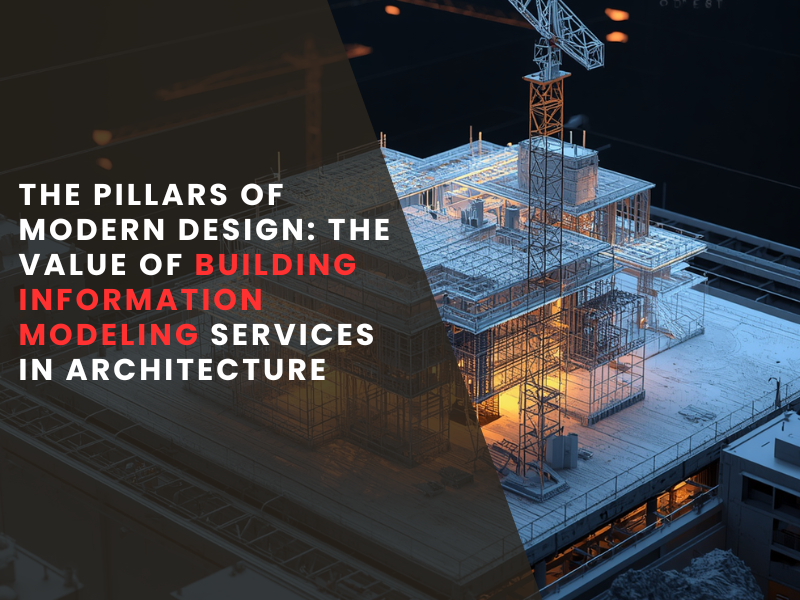
The architectural landscape is undergoing a massive transformation. Building Information Modeling is getting better, and the expectations placed on modern architectural firms are higher than ever before. As commercial, residential, and infrastructure projects grow increasingly complicated, the days of relying on isolated 2D drafting workflows are ending.
Architecture, engineering, and construction (AEC) professionals need systems that can handle a massive amount of data. They need workflows that make it easier for multidisciplinary teams to work together, automate repetitive documentation tasks, and help get projects finalized faster without sacrificing quality.
This is exactly why adopting comprehensive Building Information Modeling Services is no longer just a technological upgrade, it is a fundamental requirement for survival and growth in the modern AEC industry.
The industry is rapidly shifting toward:
- Intelligent, data-rich 3D workflows
- Cloud-connected, real-time collaboration
- Data-driven project management and lifecycle tracking
- Automated clash detection and resolution
- Faster digital construction delivery
Modern architectural projects involve many people working together simultaneously. Architects, structural engineers, mechanical engineers, contractors, and facility managers all need to communicate flawlessly to make sure projects are done correctly, within budget, and strictly on time.
This is where specialized BIM Consulting Services make a difference. By integrating highly detailed virtual models before a single physical brick is laid, firms can eliminate the workflow friction that traditionally slows down project delivery.
Moving Beyond the Blueprint: The Digital Shift in Architecture
For decades, the standard deliverable in architecture was the 2D blueprint. While effective for basic visualization, 2D drawings are fundamentally disconnected. A change made in a floor plan does not automatically update the section view, the elevation, or the material schedule.
This siloed approach creates massive vulnerabilities. When structural engineers update steel framing without instantly notifying the architectural team, clashes occur. When MEP (Mechanical, Electrical, and Plumbing) contractors design complex ductwork using outdated architectural backgrounds, the result is costly rework on the construction site.
Transitioning to 3D BIM Modeling Services solves this disconnect. A BIM model is not just a 3D picture; it is a dynamic, data-rich database. Every wall, door, pipe, and beam contains critical metadata, dimensions, material properties, load-bearing capacities, and cost codes.
When a professional utilizes a dedicated BIM Service, they are moving away from passive drawings into active digital prototyping. If an architect moves a window in a 3D model, the associated floor plans, elevations, sections, and window schedules update instantly and automatically. This parametric intelligence is what separates true BIM from basic 3D CAD.
Did You Know?
Recent industry data highlights a massive acceleration in digital technology deployment. Over 65% of construction and architectural firms now report a measurable business impact from active digital collaboration tools, with early adopters saving upwards of 500 to 1,000 production hours annually by eliminating manual documentation updates.
The Three Pillars of Value in BIM Services
The true value of BIM cannot be measured by a single feature. It is realized through a combination of workflow enhancements that target the most common frustrations in the architectural process.
These enhancements can be categorized into three core pillars: Efficiency, Accuracy, and Collaboration.
Ready to Scale Your Virtual Design & Construction Capabilities?
Maximize your project delivery speed while significantly reducing overhead. Deploy an agile production team specializing in multi-disciplinary modeling, clash detection, and high-maturity documentation by exploring our comprehensive BIM Services.
Pillar 1: Unmatched Efficiency in the Project Lifecycle
Time is the most valuable commodity in any architectural project. Unfortunately, traditional workflows consume massive amounts of time on repetitive, non-design tasks.
Architects and draftspersons frequently spend hours:
- Searching for discrepancies across multiple 2D sheets
- Manually updating door and window schedules
- Generating new section views for every minor design revision
- Coordinating information between disjointed disciplines
Leveraging professional BIM Drafting Services fundamentally changes this dynamic. Because the 3D model acts as a single source of truth, the time required to generate construction documentation is drastically reduced.
Instead of drawing a section view line by line, the software generates it directly from the 3D geometry. This means architectural teams can spend less time managing paperwork and more time focusing on high-level design and spatial optimization.
Furthermore, utilizing outsourced BIM Design Services allows firms to scale their production capacity instantly. Rather than overburdening in-house staff with tedious modeling tasks during a deadline crunch, firms can rely on external experts to push the model forward.
Pillar 2: Pinpoint Accuracy and Pre-Construction Clash Detection
One of the most expensive phrases in the construction industry is "rework." When a structural steel beam intersects with a critical HVAC duct on the job site, the project grinds to a halt. RFIs (Requests for Information) are filed, schedules are delayed, and budgets inflate.
This is where Pre-construction BIM Services provide unparalleled ROI. By building the entire project virtually before physical construction begins, BIM teams can perform rigorous, automated clash detection.
Using advanced software like Autodesk Navisworks or Revit, a BIM coordinator can overlay the architectural model with the structural and MEP models. The software automatically highlights "hard clashes" (where two objects occupy the same physical space) and "soft clashes" (where an object violates the required clearance space of another).
Instead of discovering a pipe running through a steel column on the construction site, the design team sees it on their screen months in advance. They can reroute the pipe digitally, at zero cost, ensuring that the final construction documentation is flawlessly coordinated.
To achieve this level of precision, firms heavily rely on Revit BIM Services. The continuous evolution of this software makes it easier to handle complex geometry and massive data sets. For those looking to understand where the technology is heading, exploring Revit 2027: Everything New Architects and BIM Professionals Need to Know highlights how smarter automation and AI-assisted processes are making exactness in modeling faster than ever.
Pillar 3: Seamless Collaboration Across Disciplines
Projects are no longer handled by a single office working on local servers. Even mid-sized projects are often distributed, with teams working from various locations across the globe.
The software and workflows must allow architects, structural consultants, MEP engineers, and contractors to communicate seamlessly throughout the project lifecycle.
Without a unified model, coordination becomes a nightmare of email chains, outdated file versions, and mismatched data. Professional BIM Engineering Services establish a Collaborative Data Environment (CDE). This cloud-based hub ensures that every stakeholder is working from the absolute latest version of the model.
If the structural team increases the depth of a floor slab, the architectural team sees the update in real-time. If the mechanical engineer resizes an air handling unit, the spatial requirements are instantly reflected. This level of transparency eliminates the finger-pointing and communication breakdowns that plague traditional construction methods.
By utilizing experienced BIM Service Providers, architectural firms can ensure that their models are set up correctly from day one, with strict naming conventions, organized worksets, and optimized file sizes that prevent the software from crashing under the weight of multidisciplinary data.
Handling Complex Projects: The Need for Advanced Modeling
While small residential projects might scrape by with basic 3D tools, large-scale commercial developments, high-rise towers, and complex healthcare facilities absolutely demand high-level 3D BIM Services.
Once projects reach a certain scale, software limitations and workflow bottlenecks become highly visible. Teams start dealing with:
- Extremely heavy central files that take minutes to save
- Slow navigation and viewport lagging
- Coordination bottlenecks between dozens of linked models
- Massive, difficult-to-manage documentation packages
Handling these enterprise-scale challenges requires specific expertise in Revit Modeling Services. The model must be logically broken down into manageable pieces. Worksets must be meticulously managed so that users are not loading unnecessary structural steel elements when they only need to detail an interior partition.
This is where partnering with a firm that specializes in BIM Outsourcing Services becomes a strategic advantage. It allows architectural practices to maintain their focus on creative design and client management, while a dedicated team of technical experts handles the heavy lifting of model management, data input, and schedule extraction.
Did You Know?
In large construction projects valued over $50 million, approximately 80% of major contractors now mandate the use of high-LOD (Level of Development) BIM models. This ensures that the transition from architectural design to structural detailing and MEP fabrication is completely seamless.
Optimizing Documentation Through Revit Drafting Services
In most architectural projects, creating the initial 3D model is only the beginning. The majority of production time is actually spent generating, formatting, and refining the 2D documentation required for permitting and construction.
Managing these massive documentation sets can be exhausting. Teams must constantly organize sheets, adjust annotation tags, refine detail references, and ensure that every schedule matches the physical model perfectly.
High-quality Revit Drafting Services take the pain out of this phase. Because the views are intrinsically linked to the model, the drafting process becomes a verification exercise rather than a manual drawing exercise.
When a door type is changed from a single swing to a double swing, the change is instantly reflected in the floor plan, the door schedule, the interior elevations, and the material takeoff. This interconnected workflow means that quality control takes a fraction of the time, resulting in higher profit margins and drastically reduced stress for the architectural team.
Recognizing the Broader Importance of BIM in the AEC Sector
The three pillars, Efficiency, Accuracy, and Collaboration—are transforming how individual projects are executed. However, to truly grasp the monumental shift occurring in the industry, one must look at the larger ecosystem.
BIM is not just a tool for generating drawings; it is becoming a comprehensive lifecycle management system. The data embedded in these models during the architectural phase will eventually be used by contractors for 4D scheduling (time) and 5D estimating (cost). After construction, that same data is handed over to facility managers to operate the building for decades to come.
Understanding this macro perspective is crucial for any firm looking to scale their operations and win larger bids. For a deeper dive into how this technology is fundamentally rewriting the rules of the industry, reading about the broader Importance of Building Information Modeling in Architectural Industry provides essential context for modern design professionals.
Architectural firms that fail to recognize this shift will find themselves increasingly marginalized, unable to compete with the speed, accuracy, and cost-effectiveness of their BIM-enabled competitors.
Overcoming the Learning Curve
Despite the obvious benefits, transitioning to a fully optimized BIM environment is not without its challenges. The software requires a steep learning curve, and hardware requirements for managing complex 3D environments are significant.
Furthermore, creating custom families, setting up highly organized project templates, and establishing strict CAD/BIM standards takes hundreds of hours of non-billable setup time.
This is why many forward-thinking firms are moving away from trying to build massive in-house BIM departments from scratch. Instead, they leverage external BIM Modeling Services to instantly bridge the skills gap. By collaborating with specialized partners, architects can immediately offer world-class, data-rich modeling to their clients without the overhead of recruiting, training, and retaining specialized technical staff.
Conclusion
The architectural industry is evolving at a breakneck pace, driven by the demand for smarter, faster, and more sustainable construction. Building Information Modeling is no longer an experimental technology, it is the foundational language of modern design.
By embracing the core pillars of efficiency, accuracy, and collaboration, architectural firms can transcend the limitations of traditional 2D drafting. Utilizing robust Building Information Modeling Services allows teams to eliminate costly construction errors through clash detection, automate exhausting documentation workflows, and maintain a seamless, single source of truth across all engineering disciplines.
The transition to a fully digital, 3D workflow requires investment and adaptation, but the return on investment is undeniable. In a highly competitive landscape, the firms that build their foundations on intelligent, data-driven modeling will be the ones that shape the skylines of the future.