

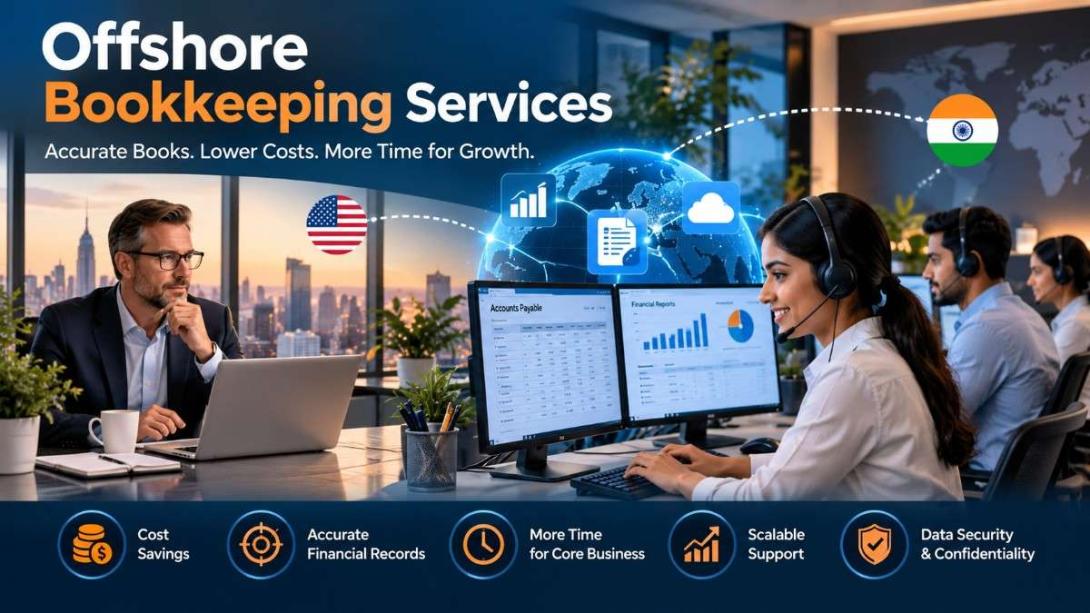
For CFOs, controllers, and finance executives, bookkeeping is more than recording transactions. Accurate books support financial reporting, cash-flow visibility, tax preparation, budgeting, and better business decisions. As transaction volumes increase, many U.S. companies are exploring offshore bookkeeping services to create a more scalable and efficient finance operation.
Rather than expanding an internal team for every routine accounting function, businesses can work with specialized offshore professionals to manage defined bookkeeping processes under established workflows and controls.
What Are Offshore Bookkeeping Services?
Offshore bookkeeping services involve outsourcing bookkeeping and related accounting tasks to a professional team located outside the company's home country. For U.S. businesses, these services can support day-to-day financial operations while the internal finance team retains oversight of critical financial decisions.
Typical outsourced bookkeeping activities may include:
- General ledger maintenance
- Accounts payable and accounts receivable support
- Bank and credit card reconciliations
- Invoice and payment processing
- Transaction categorization
- Financial data entry
- Month-end closing support
- Management reporting assistance
- Bookkeeping cleanup and catch-up
- Documentation and accounting records management
Why U.S. Companies Are Evaluating Offshore Bookkeeping
For senior management, the conversation is increasingly about finance scalability, process efficiency, and resource allocation rather than simply outsourcing routine work.
An offshore bookkeeping model can provide additional operational capacity when transaction volumes grow, new locations are added, or finance teams need support during month-end and year-end cycles.
It can also allow internal accountants, controllers, and CFOs to spend more time on activities such as financial analysis, forecasting, budgeting, cash-flow management, and strategic planning.
The CFO Perspective: More Than a Cost Discussion
While cost is often considered when evaluating offshore bookkeeping, experienced finance leaders typically look at the broader operating model.
Important considerations include:
Process standardization: Clearly documented bookkeeping procedures can create more consistent workflows.
Scalability: Businesses can adjust support based on transaction volume and operational requirements.
Finance-team capacity: Routine work can be delegated while senior finance professionals concentrate on higher-value responsibilities.
Reporting readiness: Well-maintained accounting records can support timely management reporting and financial analysis.
Operational flexibility: Outsourced teams can provide additional resources during periods of increased workload.
Choosing the Right Offshore Bookkeeping Partner
Not every outsourcing provider follows the same processes. U.S. businesses should evaluate factors such as accounting expertise, data-security practices, communication processes, quality controls, technology compatibility, reporting procedures, and the provider's experience supporting similar business operations.
A successful outsourcing relationship should also establish clear responsibilities between the company's internal finance team and the offshore provider. Defined workflows, approval controls, escalation procedures, and performance expectations can help create accountability.
How iRapidO Supports Finance Back-Office Operations
iRapidO provides finance and accounting back-office support for businesses seeking additional operational capacity. Its outsourcing approach can support bookkeeping and related finance processes through structured workflows and dedicated operational assistance.
For organizations considering offshore bookkeeping services, the objective should be to build a reliable extension of the finance function—not simply transfer repetitive tasks to another location.
Final Thoughts
Offshore bookkeeping services can be part of a broader finance transformation strategy for U.S. businesses looking to improve scalability, streamline routine accounting processes, and allow internal finance leaders to focus on strategic priorities.
With the right governance, technology, communication, and quality controls, an offshore bookkeeping model can become an extension of a company's finance operation. iRapidO helps businesses explore scalable finance and accounting back-office support aligned with their operational requirements.