
QKS Group’s latest Network Observability market research provides a comprehensive and data-driven evaluation of the evolving global market landscape, focusing on the convergence of AI-driven analytics, hybrid infrastructure monitoring, telemetry correlation, and real-time automated insights. As organizations accelerate digital transformation, embrace distributed architectures, and shift workloads across hybrid and multi-cloud environments, network infrastructure complexity continues to rise. Traditional monitoring approaches that rely purely on reactive alerting no longer meet enterprise needs. Instead, modern businesses require complete end-to-end network observability, enabling contextual analysis, predictive intelligence, and automated remediation that align business outcomes with network performance. This report is designed to guide technology vendors in shaping product strategy, platform innovation, and competitive differentiation, as well as help buyers assess capabilities, deployment models, and future-readiness.
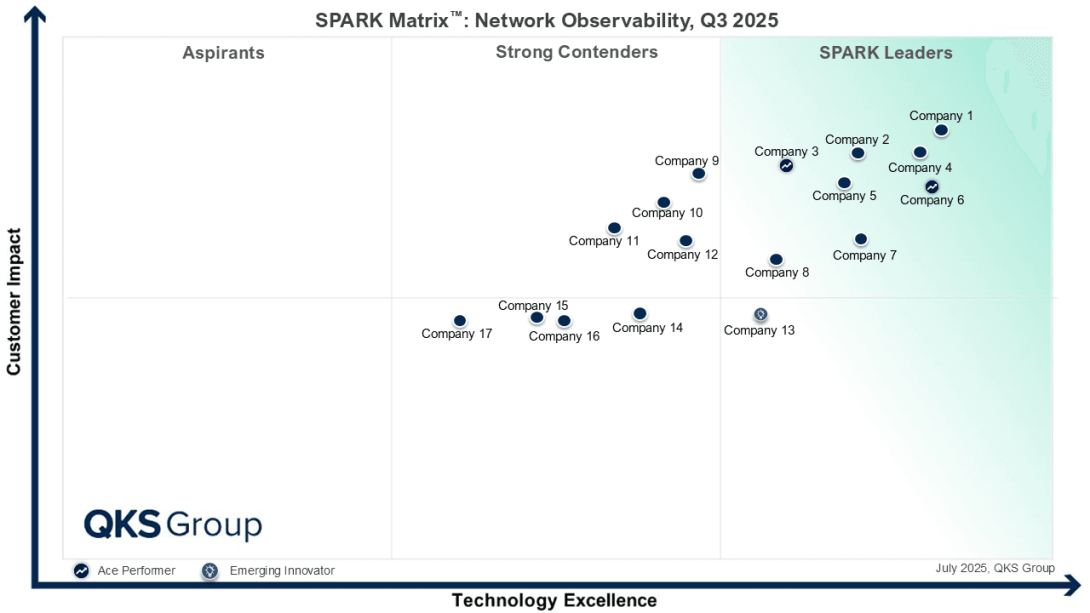
A key component of this study includes the proprietary SPARK Matrix, which evaluates and ranks leading vendors based on technology excellence and customer impact. The assessment offers a holistic comparison and positioning of global vendors including Arista Networks Inc., Aviz Networks, Broadcom Inc., Cisco, Ericsson, HPE Aruba Networking, InfoVista, Kentik, LiveAction - A BlueCat Company, LogicMonitor, ManageEngine, NETSCOUT, Progress, RADCOM, Riverbed Technology, SolarWinds, and Viavi Solutions Inc. The SPARK Matrix provides clarity for decision-makers on vendor maturity, ecosystem strength, innovation focus, scalability, automation capability, and value delivery model.
Key Findings
The research highlights that the demand for real-time, AI-assisted, and automation-enabled network observability platforms is expanding rapidly, driven primarily by cloud-native adoption, remote workforce enablement, edge computing deployments, SD-WAN modernization, and zero-trust security frameworks. Enterprises are shifting from component-level monitoring to outcome-based, correlated insights, enabling both proactive incident prevention and faster resolution. Another significant finding is that advanced vendors are investing in telemetry enrichment, self-healing automation, anomaly prediction, and integrated observability pipelines designed for scale, interoperability, and autonomous operations.
The report also emphasizes the importance of unified visibility across physical, virtual, multi-cloud, SaaS, IoT, and 5G environments. As stated, “Vendors that can correlate telemetry across hybrid environments, enable real-time anomaly detection, and support AIOps-driven automation are gaining a competitive edge.” This marks a definitive shift from monitoring to intelligent, autonomous observability ecosystems, creating new innovation opportunities across data analytics, machine learning, and security-driven network insights.
SPARK Image
The SPARK Matrix visual positioning model provides a detailed quadrant-style graphical representation showcasing where each vendor stands relative to its competitors. Vendors are mapped based on innovation leadership, market penetration, execution capability, and overall business value. The graphic helps both enterprise buyers and decision-makers quickly evaluate strategic fit, technology maturity, and future alignment.
Vendor Profiles
Each vendor profile provides a detailed analysis that includes:
Company overview & product positioning
Platform architecture & feature maturity
AI, ML, and automation capabilities
Deployment models and scalability strengths
Security, interoperability, and ecosystem partnerships
Market reach, customer success evidence & pricing flexibility
These profiles enable enterprises to evaluate vendor differentiation in areas such as data depth, analytics quality, visualization, real-time performance monitoring, and integration with DevOps, SecOps, and AIOps frameworks.
Market Definition & Capabilities
Network Observability is defined as the ability to continuously collect, correlate, analyze, visualize, and act on network telemetry data across distributed, hybrid environments. Core capabilities include packet-level inspection, streaming telemetry ingestion, flow-aware analytics, anomaly prediction, drill-down root-cause analysis, and automation workflows. Modern observability platforms also leverage open APIs, federated data models, cloud-native design, and agentless data capture to support scale and interoperability.
Evaluation Criteria
Vendor assessment includes:
Platform architecture & openness
Data correlation depth & AI intelligence
Automation maturity & closed-loop capabilities
User experience, modularity, & scalability
Support, pricing model, & enterprise value delivery
Research Methodologies
QKS Group adopts a blended research approach involving primary interviews, platform demonstrations, technical benchmarking, industry data modeling, and competitive scoring. This ensures both qualitative and quantitative validation, producing a reliable and neutral market view for stakeholders.