

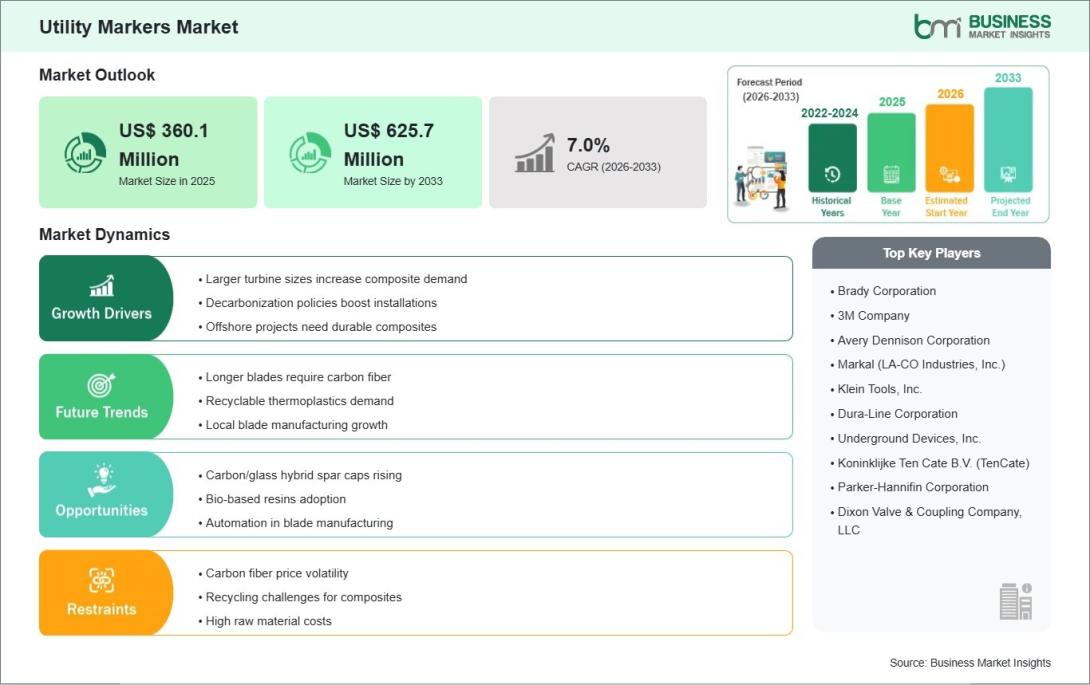
The global civil infrastructure protection and subsurface asset management landscape is experiencing powerful upward momentum, fundamentally supported by an industry-wide transition toward intelligent tracking solutions to mitigate accidental utility strikes, reduce liabilities, and streamline subterranean mapping workflows.
Business Market Insights forecasts that the global Utility Markers Market value will surge to US$ 0.62 billion by 2033 from its 2025 baseline of US$ 0.36 billion, progressing at a steady CAGR of 7.0% over the 2026–2033 forecast period.
Technological advancement is transforming the market, with manufacturers focusing on modern architectures that integrate RFID and Geographic Information Systems (GIS) capabilities directly into the markers. These efficiency upgrades allow for precise 3D localization and digital data storage, significantly reducing the time required for asset identification. This ecosystem collaboration between marker manufacturers and software developers is creating highly integrated, smart utility networks that support rapid urban development and minimize costly service disruptions.
Download Sample Report : https://www.businessmarketinsights.com/sample//BMIPUB00035723
What Is A Utility Marker?
A utility marker is a physical or electronic identification device deployed either above or below ground to precisely indicate the location, depth, and type of buried infrastructure. Operating through passive visual cues, electromagnetic resonance, or radio-frequency identification (RFID), its fundamental purpose is to serve as a reliable reference point for construction crews and utility operators, preventing accidental strikes on critical pipelines, cables, and conduits.
The technology offers immense operational flexibility, with configurations ranging from simple surface warning tapes and flags to highly advanced electronic marker balls and disks. Modern electronic markers are designed to handle complex environments, consisting of passive antennas tuned to specific frequencies that reflect signals sent by above-ground locators. They can withstand extreme soil conditions, moisture, and temperature fluctuations, ensuring long-term asset visibility without requiring internal power sources.
Market Drivers
A primary driver of the Utility Markers Market is the massive expansion of underground utility networks driven by rapid urbanization and smart city initiatives. The commercial scale of deploying new water pipelines, 5G fiber-optic cables, and decentralized power grids requires a corresponding volume of markers to map and secure these assets, fueling sustained demand from both municipal and private sector network operators.
The technological evolution of electronic and RFID markers acts as the second major driver. As utility management transitions from manual record-keeping to digital mapping, the ability of smart markers to store asset-specific data—such as installation dates, utility types, and maintenance history—provides significant cost-reduction benefits by accelerating future excavation processes and reducing diagnostic errors.
Furthermore, stringent regulatory and safety compliance mandates are accelerating modernization and fleet renewal cycles. Governments and occupational safety agencies worldwide are strictly enforcing "Call Before You Dig" protocols and mandatory marking standards to prevent catastrophic gas leaks or power outages, compelling contractors to invest heavily in reliable, compliant marking solutions.
Market Segmentation
By Product Type
- Marker Balls and Disks: Engineered with internal passive antennas for deep underground deployment, these are ideal for precise point marking of critical junctions, valves, and splices in varied soil environments.
- Underground Warning Tape: Highly visible, durable polymer strips buried directly above utility lines to provide early visual warning to excavation machinery before the actual asset is reached.
- Marker Posts and Signs: Highly visible surface-level indicators utilized primarily in rural or long-distance pipeline routes to provide continuous alignment reference for ground crews.
By Detection Technology
- Electronic/RFID Marking: Offers advanced digital identification by reflecting tuned electromagnetic signals and transmitting stored asset data, highly utilized in complex, congested urban infrastructure.
- Magnetic/Resonance Detection: Relies on tuned circuits that resonate at specific frequencies corresponding to the utility type, providing highly reliable detection regardless of ground conditions.
- Passive Visual Marking: Non-electronic solutions dependent on standard color-coding protocols to identify the utility type visually upon unearthing.
The Marker Balls and Disks segment held the dominant market share in 2025 due to its extensive use in critical infrastructure mapping. However, the Electronic/RFID Marking segment is projected to register the highest growth rate during the forecast period as digital asset management becomes an industry standard.
Regional Insights
- North America remains the dominant market, supported by robust regulatory frameworks regarding excavation safety, extensive legacy infrastructure modernization, and a mature industrial base.
- Europe maintains a significant market share through stringent environmental regulations, regional directives prioritizing underground grid expansions, and a strong focus on operational safety.
- Asia-Pacific represents the highest growth region, fueled by rapid industrialization, massive urban infrastructure expansion, and booming telecommunications and power sectors across emerging economies.
- Middle East & Africa is a key area for large-scale greenfield construction and water distribution network development projects.
- South & Central America is experiencing steady adoption as regional utilities modernize their operational systems to reduce accidental service outages.
Top Players in the Utility Markers Market
The competitive landscape is characterized by global engineering and technology firms focused on innovation, scalability, and geographic expansion.
- 3M Company
- Tempo Communications, Inc.
- Komplex
- Hexatronic Group AB
- Radiodetection Ltd.
- Rycom Instruments, Inc.
- Seton (Brady Corporation)
- Berntsen International, Inc.
- National Marker Company
- Dura-Line Corporation
Leading players are actively investing in R&D to develop advanced materials, digital integrations, and performance optimization to secure long-term contracts and market position.
Technological Innovations
Digitization and IoT/sensor integrations are rapidly transforming utility markers from simple locators into active nodes of smart infrastructure. The integration of high-capacity RFID microchips allows markers to interface directly with cloud-based Geographic Information Systems (GIS), enabling field workers to instantly access and update digital blueprints via mobile devices during excavation.
Material science breakthroughs are optimizing performance in harsh underground environments. Next-generation polymer casings and advanced resin formulations ensure that buried electronic markers are entirely impervious to corrosive soils, acidic groundwaters, and extreme thermal cycling, guaranteeing operational lifespans that match or exceed the utilities they mark.
Environmental compliance and sustainability trends are also shaping modern design. Manufacturers are increasingly utilizing recycled plastics and eco-friendly manufacturing processes to produce marker tapes and posts, aligning with the green procurement policies adopted by major global utility operators and municipalities.
Future Market Outlook
The future outlook for the Utility Markers Market is highly optimistic, linking sustained demand directly to global modernization goals and data-intensive infrastructure expansion through 2033. The ongoing global rollout of 5G networks, decentralized renewable energy grids, and smart water management systems will require unprecedented volumes of accurate, reliable utility marking solutions.
Market leadership in the coming decade will be defined by operational agility, technical versatility, and cost efficiency. Companies that can seamlessly bridge the gap between physical marking hardware and digital asset management software, providing end-to-end mapping solutions, will command a decisive competitive advantage in the evolving infrastructure ecosystem.
Frequently Asked Questions (FAQs)
What is the projected size of the Utility Markers Market by 2033?
The market is projected to reach US$ 625.7 Million by 2033, rising from US$ 360.1 Million in 2025.
What is the CAGR for the Utility Markers Market?
The market is expected to grow at a CAGR of 7.0% from 2026 to 2033.
Which segment is essential or dominant?
The Marker Balls and Disks segment held the dominant market share in 2025 due to their critical role in precise point marking for complex underground environments.
Which region is expected to grow the fastest?
Asia-Pacific is projected to exhibit the fastest growth, driven by rapid industrial expansion and infrastructure development.
What is the primary factor driving demand?
The massive expansion of underground utility networks driven by urbanization and smart city initiatives is the primary factor accelerating market demand.
Browse More Reports:
https://www.businessmarketinsights.com/reports/specialty-advanced-ceramics-market
https://www.businessmarketinsights.com/reports/specialty-tapes-market
https://www.businessmarketinsights.com/reports/sprayed-concrete-market
About Us
Business Market Insights is a market research platform that provides subscription service for industry and company reports. Our research team has extensive professional expertise in domains such as Electronics & Semiconductor; Aerospace & Defense; Automotive & Transportation; Energy & Power; Healthcare; Manufacturing & Construction; Food & Beverages; Chemicals & Materials; and Technology, Media, & Telecommunications.
Contact Us
If you have any questions about this report or would like further information, please contact us:
Contact person: Ankit Mathur
Email: sales@businessmarketinsights.com
Phone: +16467917070