
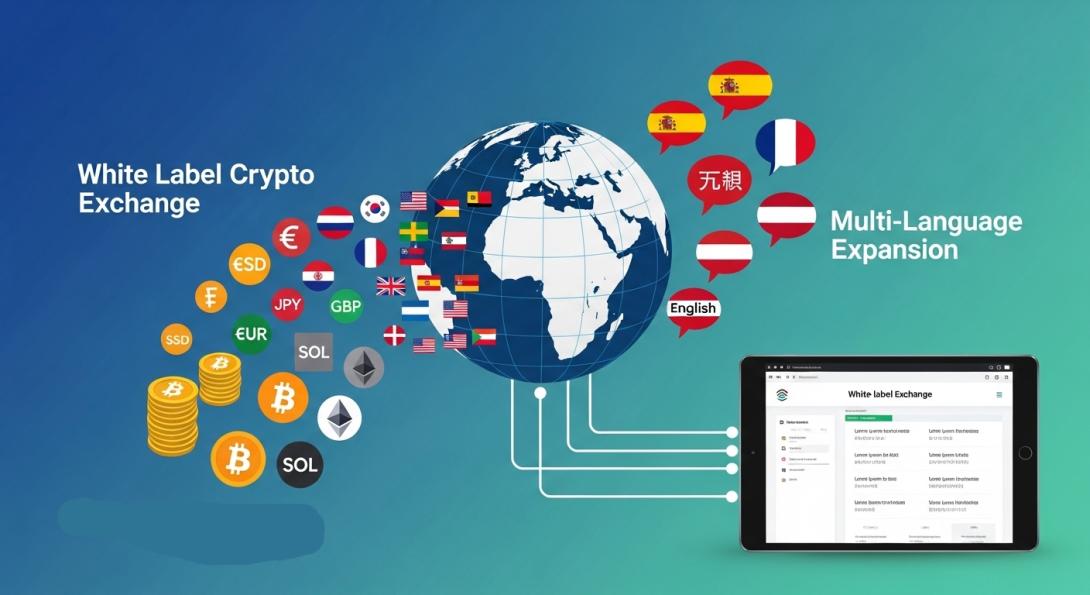
As cryptocurrency adoption spreads across borders, exchanges are no longer local or regional products. Users now expect seamless access to digital asset trading regardless of geography, language, or currency. For businesses entering or expanding in global crypto markets, the ability to support multiple currencies and languages is no longer a value-added feature—it is a competitive requirement.
However, building a globally accessible crypto exchange from scratch is operationally complex. Currency conversion logic, localized interfaces, regional payment systems, regulatory variation, and multilingual customer support all introduce layers of technical and operational difficulty. For many organizations, especially those without large internal blockchain and infrastructure teams, this complexity can delay expansion or derail growth entirely.
White Label Crypto Exchanges have emerged as a practical and scalable solution to this challenge. By providing pre-built infrastructure designed for internationalization, white label platforms allow businesses to expand across regions efficiently while minimizing technical risk and cost.
Why Global Expansion Demands Built-In Localization Capabilities
The global nature of crypto trading
- Cryptocurrency markets operate 24/7 across borders
- Users trade from different countries using local currencies
- Language accessibility directly impacts trust and adoption
- Payment preferences vary widely by region
The challenge of building global-ready platforms
- Multi-currency accounting is technically complex
- Language localization affects UI, UX, and compliance flows
- Payment integrations differ by country
- Regulatory rules vary across jurisdictions
Why white label platforms simplify expansion
- Localization features are built into the core platform
- Currency and language modules are pre-tested
- Regional scaling does not require rebuilding infrastructure
These capabilities make white label platforms an ideal foundation for international growth when supported by a reliable White Label Crypto Exchange Development Company
Understanding Multi-Currency and Multi-Language Requirements in Crypto Exchanges
Expanding into global markets requires more than translating text or adding new currency symbols. It involves deep system-level capabilities that must function reliably at scale.
What multi-currency support really means
A multi-currency crypto exchange must handle:
- Multiple fiat currencies alongside cryptocurrencies
- Real-time exchange rate conversions
- Accurate accounting and reporting per currency
- Region-specific pricing and fee structures
White Label Crypto Exchange Development addresses these needs at the platform level.
What multi-language support truly involves
Language support impacts:
- User interfaces and dashboards
- Onboarding and KYC flows
- Transaction notifications and emails
- Customer support and help documentation
White Label Crypto Exchange Platform development integrates localization frameworks that allow consistent experiences across languages.
What Is a White Label Crypto Exchange Platform?
A White Label Crypto Exchange Platform is a ready-made trading system built by specialized providers and licensed to businesses under their own branding. The platform includes core trading, wallet management, compliance tools, and administrative controls, all designed to be configurable for different regions and user groups.
Key components relevant to global expansion
- Multi-currency wallet infrastructure
- Localized user interfaces
- Configurable compliance rules
- API-driven integrations
- Scalable backend architecture
Through White Label Cryptocurrency Exchange solutions, businesses avoid building localization features from scratch.
How White Label Platforms Enable Multi-Currency Trading at Scale
Unified wallet architecture for multiple currencies
White label platforms use unified wallet systems that support:
- Multiple fiat currencies
- Multiple blockchain-based assets
- Automated balance reconciliation
- Currency-specific transaction histories
This abstraction simplifies financial operations for businesses.
Real-time currency conversion and pricing
White Label Crypto Exchange software development includes:
- Live exchange rate feeds
- Automated conversion logic
- Transparent pricing displays
Users can trade confidently using familiar local currencies.
Fiat On-Ramps and Off-Ramps for Global Users
Importance of local payment methods
Users prefer region-specific payment options such as:
- Bank transfers
- Card payments
- Local payment gateways
White Label Crypto Exchange Platform development integrates multiple fiat rails to support this diversity.
Managing settlement across currencies
White label platforms handle:
- Currency-specific settlement cycles
- Fee calculation per region
- Automated reporting
This reduces operational complexity for exchange operators.
Supporting Multi-Language Interfaces Without Rebuilding UX
Language frameworks built into white label platforms
White label platforms include:
- Language packs
- Locale-aware formatting
- Right-to-left and left-to-right support
This allows quick rollout of new languages.
Consistent user experience across languages
White Label Crypto Exchange Development ensures:
- Identical functionality across regions
- Unified design standards
- Centralized content management
Businesses avoid fragmented user experiences.
Localization Beyond Translation
Cultural and regulatory localization
True localization includes:
- Region-specific compliance messaging
- Local risk disclosures
- Market-appropriate terminology
White Label Crypto Exchange Development Services support these adaptations without code rewrites.
Time zones and regional settings
White label platforms manage:
- Time zone displays
- Regional date and number formats
- Localized notifications
These details enhance user trust and usability.
Regulatory and Compliance Alignment Across Regions
Multi-region compliance support
White label platforms allow configuration for:
- Different KYC thresholds
- AML monitoring rules
- Reporting requirements
This is essential for global operations.
Reducing regulatory friction
White Label Crypto Exchange Development Services often include:
- Integration with global identity providers
- Transaction monitoring tools
- Audit-friendly reporting
This simplifies expansion into regulated markets.
Liquidity Management Across Currencies and Regions
Aggregated liquidity pools
White label exchanges connect to:
- Global liquidity aggregators
- Market makers
- External exchanges
This ensures consistent liquidity across trading pairs.
Managing regional demand differences
White Label Crypto Exchange Platform development supports:
- Region-specific asset listings
- Pair prioritization
- Dynamic fee adjustments
This flexibility improves market depth.
Security Consistency Across Global Operations
Unified security architecture
White label platforms apply consistent security standards across regions, including:
- Cold storage asset custody
- Multi-signature authorization
- Encrypted user data
This avoids regional security gaps.
Centralized monitoring and incident response
Providers manage:
- Threat detection
- Vulnerability patching
- Infrastructure upgrades
This centralized approach strengthens global security posture.
Scaling Infrastructure for Global User Growth
Built-in scalability
White Label Crypto Exchange Platform development focuses on:
- Horizontal scaling
- Load balancing
- High availability
This ensures stable performance as new regions are added.
Handling traffic spikes across time zones
Global platforms experience continuous activity. White label systems are designed for:
- 24/7 operation
- Regional traffic surges
- Market volatility
This resilience is critical for international success.
Step-by-Step Roadmap for Multi-Currency and Multi-Language Expansion
Step 1: Define target regions
- Identify priority markets
- Analyze currency and language needs
- Assess regulatory considerations
Step 2: Select a globally capable provider
Evaluate White Label Crypto Exchange Development Company offerings based on:
- Localization features
- Payment integrations
- Compliance flexibility
Step 3: Configure currencies and languages
- Enable supported fiat and crypto assets
- Activate language packs
- Customize regional settings
Step 4: Integrate local services
- Payment gateways
- Identity verification providers
- Customer support tools
Step 5: Test region-specific workflows
- Onboarding flows
- Currency conversions
- Reporting accuracy
Use Cases: Businesses Expanding Globally with White Label Platforms
Startups entering international markets
Startups use White Label Crypto Exchange Development to expand beyond their home markets without rebuilding infrastructure.
Fintech firms offering global trading
Fintech companies leverage White Label Crypto Exchange Platform development to support users across multiple regions.
Brokers serving international clients
Brokers adopt White Label Cryptocurrency Exchange solutions to offer localized trading experiences.
Enterprises launching regional platforms
Large organizations use White Label Crypto Exchange software development to deploy region-specific platforms efficiently.
Customization Without Fragmentation
Configurable regional features
White label platforms allow:
- Region-based feature toggles
- Currency-specific fees
- Language-specific messaging
Maintaining a unified core system
This approach ensures:
- Easier maintenance
- Faster updates
- Lower technical risk
White Label Crypto Exchange Platform development balances flexibility with stability.
Cost Efficiency of White Label Expansion
Cost challenges of custom global platforms
Building multi-currency, multi-language systems internally requires:
- Separate development efforts
- Dedicated regional teams
- High ongoing maintenance costs
White label cost advantages
White Label Crypto Exchange Development Services provide:
- Shared infrastructure costs
- Predictable pricing
- Lower operational overhead
This makes global expansion financially viable.
Common Challenges and How White Label Platforms Address Them
- Currency reconciliation errors mitigated by automated systems
- Inconsistent translations avoided through centralized language management
- Regulatory misalignment reduced via configurable compliance rules
- Performance issues addressed by scalable infrastructure
These benefits accelerate international growth.
Choosing the Right White Label Crypto Exchange Development Company
Global expansion evaluation checklist
When selecting a White Label Crypto Exchange Development Company and its White Label Crypto Exchange Development Services, businesses should assess:
- Multi-currency wallet support
- Language localization frameworks
- Regional compliance configurability
- Payment gateway integrations
- Scalability and uptime guarantees
- Ongoing support and upgrades
- Transparent pricing structures
The right partner enables smooth international expansion.
Long-Term Growth Through White Label Platforms
Continuous regional expansion
White label providers regularly add:
- New currency integrations
- Additional language support
- Enhanced localization features
This supports ongoing growth.
Future-proof architecture
White Label Crypto Exchange software development ensures platforms remain adaptable as markets evolve.
Conclusion: Scaling Globally with Confidence Using White Label Exchanges
Why white label platforms enable global reach
- Built-in multi-currency capabilities
- Seamless multi-language user experiences
- Centralized security and compliance
- Scalable infrastructure for international growth
Strategic advantages for expanding businesses
- Faster expansion through White Label Crypto Exchange Development
- Flexible regional deployment using White Label Crypto Exchange Platform development
- Reliable performance supported by White Label Crypto Exchange software development
- Expert guidance from White Label Crypto Exchange Development Services
- Sustainable growth through partnership with a trusted White Label Crypto Exchange Development Company
For businesses aiming to expand into global crypto markets, White Label Crypto Exchanges provide a proven, efficient, and scalable foundation. By removing the technical and operational barriers associated with multi-currency and multi-language support, white label platforms empower organizations to focus on growth, customer acquisition, and long-term market leadership.