
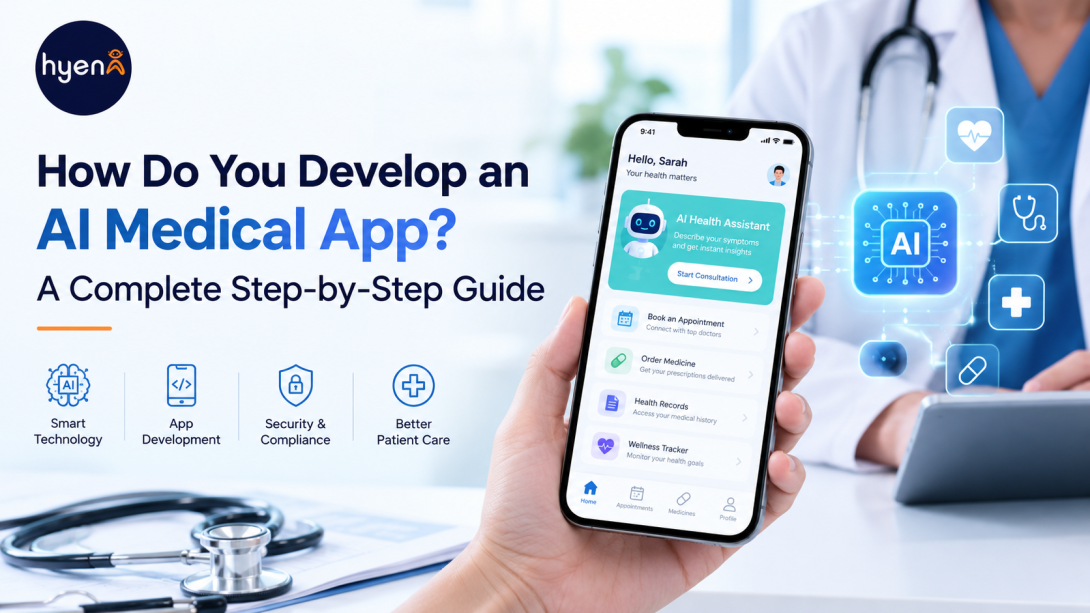
Creating an AI medical app consists of defining a healthcare problem, deciding on the AI tech, developing secure features, and testing the app with medical experts. For businesses interested in AI App Development, it is important to evaluate the tech, understand compliance and regulations, and estimate the Cost to Develop a Healthcare App before making an investment.
Healthcare apps have the potential to go beyond scheduling and storing appointments and records. They can facilitate virtual consultations, provide reminders and prompts to take medication, and assess symptoms and provide other user-specific health insights. With the right development strategy, businesses can build innovative and valuable apps that improve patient care, increase provider efficiency and enhance overall health outcomes.
What is an AI Medical App?
Apps that utilize artificial intelligence, machine learning, natural language processing, or computer vision, in order to assist in performing specific tasks in the field of healthcare, are considered AI medical apps. A few examples can include an app to assist patients in organizing their symptoms to take with them to a consultation or an app to assist clinicians in interpreting a set of medical images.
The resources offered by the FDA on AI-enabled medical devices show how the FDA encourages the use of AI in medical imaging and other areas of medicine. However, generating medical advice or other suggestions through an AI app should not be relied upon to replace a clinician's professional judgment. Clinical applications of AI need to be validated appropriately.
How to Develop an AI Medical App: Step-by-Step
Step 1: Identify Your Healthcare Use Case
Start by deciding what problem your app will solve. Trying to build every healthcare feature at once can increase costs and make the product difficult to manage.
Consider these potential use cases:
- AI symptom checker: Helps users organize symptoms and understand when to seek medical care.
- Virtual healthcare app: Connects patients with doctors through video consultations.
- Medicine delivery app: Supports prescription uploads, pharmacy orders, and delivery tracking.
- Remote patient monitoring: Helps track selected health measurements through connected devices.
- Medical documentation assistant: Helps clinicians summarize consultations and organize notes.
Choose one primary use case, validate it with potential users, and expand only when the core experience works well.
Step 2: Research the Market and Plan Features
Study competing applications, patient expectations, and existing healthcare workflows. If you're planning a medicine delivery platform, examine the ordering process, prescription verification, pharmacy integrations, payment options, and delivery management.
For example, a patient ordering prescribed medication should be able to upload a valid prescription, receive confirmation from the pharmacy, and track the order without unnecessary steps.
This is also the stage to evaluate the MedLife app development cost as a market research benchmark. The actual budget for a comparable application depends on its features, integrations, technology, and operational requirements.
Step 3: Choose the Right AI Technology
Your technology stack should match the problem rather than follow a trend.
Machine learning can identify patterns in suitable datasets, natural language processing can help interpret clinical text, and computer vision can analyze medical images for validated use cases.
Generative AI can also support conversational interfaces and clinical documentation. Still, it can produce inaccurate information. Use reliable clinical sources, appropriate safeguards, human review, and clear limitations wherever patient care may be affected.
Step 4: Design and Develop the Application
Work with an experienced mobile development company to create a secure, accessible, and easy-to-use application.
The development process generally includes:
- Designing patient and healthcare professional interfaces.
- Building the backend, APIs, and database.
- Integrating the selected AI models.
- Connecting electronic health records or third-party healthcare services where required.
- Implementing secure authentication, access controls, and audit logs.
- Testing the app across supported devices.
iOS Development and Android development should account for accessibility, performance, and consistent user experiences. Hyena Information Technologies can be considered as a technology partner for planning and building custom AI-powered mobile applications.
Step 5: Protect Patient Data and Meet Compliance Requirements
Healthcare applications handle sensitive information, so security cannot be an afterthought. Apply encryption, role-based access, secure data storage, consent management, and appropriate data-retention policies.
Depending on the market and intended use, requirements may include HIPAA in the United States, GDPR in applicable European contexts, or India's Digital Personal Data Protection framework. Apps that perform regulated medical functions may also require medical-device regulatory review.
Step 6: Test, Launch, and Improve
Before launch, test usability, security, AI accuracy, bias, and performance using representative data. Involve qualified healthcare professionals in evaluating clinical features.
After release, monitor errors, user feedback, model performance, and security issues. Establish a process for updates and human intervention when the AI produces uncertain or potentially harmful results.
What Is the Cost to Develop a Healthcare App?
The Cost to Develop a Healthcare App depends on the application's complexity, AI capabilities, platform choices, and compliance needs.
A basic healthcare app may cost less than a platform with advanced AI, electronic health record integrations, remote monitoring, and clinical validation. Similarly, the Cost To Develop Online Medicine Delivery App varies according to pharmacy integrations, prescription workflows, logistics, and payment systems.
For an initial estimate, define your minimum viable product (MVP), list essential features, and request a detailed project breakdown from your development partner. This approach makes budgeting more realistic and reduces the risk of expensive scope changes.
Why Choose Hyena Information Technologies?
Hyena Information Technologies helps businesses explore mobile application development and AI-powered digital solutions. A structured development approach can help healthcare startups and established providers translate an idea into a practical product, from feature planning and UI/UX design to implementation and testing.
The priority should be building a solution that addresses a genuine healthcare need, protects patient information, and can evolve as requirements change.
Final Thoughts
Developing an AI medical app requires more than adding an AI chatbot to a mobile interface. It calls for careful planning, appropriate technology, healthcare expertise, security, and continuous evaluation. Start with a clearly defined use case, validate the product, and scale responsibly.
Book an executive AI briefing to explore AI use cases for your business.