

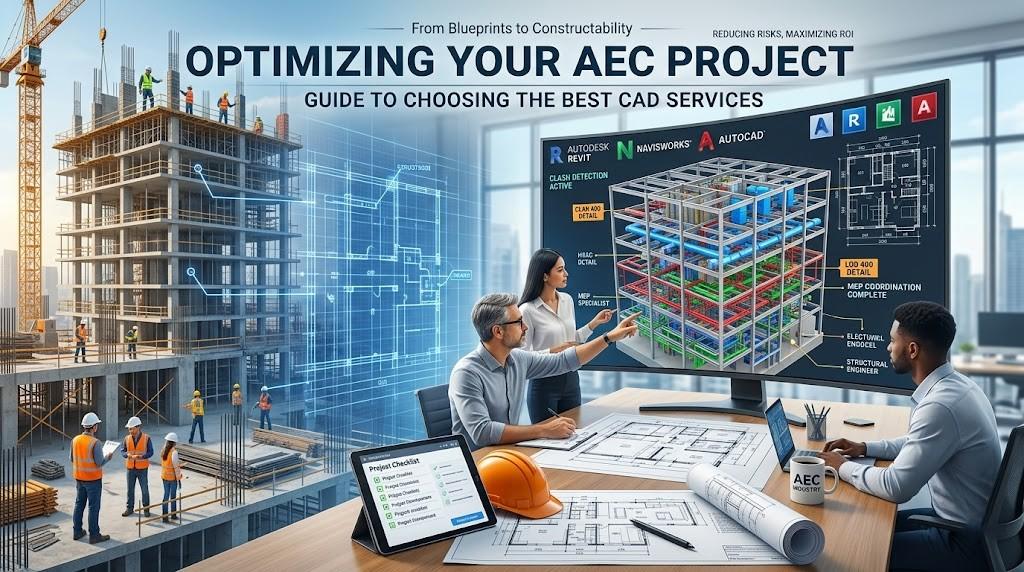
Let’s be honest: in the architecture, engineering, and construction (AEC) industry, the margin for error is practically zero. A single misaligned duct or an overlooked clash in your structural steel framework can lead to massive delays, skyrocketing rework costs, and incredibly stressful site meetings.
At the heart of a smooth, clash-free construction project lies the quality of your documentation. The drafting phase is where concepts meet constructability, and choosing the right partner to handle this phase is one of the most critical decisions a project manager or lead architect will make.
Today, a growing number of firms are realizing that maintaining a massive in-house drafting team for fluctuating project loads isn't always sustainable. This has led to a massive rise in CAD Outsourcing. But here is the catch: not all CAD partners are created equal. Finding a team that acts as a true extension of your own—rather than just an order-taker—requires a strategic approach.
If you are gearing up for a new build and wondering how to vet the countless providers out there, grab your coffee. We are going to walk through a comprehensive guide on exactly how to choose the best CAD Services for your next construction project, ensuring your budget stays intact and your site stays moving.
1. Define Your Project Scope and Discipline Precisely
Before you even begin Googling potential partners or sending out Requests for Proposals (RFPs), you need to have a rock-solid understanding of what you actually need. "We need CAD work" is too broad. The AEC industry is highly specialized, and your partner needs to be, too.
Ask yourself and your team the following questions:
- Are we talking 2D or 3D? Do you strictly need traditional 2D CAD Drafting for floor plans, elevations, and permit sets? Or does the complexity of your project demand advanced 3D CAD Modeling to visualize spatial relationships and run clash detection?
- What is the specific discipline? This is a crucial area where many firms make a misstep. Drafting disciplines are distinct languages. The team that excels at Structural Steel Detailing is not necessarily the team you want handling your MEP (Mechanical, Electrical, and Plumbing) layouts. A reliable partner will understand this technical distinction and assign specialized draftsmen to specific disciplines rather than using a "jack-of-all-trades" approach.
- What is the required Level of Development (LOD)? Are you at the conceptual design phase requiring LOD 100 or 200, or are you moving into the construction documentation phase requiring highly detailed, fabrication-ready models at LOD 400?
By clearly defining your scope, you immediately filter out providers who lack the specific expertise your project demands.
2. Evaluate Technical Expertise and Software Proficiency
Once you know what you need, it's time to evaluate the technical chops of your potential partners. A beautiful portfolio is nice, but you need to know how they build their files.
Software Ecosystems The AEC world runs on specific software ecosystems. If your firm operates entirely within Autodesk Revit, hiring a partner who strictly uses alternative software and relies on messy file conversions (like IFC exports) is going to cause a headache. Ensure the provider uses the latest, licensed versions of the software you prefer—whether that is AutoCAD, Revit, Navisworks, or specialized tools like Tekla for structural work.
Industry Standards and Codes Building codes vary wildly from region to region. A duct layout that passes code in New York might fail spectacularly in California or Sydney. The best CAD Drafting Services providers are fluent in global AEC standards. They should know the difference between AIA (American Institute of Architects) standards and RIBA (Royal Institute of British Architects) standards. Don't hesitate to ask them how they ensure compliance with local building codes during the drafting process.
3. Look for a Focus on Constructability, Not Just "Pretty Pictures"
Anyone can draw lines on a screen. The true value of expert CAD Design Services lies in constructability.
When interviewing a potential provider, ask them about their Request for Information (RFI) process. A mediocre drafter will simply trace over your redlines, even if those redlines contain a physical impossibility. An exceptional partner acts as a secondary design check. If they spot a structural beam intersecting with an HVAC run, they won’t just draw it; they will raise an RFI, propose a rerouting solution, and wait for your approval.
You want a partner who builds virtual buildings, not just digital drawings. This proactive approach to clash detection and constructability reviews is what ultimately saves you thousands of dollars in site rework.
4. Understand Their Quality Assurance (QA) and Quality Control (QC) Workflows
Quality shouldn't be an afterthought; it should be baked into the drafting process. When you outsource your CAD Drawing Services, you are trusting another entity with your firm's reputation.
Ask potential providers to walk you through their standard QA/QC checklist.
- Do they have a multi-tiered review process?
- Is the work checked by a senior engineer or a peer before it ever hits your inbox?
- How do they track revisions and handle project updates?
A reliable firm will have documented workflows that guarantee consistency. If they cannot clearly articulate their quality control process, consider that a massive red flag.
5. Assess Communication, Collaboration, and Time Zones
One of the biggest hesitations AEC firms have about CAD Outsourcing is the fear of poor communication. In a fast-paced construction project, you cannot afford to wait 24 hours for a simple question to be answered.
However, when managed correctly, time zone differences can actually be a massive advantage. Imagine sending off your redlines at 5:00 PM your time, and arriving at the office the next morning at 8:00 AM to find the revised sheets sitting in your inbox. That overnight turnaround can drastically accelerate your project timeline.
To make this work, the provider must have overlapping working hours and crystal-clear communication protocols. Establish from day one:
- Who is our primary point of contact?
- Do we use Slack, Microsoft Teams, or a specific project management dashboard?
- How frequently will we hold progress meetings?
6. The Budget Factor: Value Over "Cheap" Quotes
Let’s talk about the elephant in the room: cost. Everyone wants to save money, but in construction documentation, the cheapest hourly rate usually ends up being the most expensive option.
Drafting doesn't have to drain your budget, but you must look at the overall ROI. If Firm A charges $15 an hour but takes twice as long and requires constant hand-holding and corrections, they are costing you far more than Firm B, which charges $25 an hour but delivers flawless, clash-free drawings the first time.
Instead of hunting for the lowest bid, look for a firm that offers transparent pricing models. Do they charge hourly, per sheet, or per project? A reputable provider will review your inputs and give you a solid, realistic estimate so you can protect your margins.
If you are looking for a reliable breakdown of what high-quality drafting looks like in practice, you should definitely check out the CAD Drafting Services page over at CAD Services India. They have a fantastic overview of how technical precision and cost-effective delivery can actually go hand-in-hand.
7. Start with a Pilot Project
Never hand over a massive, multi-million dollar hospital complex as your first project with a new CAD vendor. The smartest way to vet a provider is through a pilot project.
Select a small, manageable scope of work—perhaps the MEP detailing for a single floor, or the 2D CAD Drafting for a simple residential elevation. Use this pilot to test everything:
- How quickly did they respond to your initial inquiry?
- Did they ask intelligent, clarifying questions before starting?
- Was the final output formatted correctly to your firm's specific title block and layer standards?
- How did they handle revisions?
A pilot project is a low-risk way to see if their operational rhythm matches your own.
A Must-Read Resource for Your Journey
If you want to dive even deeper into the specific metrics and questions you should be asking potential partners, I highly recommend reading this amazing guide: How to Select the Best CAD Service Provider.
It is an incredibly thorough resource that helped me solidify a lot of my own thoughts on this topic. It breaks down the nuances of vendor selection perfectly, ensuring you don't miss any blind spots before signing a contract. It's a great piece to bookmark and share with your senior team before making a final decision.
The Bottom Line
Choosing the right partner for your CAD Services is not just an administrative task; it is a strategic business decision. The right partner will not only alleviate the pressure on your internal team but will actively contribute to the profitability and success of your projects.
By taking the time to define your scope (down to the distinct disciplines), demanding technical excellence, insisting on rigorous quality control, and testing the waters with a pilot project, you can confidently build a long-term outsourcing relationship.