

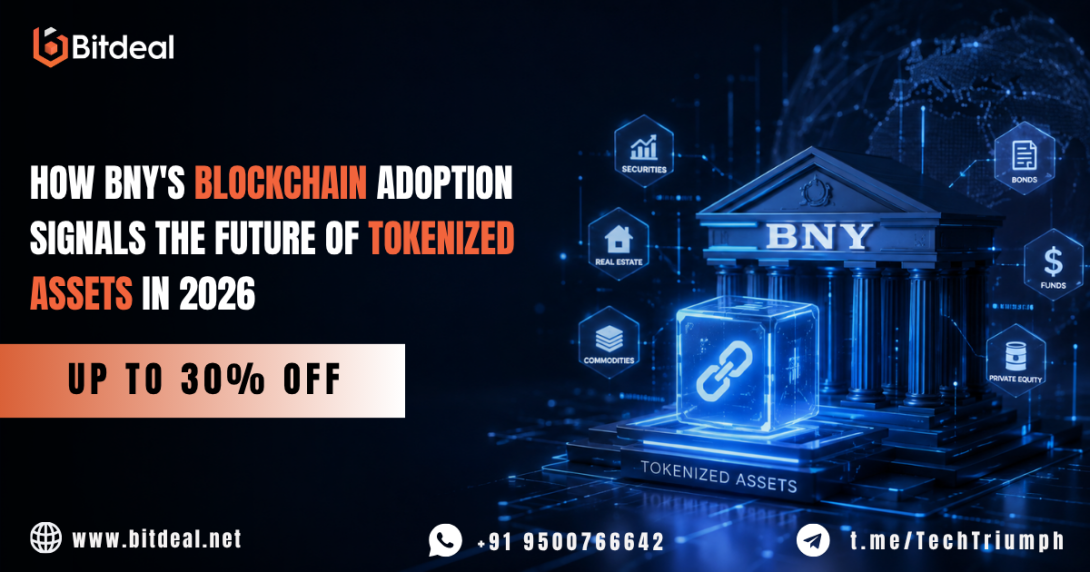
In 2026, BNY, the world's largest custodian bank, took a major step into blockchain infrastructure, rolling out tokenized deposits and later moving its core transfer agency record-keeping onto blockchain, a business that services roughly $8.6 trillion in assets. This isn't a small pilot. It's one of Wall Street's biggest institutions rebuilding core infrastructure on-chain, and it signals where tokenized assets and asset tokenization development could be headed for enterprises in 2026, a shift Bitdeal is already helping businesses prepare for.
What BNY's Move Means for Wall Street
BNY's shift to blockchain-based record-keeping creates a single on-chain ownership ledger for its transfer agency business, cutting the need for multiple parties to reconcile separate databases. Early clients include major asset managers, with tokenized fund support planned. When an institution of BNY's size adopts blockchain as core infrastructure rather than a side experiment, it signals to the rest of finance that tokenization is becoming operational, not experimental.
Why Financial Institutions Are Moving Toward Blockchain
Financial institutions are turning to blockchain and asset tokenization for clear reasons. On-chain ownership records cut the need for constant reconciliation, reducing overhead. Settlement can happen faster, sometimes near-instantly, compared to legacy processes that take days. Blockchain also supports the always-on, 24/7 operating models markets increasingly expect. BNY isn't alone either; other major banks are reportedly exploring shared, tokenized deposit networks, suggesting this is becoming an industry-wide direction.
Tokenized Assets: The Next Enterprise Opportunity
What BNY is doing with funds and deposits previews where tokenization is headed more broadly. Real-world assets, from securities and money market funds to real estate and commodities, can be represented as digital tokens with clear, verifiable ownership. For enterprises, this means faster settlement, less dependency on intermediaries, and access to markets that were harder to enter before. As more institutions validate this approach, tokenization is likely to become standard enterprise infrastructure.
How Businesses Can Prepare for Blockchain-Based Asset Systems
Businesses don't need to be a global bank to start preparing. The first step is understanding which assets or processes could benefit from tokenization, whether that's ownership records, fund management, or asset transfers. From there, it's about evaluating the right blockchain architecture (public, private, or hybrid), ensuring regulatory and compliance requirements are built in from the start, and working with partners who understand both the technical and financial sides of tokenization.
How Bitdeal Helps Businesses Build Tokenized Asset Solutions
As institutional adoption accelerates, having the right technology partner becomes just as important as the decision to tokenize. Bitdeal, a blockchain development company, helps businesses turn that decision into a secure, working solution.
Asset Tokenization Platforms
We build secure tokenization platforms that let businesses convert real-world assets, from real estate to funds, into digital tokens with clear, verifiable ownership.
Token & Smart Contract Development
We handle end-to-end token development along with secure smart contract engineering, ensuring tokenized assets are built for compliance, security, and long-term scalability.
Enterprise Blockchain Infrastructure
From security token solutions to full enterprise blockchain deployments, our team helps businesses build the underlying infrastructure needed to manage digital assets at scale.
Conclusion
BNY's blockchain adoption is more than a single bank's initiative; it's an early signal of where enterprise finance is headed. As more institutions move core infrastructure on-chain, tokenized assets are likely to become a standard part of how businesses manage ownership and value. Companies that start preparing now, with the right team like Bitdeal, will be better positioned to take advantage of this shift as it accelerates through 2026 and beyond.