
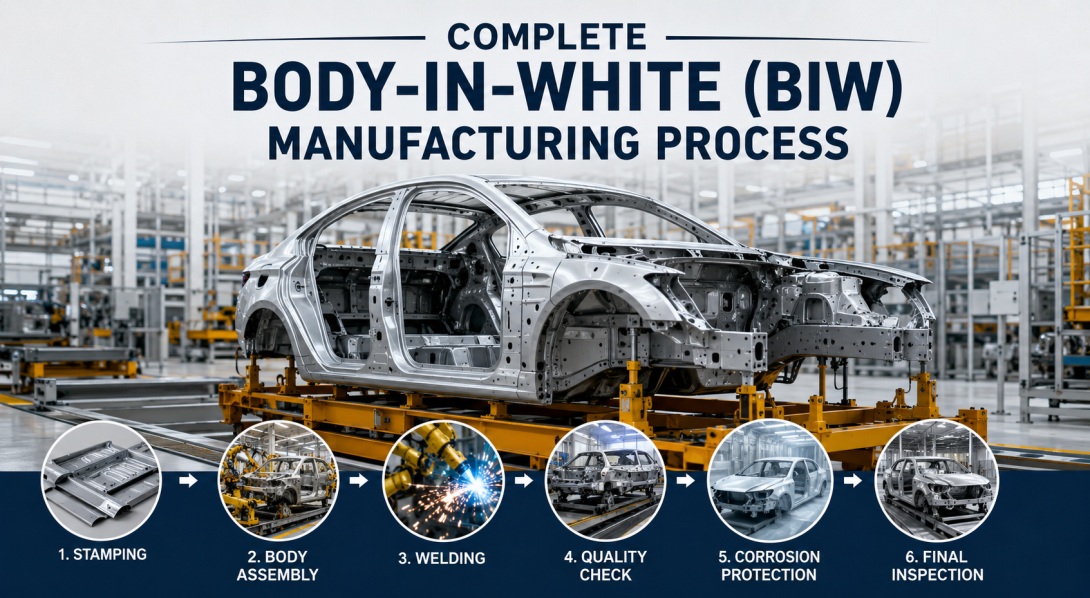
The global automotive industry is in the midst of a historic transformation. With the rapid rise of electric vehicles (EVs), increasingly strict safety standards, and demanding emission regulations, original equipment manufacturers (OEMs) are facing unprecedented manufacturing challenges. Yet, no matter how advanced a vehicle’s powertrain or software becomes, its core foundation remains the same: the physical structure that houses the passengers, supports the mechanical components, and absorbs impact energy. This foundational stage of automotive manufacturing is known as Body-in-White (BIW)—the critical phase where a car body's structural frame and sheet metal components are joined together before painting and final assembly.
In this highly specialized and competitive arena, HIROTEC stands out as an undisputed global leader. With over 90 years of engineering expertise, HIROTEC delivers premium BIW solutions, high-quality closure panels, exhaust systems, and turnkey manufacturing equipment to some of the world’s most renowned automotive brands. Operating 32 state-of-the-art facilities across 8 countries—including Japan, America, India, Germany, Mexico, Thailand, China, and Korea—and employing over 6,000 highly skilled professionals, the HIROTEC Group produces an astonishing 9 million vehicle doors annually. This article explores the engineering brilliance, advanced automation, and holistic manufacturing philosophy that solidify HIROTEC’s position at the forefront of the automotive sector.
The Critical Role of Body-in-White and Closures
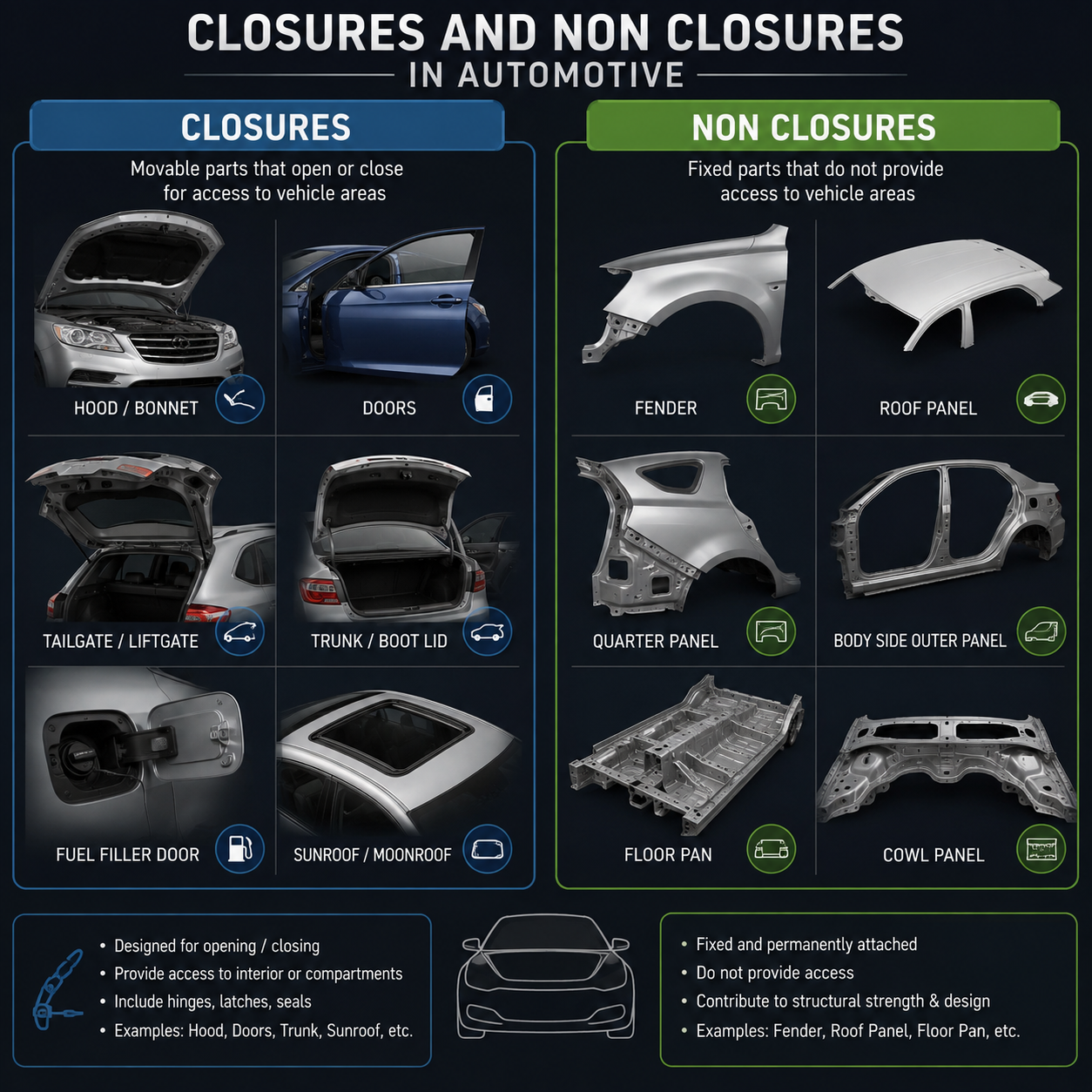
Body-in-White refers to the stage in automotive production where the vehicle's unpainted sheet metal components are welded or joined together. It is the literal skeleton of the car. Within the BIW umbrella, HIROTEC specializes in "closures." Closures encompass the moving parts of the vehicle’s exterior—specifically the doors, hoods, and liftgates (or tailgates).
Closures are notoriously difficult to manufacture because they must satisfy two seemingly contradictory requirements. First, they must be structurally robust. A vehicle door acts as a primary barrier during a side-impact collision, housing heavy intrusion beams to protect occupants. Second, closures must possess a flawless "Class A" surface finish and align perfectly with the rest of the car’s body to ensure aesthetic appeal and aerodynamic efficiency. Any microscopic deviation in a door’s alignment can lead to wind noise, water leaks, or increased drag. HIROTEC’s mastery lies in balancing these intense structural demands with absolute cosmetic perfection.
The Full Vertical Approach: A Unified Manufacturing Ecosystem
What truly differentiates HIROTEC from traditional automotive suppliers is its "Full Vertical Approach" (FVA). In conventional manufacturing, an OEM might hire one company to design a door, another to build the stamping dies, a third to design the robotic assembly line, and a fourth to actually manufacture the part. This fragmented approach inevitably leads to communication breakdowns, engineering delays, and quality control issues.
HIROTEC completely eliminates these inefficiencies by acting as a one-stop solution. Their Full Vertical Approach encompasses the entire product lifecycle from a single, unified source:
- Product Engineering & Design Simulation: Before a single piece of steel is cut, HIROTEC’s engineers use advanced computer-aided design (CAD) and finite element analysis (FEA) to simulate how the metal will behave during stamping, joining, and in real-world crash scenarios.
- Die Manufacturing: HIROTEC engineers and builds its own world-class stamping dies. Their expertise in this area is so refined that they hold the global record in the Quick Die Change Competition—an incredible 30 seconds—showcasing their unparalleled operational efficiency.
- Assembly Systems & Tooling: HIROTEC custom-designs the exact robotic cells, jigs, and fixtures needed to assemble the parts they engineer.
- In-House Mass Production: Finally, the components are mass-produced on HIROTEC’s own 100% automated assembly lines and shipped directly to the OEM’s final assembly plant.
By integrating die engineering with manufacturing engineering, HIROTEC drastically reduces development timelines. Potential structural flaws or manufacturing bottlenecks are identified and resolved in the digital realm long before physical production begins.
Core Manufacturing Technologies: Stamping, Welding, and Robotic Hemming
At the heart of HIROTEC’s BIW operations is a symphony of advanced robotics and precision metallurgy. The manufacturing pipeline generally follows a strict, highly automated sequence.
It begins with precision stamping, where massive mechanical presses force high-strength steel or aluminum into complex 3D shapes. Once the inner and outer panels of a door or hood are stamped, they move to Inner Panel Assembly. Here, industrial robots execute hundreds of spot welds with pinpoint accuracy, joining the internal structural components (such as crash beams and window tracks) to the inner panel.
The most critical step in closure manufacturing is robotic hemming. Because you cannot weld the outer cosmetic panel to the inner structural panel without leaving ugly burn marks and warping the "Class A" visible surface, the two panels must be joined through hemming. Hemming is a metalworking process where the edge of the outer panel is literally folded over the edge of the inner panel and squeezed tight. HIROTEC is an industry pioneer in robotic roller hemming. Using advanced robotic arms equipped with specialized roller heads, the metal is gradually bent and flattened in multiple passes. This creates a beautifully crisp, clean edge that securely locks the panels together without the need for high-heat welding, preserving the vehicle's exterior aesthetics.
neXt: Driving Industry 4.0 and Smart Factory Automation
HIROTEC does not merely use automation; they build it. Through their next division, HIROTEC provides cutting-edge factory automation solutions that enable manufacturers worldwide to optimize production, boost efficiency, and achieve greater consistency.
Embracing the principles of Industry 4.0, HIROTEC integrates the Internet of Things (IoT), machine learning, and advanced data analytics directly into their assembly lines. Sensors on robotic arms and stamping presses continuously monitor variables like temperature, pressure, and motor torque in real-time. This data allows for predictive maintenance—meaning the factory's artificial intelligence can detect when a robot is likely to fail or when a die needs sharpening before a breakdown actually occurs. This commitment to intelligent automation allows HIROTEC to operate with a clear, ambitious mandate: Zero Defects, Zero Delays, and Zero Downtime.
Rigorous Quality Assurance, Acoustics, and NVH
A vehicle closure does far more than just open and close. It must withstand hundreds of thousands of operating cycles, seal the cabin from the elements, and provide acoustic insulation. HIROTEC’s testing protocols are famously relentless.
One major focus is NVH (Noise, Vibration and Harshness). To ensure a quiet, luxurious cabin experience, engineers must eliminate structural resonances that can amplify road and wind noise. HIROTEC utilizes highly sophisticated tools like laser-scanning vibrometers. These lasers map the microscopic vibrations across a door's surface as it is slammed shut. If a section of the door vibrates too much, engineers will adjust the structural ribbing or adhesive placement to dampen the sound, ensuring a solid, satisfying "thud" when the customer closes their car door. Furthermore, rigorous "Door Sag Rigidity" tests ensure that the hinges and frame will not warp or droop over a lifetime of use.
The Future: Lightweighting and Multi-Material Joining
As the automotive industry pivots toward electric vehicles, the demands placed on BIW structures are changing. EV batteries are incredibly heavy, meaning the rest of the car must become lighter to maximize driving range. This concept, known as "lightweighting," is a major focus for HIROTEC’s Advanced Engineering Center (AEC).
HIROTEC is pioneering techniques for multi-material joining. The cars of the future will not be made entirely of steel; they will be complex mosaics of ultra-high-strength steel, lightweight aluminum alloys, and Carbon Fiber Reinforced Polymers (CFRP). Joining these dissimilar materials is an immense engineering challenge—you cannot simply weld aluminum to steel or carbon fiber. HIROTEC is developing industry-leading solutions using advanced structural adhesives, self-piercing rivets, and flow-drill screws to securely bond these futuristic materials together, ensuring that tomorrow’s EVs are lighter, stronger, and more efficient than ever before.
Conclusion
From the very first stamped panel to the final robotic quality inspection, Body-in-White manufacturing represents the absolute pinnacle of industrial engineering. Guided by the continuous improvement philosophy of Kaizen, HIROTEC Corporation has spent over nine decades perfecting this craft. Through their full vertical approach, relentless commitment to smart automation, and pioneering research into lightweight materials, HIROTEC does much more than supply car parts. They are actively shaping the future of global automotive manufacturing, ensuring that the vehicles of tomorrow are safer, quieter, and structurally flawless.