
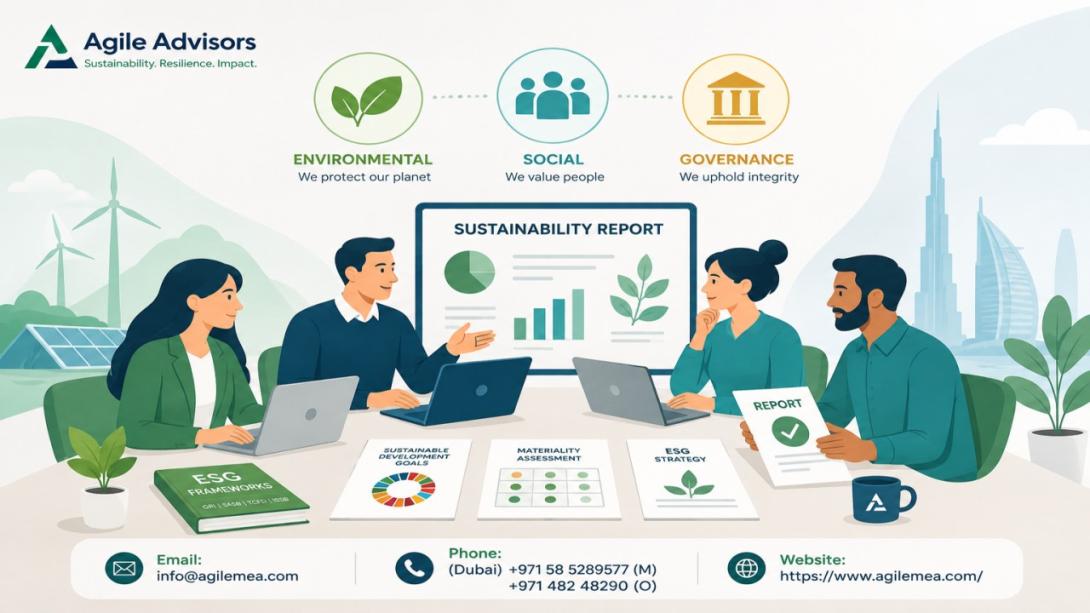
The landscape of corporate accountability in the United Arab Emirates has fundamentally transformed. What was once a voluntary exercise in corporate citizenship has become a binding legal obligation. Federal Decree-Law No. 11 of 2024, the UAE's federal climate law, came into force on 30 May 2025 and has made climate reporting a legal duty, with a compliance deadline of 30 May 2026. For business continuity managers, compliance officers, and organizational leaders, understanding the intricacies of UAE ESG reporting is no longer optional. It is a strategic imperative that carries significant financial and reputational consequences.
ESG and Sustainability Reporting: Beyond Environmental Metrics
While the Climate Change Law focuses heavily on the environmental dimension, ESG and sustainability reporting in the UAE encompasses a broader spectrum. The "S" and "G" components are increasingly significant, with 2025 being designated as the Year of Community, placing particular focus on the capacity of businesses to drive social impact.
What ESG and Sustainability Reporting Encompasses
Comprehensive ESG and sustainability reporting covers three interconnected pillars:
l Environmental: Greenhouse gas emissions (Scope 1, 2, and material Scope 3), energy consumption, water usage, waste management, and climate risk assessment
l Social: Employee diversity statistics, health and safety performance, community investment programs, human rights policies, and workforce development
l Governance: Board composition and independence, executive compensation frameworks, anti-corruption policies, and stakeholder engagement processes
The commercial case for robust ESG and sustainability reporting is equally compelling. Recent research indicates that 59% of businesses now expect poor ESG performers to be removed from their supply chains. With over 90% of enterprise greenhouse gas emissions occurring in supply chains, which represent 50 to 70% of operating costs, the ability to demonstrate ESG performance has become a competitive differentiator.
ESG Reporting Frameworks: Choosing the Right Standards
The UAE does not prescribe a single reporting framework but rather endorses multiple internationally recognized standards. Understanding and selecting appropriate ESG reporting frameworks is essential for producing credible, decision-useful disclosures.
Key ESG Reporting Frameworks in the UAE
The Global Reporting Initiative (GRI) provides a modular framework for materiality-driven disclosures, making it ideal for the UAE's diverse sectors. The Dubai Financial Market's ESG Guide endorses GRI for comprehensive reporting. GRI supports broad stakeholder transparency and is widely adopted, with over 300 UAE companies already using GRI voluntarily.
The Sustainability Accounting Standards Board (SASB) offers industry-specific metrics that address investor-focused reporting needs. The DFM's ESG Guide endorses SASB for industry metrics, harmonizing with TCFD and IFRS S2 requirements.
International Sustainability Standards Board (ISSB) standards, including IFRS S1 (General Requirements for Sustainability Disclosures) and IFRS S2 (Climate-related Disclosures), are increasingly being adopted. The UAE is an early adopter of ISSB standards, and most large and publicly listed companies will need to produce ISSB-aligned sustainability reports by 2026.
The Task Force on Climate-related Financial Disclosures (TCFD) addresses climate-related risk disclosure and forms the foundation for IFRS S2.
Regulatory Requirements by Entity Type
The choice of ESG reporting frameworks depends significantly on the organization's regulatory status:
l Listed companies on ADX and DFM: Must submit annual sustainability reporting within 90 days of financial year-end, aligned with GRI and TCFD frameworks
l ADGM entities: Must comply with the ESG Disclosures Framework if they exceed a US$68 million turnover threshold, employing a flexible comply-or-explain approach
l DIFC-regulated entities: Face additional mandates regarding sustainable finance and risk management
l All UAE entities: Subject to Federal Decree-Law No. 11 GHG measurement and reporting requirements
The Role of an ESG Consultant in Your Compliance Journey
Navigating the complex and evolving landscape of UAE ESG reporting requires specialized expertise. Engaging a professional ESG consultant provides organizations with the strategic guidance needed to achieve compliance efficiently and effectively.
What an ESG Consultant Delivers
A qualified ESG consultant brings comprehensive capabilities to the reporting process:
l Conducting gap assessments to evaluate current capabilities against regulatory requirements and international frameworks
l Performing materiality assessments using GRI 3 or SASB maps to identify priority disclosure topics
l Developing robust data collection and reporting systems aligned with chosen frameworks
l Preparing sustainability reports that meet regulatory deadlines and stakeholder expectations
l Guiding emissions measurement, including Scope 1, 2, and material Scope 3 calculations
l Supporting internal audit and third-party assurance readiness
As an experienced ESG consultant, Agile Advisors supports businesses in aligning with global ESG standards while addressing local regulatory and stakeholder expectations. Their team of expert sustainability report consultants guides organizations through the entire reporting lifecycle, from initial assessment to final disclosure.
Conclusion
The era of voluntary ESG reporting in the UAE has ended. Federal Decree-Law No. 11 of 2024 has established mandatory obligations that affect virtually every organization operating in the country. With the compliance deadline of 30 May 2026 approaching, the time to act is now. Understanding the requirements of UAE ESG reporting, developing comprehensive ESG and sustainability reporting capabilities, selecting appropriate ESG reporting frameworks, and engaging a qualified ESG consultant are essential steps toward achieving compliance and gaining a competitive advantage.