

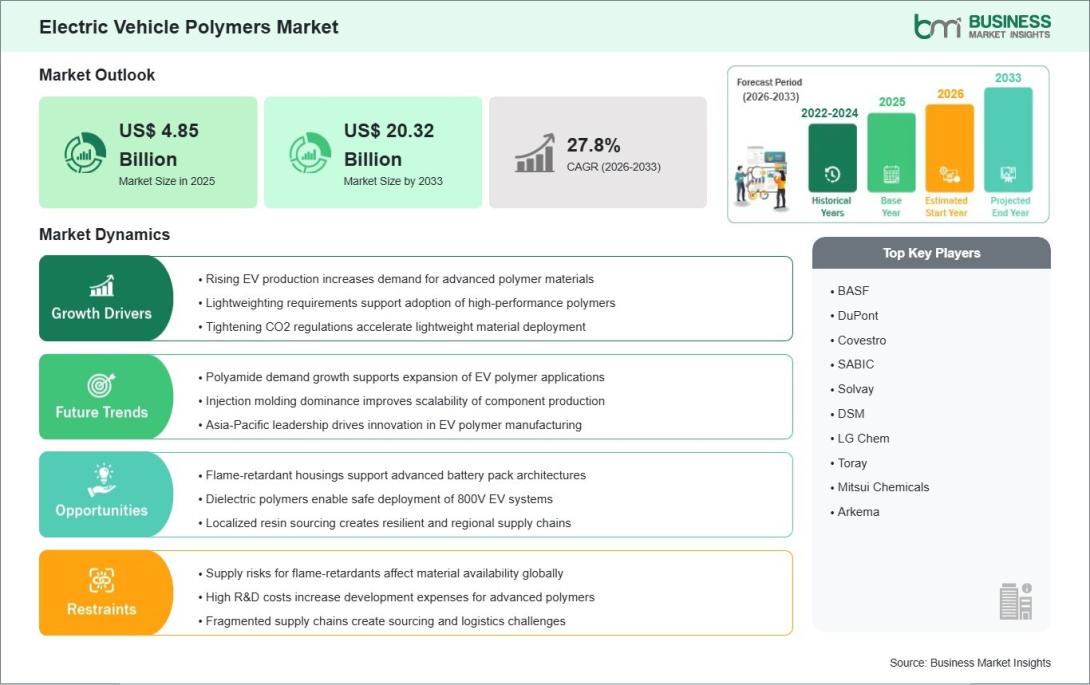
A major operational scale-up is redefining high-volume injection molding, extrusion processing, and polymer compounding pipelines, fueled by the commercial necessity to deliver high-durability, flame-retardant structural and insulation components that optimize vehicle safety and assembly efficiency worldwide.
Based on market intelligence from Business Market Insights, the global Electric Vehicle Polymers Market is anticipated to reach US$ 20.32 billion by 2033, mounting from its 2025 value of US$ 4.85 billion at a projected CAGR of 27.8% from 2026 to 2033.
Technological advancements in high-performance engineering plastics, flame-retardant composites, electromagnetic interference (EMI) shielding, and specialized elastomers are transforming the Electric Vehicle Polymers Market. Material scientists and automotive OEMs are increasingly replacing heavy traditional metal components with advanced polymers to reduce overall vehicle weight while maintaining structural integrity and electrical insulation. As automakers strive to improve battery efficiency and vehicle range, specialized polymers are emerging as a critical component of global electric mobility expansion strategies.
Download Sample Report : https://www.businessmarketinsights.com/sample/BMIPUB00035597
What Is Electric Vehicle Polymers?
Electric vehicle polymers are highly engineered synthetic materials, including advanced plastics and elastomers, formulated specifically to meet the strict mechanical, thermal, and electrical demands of electric mobility. Unlike standard automotive plastics used primarily for aesthetic interior trims, EV polymers must fulfill critical functional roles such as battery cell housing, high-voltage cable insulation, and powertrain thermal management.
The technology offers significant advantages including up to 50% weight reduction compared to conventional metal counterparts, exceptional chemical resistance, superior electrical insulation, and built-in flame retardancy. With support for complex geometric molding and parts consolidation, advanced polymers are becoming an indispensable alternative to steel and aluminum across next-generation vehicle architectures.
Market Drivers
A major driver of the Electric Vehicle Polymers Market is the automotive industry's intense focus on vehicle lightweighting. Because electric vehicle batteries are exceptionally heavy, reducing the weight of the chassis, powertrain enclosures, and body components is essential to maximizing driving range on a single charge. High-performance polymers allow manufacturers to drastically cut weight without sacrificing the mechanical strength required for crash safety.
The critical need for advanced thermal management and safety in high-voltage systems is also accelerating market growth. Lithium-ion batteries generate significant heat during rapid charging and discharging cycles. Automakers are increasingly deploying specialized flame-retardant and thermally conductive polymers for battery modules, cooling plates, and busbars to prevent thermal runaway and protect passengers from electrical hazards.
The global regulatory push toward sustainability and the circular economy is creating additional opportunities for market expansion. Governments worldwide are enforcing strict end-of-life vehicle (ELV) recycling mandates. In response, material suppliers are rapidly developing bio-based polymers and highly recyclable thermoplastic composites, allowing OEMs to reduce their carbon footprint and align with green manufacturing standards.
Market Segmentation
By Type
- Engineering Plastics (Polyamide, Polycarbonate, PPS, etc.): The largest segment, heavily utilized for structural battery enclosures, motor housings, and high-voltage connectors due to superior strength and heat resistance.
- Elastomers: Vital for sealing applications, thermal gap pads, and vibration damping across complex electronic and powertrain assemblies.
By Component
- Powertrain & Battery Systems: Represents the dominant application segment, driven directly by the massive volume of plastics required for cell carriers, module housings, and electrical insulation.
- Exterior & Interior: Benefiting from ongoing parts consolidation and lightweighting of door panels, liftgates, and aerodynamic fascia.
- Charging Infrastructure: Experiencing rapid growth as charging station networks expand, requiring durable, weather-resistant, and flame-retardant polymer casings.
By Vehicle Type
- Passenger EVs: Supports high-volume consumer vehicle manufacturing lines, requiring millions of tons of engineered polymers annually to meet global demand.
- Commercial EVs: Enables fleet logistics operations and electric transit buses requiring highly durable, heavy-duty structural plastics.
The engineering plastics segment dominated the market in 2025 as vehicle manufacturers heavily prioritized flame-retardant structural housings for battery packs. Powertrain and battery systems accounted for the largest component share due to the intensive need for thermal management and electrical isolation in high-voltage zones. Passenger EVs represented the dominant vehicle type segment because of high global production volumes and rapid consumer adoption.
Regional Insights
- Asia-Pacific holds the absolute largest market share, anchored by China's undisputed position as the world's largest EV producer, alongside massive battery manufacturing expansions in South Korea, Japan, and India.
- Europe remains a highly significant market, driven directly by strict EU emissions mandates, aggressive vehicle lightweighting initiatives by premium automakers, and robust circular economy recycling regulations.
- North America is expected to witness substantial growth, fueled by the rapid scaling of localized EV production facilities across the United States and Canada, backed by federal manufacturing incentives.
- Middle East & Africa is emerging as an active region, supported by transport modernization plans and growing investments in sustainable urban mobility.
- South & Central America is gradually expanding as regional automotive assembly hubs integrate cost-effective lightweight materials for localized electric vehicle production.
Top Players in the Electric Vehicle Polymers Market
The market is highly competitive and technology-driven, with leading global chemical companies focusing on custom formulations, thermal conductivity, and sustainable raw material sourcing.
- BASF SE
- Covestro AG
- Celanese Corporation
- SABIC
- DuPont de Nemours, Inc.
- Evonik Industries AG
- Solvay S.A.
- LANXESS AG
- Arkema S.A.
- LG Chem Ltd.
These companies continue investing heavily in developing next-generation EMI-shielding plastics, bio-based polyamides, and strategic co-development partnerships with major automotive OEMs to optimize next-generation electric vehicle platforms.
Technological Innovations
Technological innovation is transforming the Electric Vehicle Polymers Market through the development of electromagnetically conductive plastics, smart self-healing elastomers, and advanced thermal management composites. These advancements directly address evolving industry demands surrounding electronic interference, battery safety, and manufacturing efficiency.
The emergence of EMI-shielding polymers is revolutionizing the packaging of delicate automotive electronics. As vehicles integrate more sensors, radar, and high-voltage cables, electromagnetic interference becomes a severe risk. Advanced conductive plastics provide built-in EMI shielding, eliminating the need for heavy metal foils and secondary protective coatings, thereby streamlining production and reducing weight.
Additionally, material science providers are engineering highly recyclable, continuous fiber-reinforced thermoplastic composites. These specialized materials offer the structural strength of traditional metals but can be rapidly thermoformed in automated presses and easily melted down for recycling at the end of the vehicle's life, ensuring absolute alignment with global sustainability goals.
Future Market Outlook
The future outlook for the Electric Vehicle Polymers Market remains exceptionally strong. Continued global scaling of electric mobility, the structural transition toward integrated cell-to-pack (CTP) battery architectures, and ongoing advancements in autonomous vehicle sensors will support robust market expansion through 2033.
As vehicle engineering moves further toward highly integrated, software-defined electric vehicle skateboards, the demand for traditional metal components will continue to decrease in favor of smart, lightweight chemical solutions. Companies that focus on developing flame-retardant bio-plastics, high-performance thermal interfaces, and highly recyclable composite materials are positioned to secure dominant long-term growth opportunities in this fast-paced automotive landscape.
Frequently Asked Questions (FAQs)
What is the projected size of the Electric Vehicle Polymers Market by 2033?
The market is projected to reach US$ 32.5 Billion by 2033, rising from US$ 6.5 Billion in 2025.
What is the CAGR for the Electric Vehicle Polymers Market?
The market is expected to grow at a CAGR of 22.3% from 2026 to 2033.
Which polymer type segment dominates the market?
The engineering plastics segment held the largest market share in 2025 due to its indispensable balance of structural strength, high heat resistance, and flame retardancy required for battery enclosures.
Which component segment leads the market?
Powertrain and battery systems dominated the market because of the high volume of specialized polymers mandatory for safely assembling, insulating, and cooling large-scale EV battery modules.
Which region accounts for the largest share?
Asia-Pacific holds the largest market share, driven by its absolute dominance in global electric vehicle manufacturing and localized battery supply chains.
Browse More Reports:
https://www.businessmarketinsights.com/reports/sodium-reduction-ingredients-market
https://www.businessmarketinsights.com/reports/solid-state-cooling-market
https://www.businessmarketinsights.com/reports/sound-reinforcement-market
About Us
Business Market Insights is a market research platform that provides subscription service for industry and company reports. Our research team has extensive professional expertise in domains such as Electronics & Semiconductor; Aerospace & Defense; Automotive & Transportation; Energy & Power; Healthcare; Manufacturing & Construction; Food & Beverages; Chemicals & Materials; and Technology, Media, & Telecommunications.
Contact Us
If you have any questions about this report or would like further information, please contact us:
Contact person: Ankit Mathur
Email: sales@businessmarketinsights.com
Phone: +16467917070