
Global Electric Vehicle Market to Surpass USD 1.23 Trillion by 2032
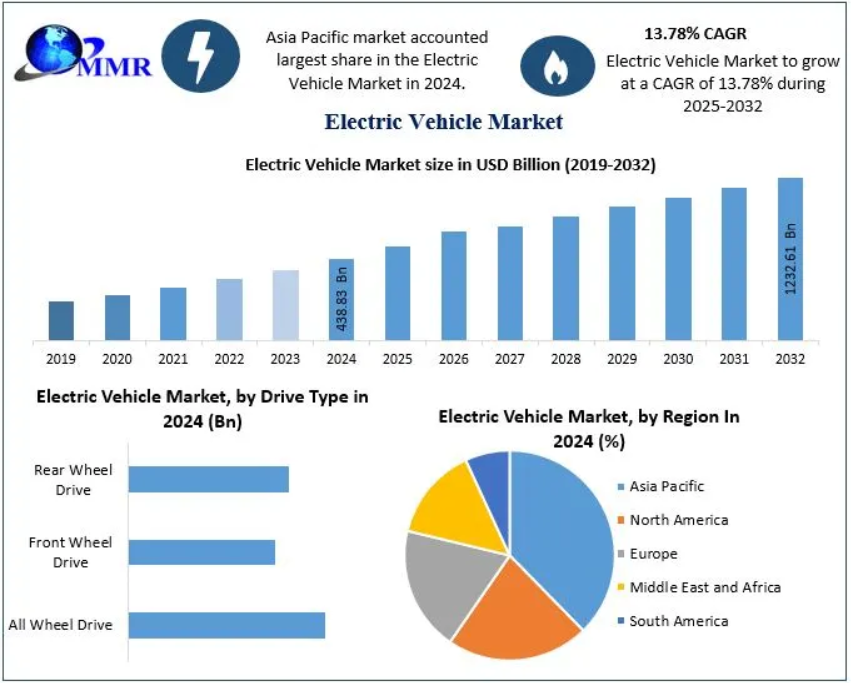
The Global Electric Vehicle (EV) Market was valued at USD 438.83 billion in 2024 and is expected to grow at a CAGR of 13.78% between 2025 and 2032, reaching nearly USD 1,232.61 billion by 2032. The market is witnessing unprecedented momentum as governments, consumers, and automakers align toward zero-emission mobility and reduced reliance on fossil fuels.
Electric Vehicle Market Overview
Electric vehicles (EVs) run on one or more electric motors powered by rechargeable batteries, offering a sustainable alternative to traditional internal combustion engine (ICE) vehicles. With zero tailpipe emissions, EVs are considered a cornerstone of the global decarbonization strategy, contributing to reduced greenhouse gas emissions and cleaner air in urban centers.
The MMR Global EV Market Report explores adoption trends, infrastructure growth, battery demand, and policies accelerating EV uptake. It also includes insights into company financials, venture capital investments, and global EV trade, making it a valuable resource for investors, automakers, and policymakers.
Market Dynamics
1. Technological Advancements and Infrastructure Expansion
The rollout of EV charging infrastructure is one of the primary enablers of growth. According to the U.S. Department of Energy, more than 10,000 new charging stations were added in 2024 alone, improving accessibility and reducing consumer range anxiety. Governments across North America, Europe, and Asia are investing billions to expand charging networks. For example, the EU Green Deal sets ambitious adoption targets that are reshaping transport policies across Europe.
For a deeper dive into the impact of EV infrastructure development, you can review this IEA EV outlook.https://www.maximizemarketresearch.com/request-sample/1408/
2. Environmental Awareness and Consumer Shift
Growing environmental consciousness is pushing both individuals and businesses to adopt EVs. Logistics and e-commerce companies are electrifying their fleets to cut emissions and lower operating costs. A prime example is Amazon, which deployed 50 heavy-duty EV trucks in Southern California in 2024 to decarbonize freight operations.
3. Declining Battery Costs Driving Affordability
Battery systems remain the most expensive EV component, but costs have dropped from USD 1,100/kWh in 2010 to around USD 120/kWh in 2023. In China, large-scale production and lower raw material costs are expected to reduce prices further, potentially reaching USD 60/kWh by 2030, making EVs more affordable than ICE vehicles.
Business Opportunities Across Global Markets
- India: With government incentives and a projected investment need of USD 267 billion, the EV industry could generate 10 million direct jobs by 2030. Companies like Tata Motors, Mahindra & Mahindra, and Maruti Suzuki are ramping up EV offerings.
- China: The world’s largest EV market, driven by BYD, NIO, and SAIC, supported by subsidies and large-scale infrastructure rollouts.
- Europe: Countries like Norway, Germany, and the UK lead in EV adoption with strict CO₂ regulations and purchase incentives.
- North America: The U.S. government has allocated USD 5 billion to develop a national charging network and offers incentives of up to USD 7,500 per vehicle.
For insights into how different regions are driving EV adoption, see this BloombergNEF EV market report.https://www.maximizemarketresearch.com/request-sample/1408/
Segment Insights
- By Component: Battery cells and packs dominate, given their role in energy storage, range, and performance. Advances in solid-state batteries are set to further transform the market.
- By Vehicle Type: Passenger cars lead adoption due to rising consumer demand, government subsidies, and expanded EV model offerings.
- By Propulsion Type: Battery Electric Vehicles (BEVs) are the fastest-growing, supported by improved charging infrastructure and falling battery prices.
Regional Insights
- Asia Pacific dominates, with China accounting for over 60% of global EV sales in 2024, followed by India and Japan making significant policy pushes.
- Europe is on track to phase out ICE vehicles by the mid-2030s, with Norway aiming for 100% EV adoption by 2025.
- North America is rapidly scaling EV infrastructure while Tesla, Rivian, and Lucid lead innovation.
Key Players in the EV Market
1. Tesla - (United States)
2. Rivian - (United States)
3. Chevrolet - (United States)
4. Lucid Motors - (United States)
5. Ford - (United States)
6. Fisker - (United States)
7. Nikola - (United States)
8. Proterra - (United States)
9. Canoo - (United States)
10. Lion Electric - (Canada)
11. Hyliion - (United States)
12. Hyzon Motors - (United States)
13. Faraday Future - (United States)
14. Lordstown Motors - (United States)
15. BMW - (Germany)
16. Stellantis - (Netherlands)
17. Arrival - (United Kingdom)
18. Volkswagen - (Germany)
19. Polestar - (Sweden)
20. NIO - (China)
21. BYD - (China)
22. SAIC Motors - (China)
23. GAC Motors- (China)
24. NIU - (China)
25. Tata Motors- (India)
26. Geely- (China)
27. Wuling Hong Guang MINI EV- (China)
28. Kia - (South Korea)
29. Gogoro - (Taiwan)
30. XPeng - (China)
31. Toyota - (Japan)
32. Li Auto - (China)
33. Nissan - (Japan)
Conclusion
The Global Electric Vehicle Market is entering a transformative decade, fueled by technology breakthroughs, policy support, and shifting consumer behavior. With the market projected to triple by 2032, opportunities span across EV manufacturing, charging infrastructure, battery technologies, and fleet electrification. Nations and corporations that invest today stand to lead in the next era of sustainable mobility.