

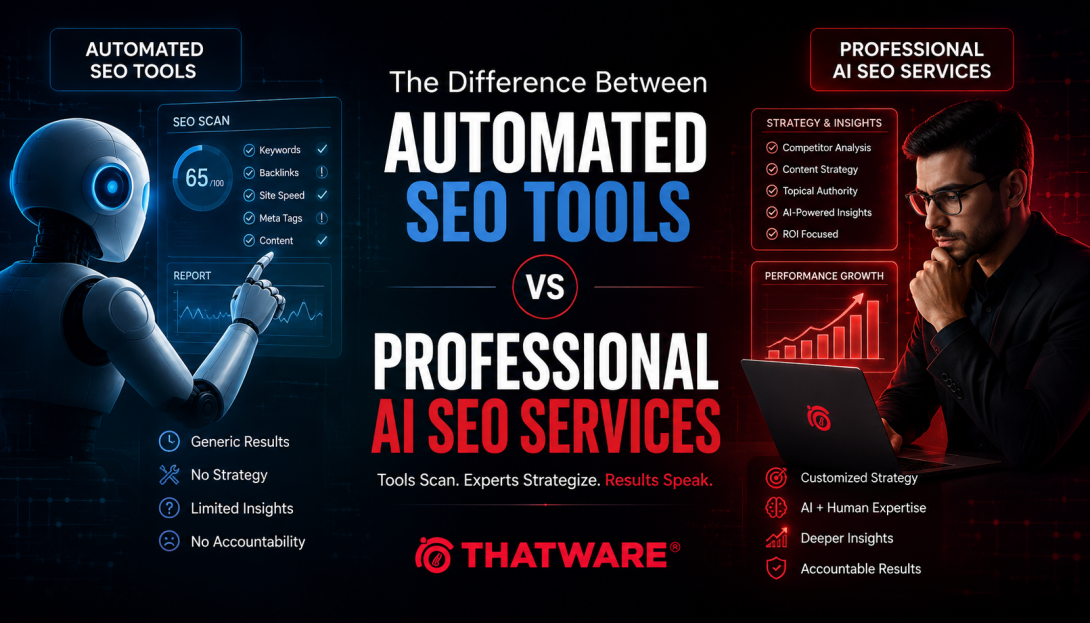
Search engine optimization has changed dramatically over the last few years. Businesses are no longer competing only for rankings on traditional search engines. Today, brands must also earn visibility in AI-generated answers, conversational search experiences, and intelligent recommendation systems. As this shift accelerates, many companies are asking an important question: should they rely on automated SEO software, or invest in expert AI SEO services?
At first glance, the two may appear similar. Both promise insights, performance improvements, and better search visibility. However, there is a significant difference between automated tools and the expertise delivered through best AI SEO services. Understanding that difference can help businesses make smarter marketing investments and avoid costly mistakes.
Why SEO Tools Have Become So Popular
The appeal of automated SEO tools is easy to understand. They are affordable, accessible, and capable of processing large amounts of data in seconds. Most platforms can audit websites, identify technical issues, track rankings, monitor backlinks, and generate reports.
For businesses with limited budgets, these tools provide valuable information that would otherwise require considerable manual effort. They can highlight broken links, missing metadata, page speed concerns, and other technical opportunities for improvement.
Automation has made SEO more efficient than ever before. Yet efficiency alone does not guarantee success.
The challenge is that tools provide data, but they do not provide judgment. They can identify what is happening, but they often cannot explain why it is happening or what should be done next.
The Limitation of Automation
Many business owners assume that modern SEO software can replace human expertise. In reality, most platforms are designed to support decision-making rather than make decisions.
Imagine receiving a technical audit containing hundreds of recommendations. Which issues should be addressed first? Which problems have the greatest business impact? Which recommendations are no longer relevant in an AI-driven search environment?
Software cannot always answer these questions effectively.
This is particularly true as search engines increasingly rely on artificial intelligence to understand entities, context, authority, and user intent. Modern search visibility depends on much more than keyword placement and technical compliance.
Businesses that rely solely on automation often discover that while reports look impressive, meaningful growth remains difficult to achieve.
What Professional AI SEO Services Bring to the Table
A professional AI SEO company for businesses approaches optimization very differently.
Rather than starting with a list of automated recommendations, experienced specialists begin by understanding the business itself. They evaluate the company's goals, target audience, competitive landscape, and current digital presence.
The focus extends beyond technical corrections. The objective is to understand how search engines and AI systems perceive the brand.
Professional agencies examine factors such as:
- Entity recognition
- Knowledge graph presence
- Topical authority
- Brand sentiment
- Content relationships
- AI-generated search visibility
- User intent alignment
These elements require strategic analysis that goes far beyond what automated tools can deliver.
While software may identify a problem, professionals determine its significance and develop a roadmap to solve it.
The Methodology Difference
One of the clearest distinctions between automated solutions and professional services lies in methodology.
Automated tools generally follow predefined rules and algorithms. Every website receives similar treatment because the software is designed to apply the same framework across thousands of domains.
Understanding AI Search Requires Human Insight
They analyze the unique circumstances surrounding each business. A healthcare organization, a SaaS company, and an eCommerce retailer all face different challenges. Effective SEO strategies must reflect those differences.
When evaluating providers, ask them how they approach research, content planning, technical implementation, and AI visibility optimization.
Experienced professionals can clearly explain their methodology. They can describe why specific actions matter and how those actions support business objectives.
Generic answers usually indicate a generic process.
Understanding AI Search Requires Human Insight
AI-powered search systems are becoming increasingly sophisticated.
Platforms such as ChatGPT, Google AI Overviews, Gemini, and Perplexity do not simply retrieve information. They interpret context, connect entities, evaluate authority, and generate responses based on multiple signals.
This complexity creates opportunities that traditional SEO tools may struggle to identify.
An experienced agency understands how AI systems consume and interpret information. They know how structured data, content architecture, entity relationships, and semantic relevance contribute to visibility within AI-generated results.
An intelligent SEO automation platform can certainly assist with data collection and monitoring, but it cannot fully replace the strategic thinking required to influence how AI systems understand and represent a brand.
Businesses that recognize this distinction often gain a significant competitive advantage.
Content Strategy Goes Beyond Keywords
Traditional SEO often focused heavily on keyword rankings.
While keywords remain important, AI-driven search has expanded the definition of content quality.
Search systems increasingly evaluate expertise, topical depth, contextual relationships, and overall authority within a subject area.
Professional AI SEO specialists build content ecosystems rather than isolated articles. They create topic clusters, supporting resources, entity connections, and comprehensive content structures designed to establish authority over time.
Most automated platforms can suggest keywords.
Few can develop a complete authority-building strategy aligned with business goals and customer needs.
This difference frequently determines whether content becomes an industry resource or simply another page competing for attention.
Reporting That Reflects Real Business Outcomes
Another important distinction involves performance measurement.
Many automated tools focus on surface-level metrics. Rankings, impressions, clicks, and page views can all provide useful information, but they do not always reveal business impact.
Professional agencies connect SEO performance to meaningful outcomes.
These outcomes may include:
- Qualified lead generation
- Revenue growth
- Brand visibility in AI-generated answers
- Customer acquisition
- Market authority
- Search share within key categories
When reporting focuses on business results rather than vanity metrics, decision-makers gain a much clearer understanding of return on investment.
Warning Signs Businesses Should Watch For
Not all AI SEO providers deliver the same level of expertise.
Be cautious of organizations that guarantee rankings, hide their methodology behind proprietary claims, or rely heavily on buzzwords without providing clear explanations.
Professional agencies are transparent. They explain what they are doing, why they are doing it, and how success will be measured.
They are comfortable discussing both opportunities and challenges.
Most importantly, they recognize that SEO success is built through strategic execution rather than promises.
The Future Belongs to Strategy and Expertise
As search technology continues to evolve, the gap between automated tools and professional services will become even more apparent.
Automation will remain valuable. Businesses should absolutely leverage software to improve efficiency, collect data, and monitor performance.
However, software alone cannot replace strategic thinking, industry expertise, and human judgment.
The organizations that succeed in AI-driven search will be those that combine powerful technology with experienced professionals who understand how modern search ecosystems actually function.
Final Thoughts
Automated SEO tools are excellent assistants, but they are not complete solutions. They help identify opportunities, streamline workflows, and provide useful insights. Yet true search growth comes from understanding how search engines and AI systems interpret information, evaluate authority, and present brands to users.
That is where professional expertise becomes invaluable. Businesses looking to build lasting visibility need more than reports and dashboards. They need a strategic partner capable of translating data into action and action into measurable results. As AI continues to reshape digital discovery, companies that invest in expertise alongside technology will be best positioned for long-term success. This is the approach that ThatWare has embraced, combining advanced AI methodologies with transparent strategy, technical excellence, and business-focused execution to help brands thrive in the evolving search landscape.