

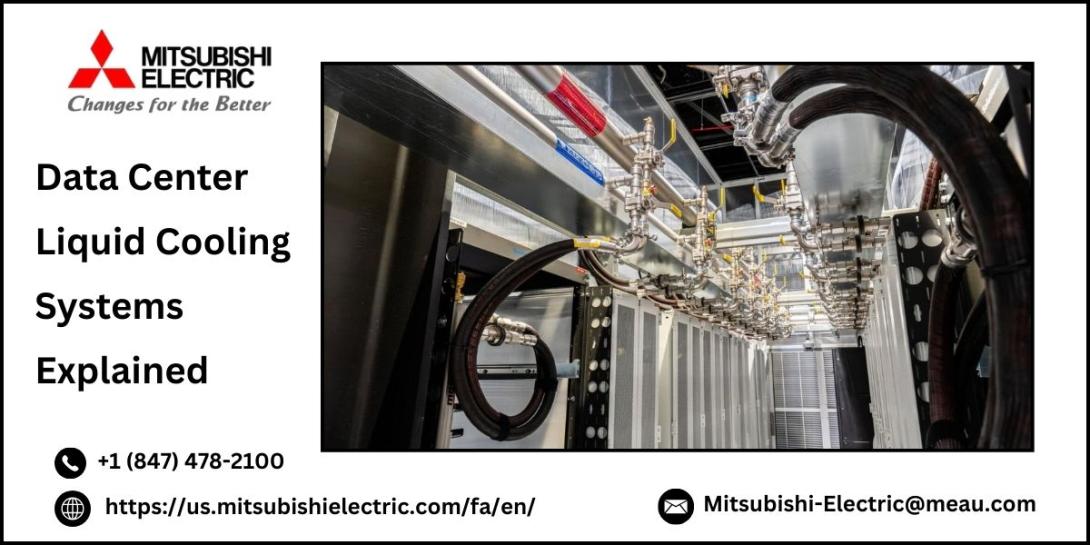
Data centers didn’t always operate at today’s intensity. Earlier facilities had room to breathe, both physically and thermally. Modern environments are different. Higher rack density, constant uptime demands, and growing automation loads have changed how heat behaves inside a facility. That shift is why data center liquid cooling systems are now part of serious infrastructure conversations rather than experimental design. Cooling has become a question of precision, not just capacity.
Why traditional cooling approaches are under pressure
Air cooling still supports many facilities, but it faces growing limitations as workloads evolve.
Heat density has outpaced airflow capability
Modern servers generate more heat in smaller footprints. Packing equipment closer together concentrates thermal output in ways airflow struggles to disperse evenly. Increasing fan speed or airflow volume only goes so far before diminishing returns set in. At higher densities, air simply can’t remove heat fast enough at the source.
Energy use rises faster than performance gains
Air-based cooling relies heavily on fans, chillers, and large air handlers. As heat loads increase, energy use grows quickly, often faster than computing output. This imbalance makes data center energy efficiency harder to sustain. Cooling becomes one of the largest operational energy expenses.
Hot spots are harder to predict and control
As layouts grow more complex, heat distribution becomes uneven. Hot spots can form behind racks or in corners where airflow patterns break down. These issues often appear gradually, making them harder to detect early. Cooling systems need faster response and finer control.
What liquid cooling actually changes
Liquid cooling alters how heat is captured and removed from equipment.
Heat transfer improves at the source
Liquids absorb heat far more efficiently than air. By placing cooling elements closer to processors and components. Heat is removed before it spreads into the surrounding environment. This localized approach stabilizes temperatures more effectively.
Reduced dependence on room-level cooling
Instead of cooling entire rooms, liquid systems target specific racks or components. This reduces wasted cooling effort and lowers overall airflow demand. Cooling becomes intentional rather than generalized.
Infrastructure adapts to higher future loads
Liquid cooling supports higher rack densities. It doesn't even force complete facility redesigns. As workloads increase, systems can scale without dramatic changes to airflow infrastructure. This flexibility supports long-term planning.
Common types of data center liquid cooling systems
Liquid cooling takes different forms depending on performance needs and facility constraints.
Direct-to-chip cooling
In direct-to-chip systems, liquid flows through cold plates mounted directly on processors. Heat is removed at the exact point where it’s generated. This method offers excellent thermal control for high-performance computing environments. It also reduces the amount of heat released into the room.
Immersion cooling
Immersion cooling places entire servers into non-conductive liquid. The liquid absorbs heat directly from components and transfers it away efficiently. This approach delivers strong cooling performance but requires changes in equipment handling and maintenance practices. It’s often used where extreme density is required.
Rear-door heat exchangers
Rear-door systems attach liquid-cooled heat exchangers to server racks. Hot air passes through the exchanger before exiting the rack. This method integrates well with existing layouts. It offers a balance between air and liquid approaches.
How automation and controls support liquid cooling
Liquid systems depend on accurate monitoring and responsive control.
Data center automation improves real-time response
Automation platforms monitor temperature, flow rate, and pressure continuously. Adjustments happen in real time as workloads shift. This prevents overheating and avoids unnecessary energy use. Automation reduces manual intervention and human error.
Variable control enables efficient operation
Many liquid systems use pumps and motors that adjust speed based on demand. This is where data center VFD technology becomes important. Variable frequency drives allow equipment to scale output instead of running at full capacity. This flexibility improves efficiency and equipment lifespan.
Integration with facility management systems
Liquid cooling controls often integrate with broader building or data center management systems. Operators gain a unified view of cooling, power, and performance metrics. Better visibility supports faster decisions
Operational considerations before adoption
Liquid cooling requires thoughtful planning before implementation.
Infrastructure readiness matters
Facilities must evaluate plumbing routes, redundancy, and leak detection systems. Retrofitting older buildings requires coordination across teams. Preparation minimizes disruption during deployment.
Staff training supports safe operation
Teams need familiarity with liquid systems to manage maintenance and troubleshooting confidently. Training ensures quick response without hesitation. Comfort with the system protects uptime.
Phased adoption reduces risk
Many facilities introduce liquid cooling gradually. Hybrid approaches allow testing performance before full rollout. This staged method builds confidence.
Common questions about liquid cooling in data centers
Is liquid cooling replacing air cooling entirely?
No. Most facilities use hybrid systems tailored to specific zones.
Does liquid cooling increase operational risk?
Well-designed systems are reliable, but training and monitoring are essential.
Is liquid cooling only for hyperscale facilities?
No. Smaller data centers adopt it for high-density areas.
Does automation simplify management?
Yes. Automation reduces manual adjustments and stabilizes performance.
Why liquid cooling is becoming a long-term strategy
Data centers continue to move toward higher density, automation, and performance. Cooling strategies must evolve to match those demands. Data center liquid cooling systems offer precise heat control, better efficiency, and greater scalability. They don’t eliminate complexity, but they manage it more effectively. In the long run, that control supports reliability, energy efficiency, and growth. In environments where uptime matters and margins are tight. Liquid cooling is increasingly less of an option and more of a necessity.