
By 2025, working from home has become commonplace for many businesses. The adaptability of current IT infrastructures has been crucial to New Work's success. Consequently, there are notable variations in the percentage of workers who have remote work arrangements among industries.
To allow employees to access all pertinent information from home, a document management system (DMS) like Konica Minolta UAE documents is a basic necessity. Nevertheless, the deployment strategy is just as important as the system itself when it comes to the required flexibility. The best way to get started with professional document management is with a cloud-based DMS. We've outlined the most important factors to take into account while moving to cloud-based document management in this post.
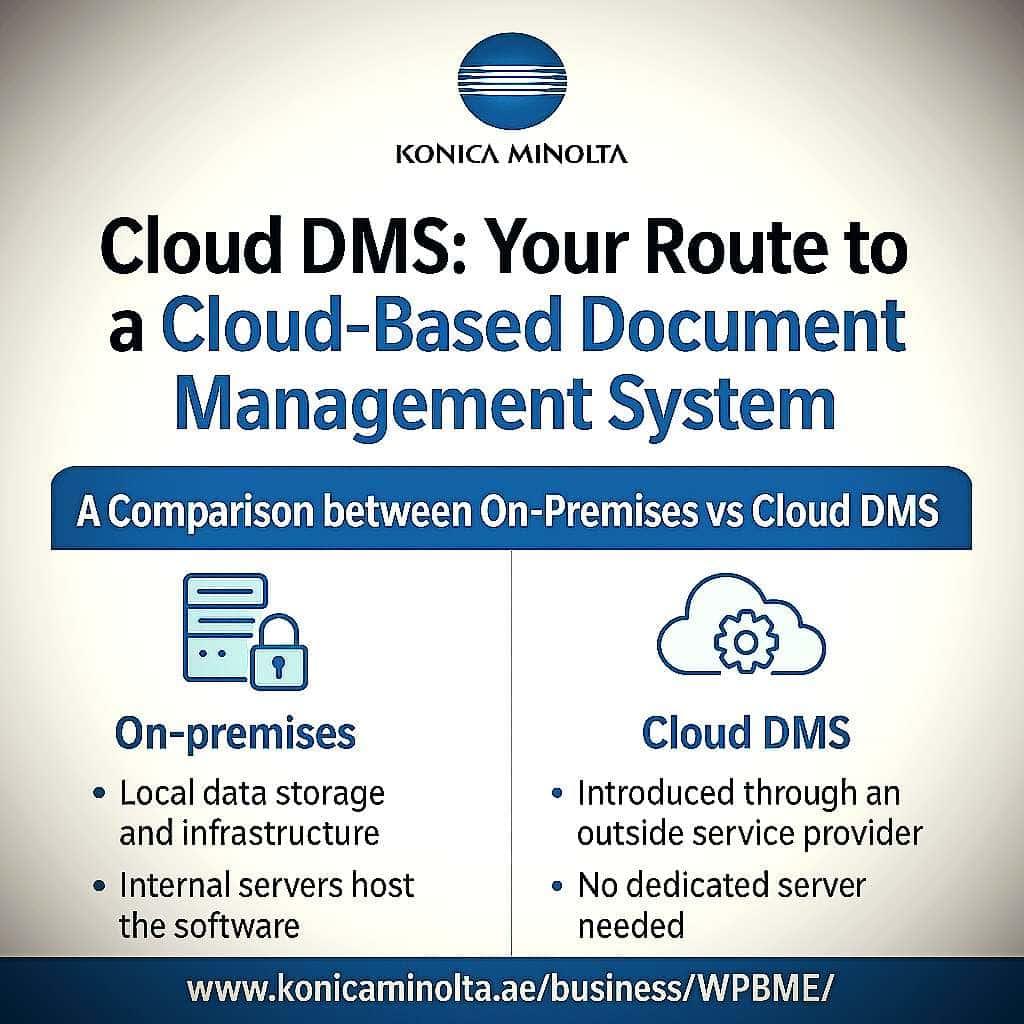
A Comparison between On-Premises vs Cloud DMS
Understanding the benefits, drawbacks, and potential alternatives of this deployment architecture is crucial before putting a cloud-based DMS into place. Here, the emphasis is on the two primary choices: using Software as a Service (SaaS) or running the software on-premises.
On-premises solutions only use local data storage and infrastructure. Your own internal servers host the software. Although this offers you the most power and complete independence from other suppliers, it also means that you are entirely in charge of your gear, data security, upkeep, and updates. This choice necessitates a high degree of internal IT proficiency.
On the other hand, introducing a DMS through an outside service provider is made easy using Software as a Service (SaaS). There is no need for a dedicated server, in contrast to on-premises alternatives. You can rent the system to suit your demands, and the software is housed in the cloud. High levels of data security and compliance are guaranteed by software suppliers such as Konica Minolta Dubai.
The Best Option for Cloud-Based Document Management
Although each model has advantages of its own, many organizations now choose the cloud, especially because of the following benefits:
1. Cost:
Low financial risk,
no large upfront expenditure,
considerable flexibility
2. Security: Cloud service providers provide their data centers with a high degree of security and protection.
3. Personalization
Because contemporary cloud-based DMS solutions are so sophisticated, they offer a wide range of customization possibilities.
Features of Cloud DMS: Comparable to On-Premises
The idea that cloud-based document management systems are less functional than on-premises alternatives is a common misconception. It's time to dispel that misconception because cutting-edge providers now provide feature sets that are the same for all deployment models. The following essential features should be considered when selecting a DMS:
• Smart Filing: Bid farewell to disorganized files, paper records, and manual filing. Your organization's focal point, particularly for remote operations, is an integrated DMS.
One of the main advantages of digital archiving is central availability. Every employee has access to the most recent information, even decades later, thanks to the automatic sorting of all documents into digital files across locations.
• System Integration: Data and documents are produced across numerous systems. By connecting to various systems, a DMS enables smooth access to stored data straight from the running application.
• Quick Search: Search times are lowered to a matter of seconds thanks to a centralized document repository and sophisticated search features. With the help of metadata tagging (such as document kind and client name), you can always find what you're looking for.