


Industrial heating is rarely just about generating heat. The real challenge is delivering the right amount of heat, at the right location, at the right temperature, and for the required duration without compromising product quality or process stability.
This is where ceramic infrared heating elements have become an important option for manufacturers, OEMs, machine builders, and process engineers. Unlike conventional heating approaches that primarily depend on transferring heat through air or direct contact, infrared ceramic elements can transfer radiant energy directly toward the target surface.
For companies evaluating a Ceramic Elements Heater manufacturer in India, the selection process should therefore go beyond price. Heater geometry, wattage, operating temperature, wavelength, power density, installation arrangement, temperature sensing, controller compatibility, and application requirements all influence the final performance.
Nexthermal provides industrial heating solutions from Bangalore, India, including ceramic infrared heating elements alongside cartridge heaters, coil heaters, tubular heaters, temperature-control systems, and customized heating solutions. Its ceramic product range includes multiple element configurations designed for applications such as ovens, curing, thermoforming, preheating, material processing, and other industrial processes. Nexthermal - Complete Heating Solutions
What Are Ceramic Infrared Heating Elements?
Ceramic infrared heating elements are electrical heating devices designed to convert electrical energy into heat and emit a significant portion of that energy as infrared radiation.
In a typical ceramic infrared element, electrical resistance heating raises the temperature of the ceramic body. The heated surface then radiates infrared energy toward the material or component being processed.
The important distinction is radiant heat transfer.
Instead of depending entirely on heated air circulating around a product, infrared heating can deliver energy directly to a surface that absorbs the radiation. Industrial ceramic infrared elements commonly operate across the medium-to-long infrared range, with the actual performance depending on the element construction, surface temperature, geometry, and application. Heating Group International B.V.
This makes ceramic infrared technology particularly useful when manufacturers need:
- Targeted heating
- Repeatable surface heating
- Fast thermal response
- Controlled heating zones
- Compact heating assemblies
- Reduced unnecessary heating of surrounding areas
- Integration into automated industrial equipment
The correct element, however, must always be selected according to the process rather than simply by nominal wattage.
Why Ceramic Infrared Heating Is Valuable in Manufacturing
A production line may have several thermal zones, each with a different heating requirement. A plastic sheet may need gradual preheating, while a coating process may require controlled surface temperature. A composite material may need uniform radiant heating over a defined area.
Ceramic infrared heaters can address these requirements because the heating energy can be directed toward the workpiece.
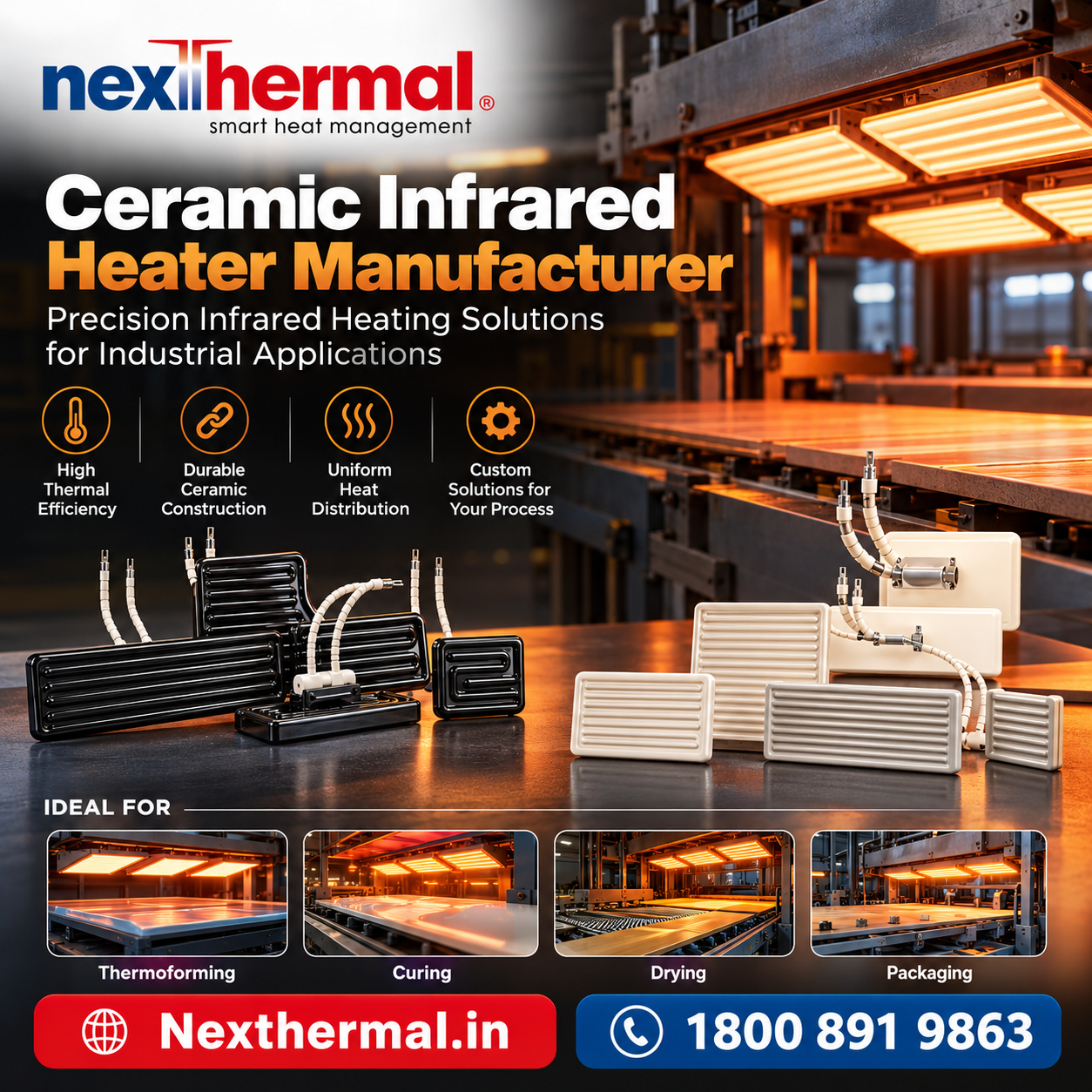
For example, Nexthermal's listed ceramic element range includes full trough, half trough, flat, hollow, quarter-flat, and square configurations. Depending on the model, the products are available in different wattages and surface-temperature ranges and can also be supplied with an embedded K-type thermocouple. Ceramic Elements Heater manufacturer
This variety matters to machine designers because the physical shape of the heater influences the heating pattern.
A heater selected for a narrow process zone may perform very differently from a heater intended to cover a larger flat surface.
Key Factors to Consider When Choosing a Ceramic Elements Heater Manufacturer
Choosing a manufacturer should begin with engineering requirements rather than a catalogue comparison.
1. Application Temperature
The first question should be: What temperature does the process actually require?
The required process temperature is not necessarily the same as the heater's surface temperature.
Engineers should consider:
- Target material temperature
- Heater surface temperature
- Heating distance
- Heat losses
- Heating cycle duration
- Ambient conditions
- Required temperature uniformity
A supplier with application-engineering capability can help determine whether the selected ceramic element has sufficient thermal capacity for the process.
2. Wattage and Power Density
Wattage determines the electrical heating input, while power density indicates how concentrated that heating input is over a particular area.
Two heaters can have the same total wattage but produce different process results because their dimensions and active surface areas differ.
For industrial applications, engineers should therefore evaluate:
Wattage + active area + heating distance + material response
rather than considering wattage alone.
Nexthermal's published ceramic product information provides different wattage and maximum power-density options across its element configurations, illustrating why element selection needs to be application-specific. Nexthermal - Complete Heating Solutions
3. Element Geometry
Geometry has a direct effect on coverage.
Depending on the process, manufacturers may require:
- Flat elements
- Trough elements
- Hollow flat elements
- Square elements
- Half elements
- Quarter elements
- Specialized configurations
A correctly selected geometry can improve heating coverage and reduce unwanted thermal variation.
For OEM machinery, this is particularly important because available installation space is often limited.
4. Wavelength
Infrared heating is not simply a matter of producing heat. The interaction between radiation and the material being heated is also important.
Different materials absorb infrared radiation differently at different wavelengths.
Therefore, process engineers should consider:
- Material composition
- Surface characteristics
- Moisture content
- Colour and reflectivity
- Material thickness
- Heating temperature
- Desired heating rate
A technically experienced Ceramic Elements Heater manufacturer should be able to discuss these factors instead of recommending a heater only from a basic voltage and wattage requirement.
Ceramic Infrared Heaters vs Conventional Heating
Traditional heating methods remain highly useful across industrial manufacturing. The objective is not to replace every conventional heater with infrared technology.
The better approach is to select the heating method that matches the process.
Ceramic infrared heating can be advantageous when the application requires surface-directed radiant energy.
Conventional heating may be more suitable when:
- A fluid needs to be heated directly
- Heat must be transferred through a metal block
- A large thermal mass must be maintained
- Immersion heating is required
- The process is primarily dependent on air circulation
For other applications, hybrid systems can also be considered.
This is why an experienced heating supplier should evaluate the complete thermal system instead of treating every enquiry as a standard product sale.
Industrial Applications of Ceramic Infrared Heating Elements
Ceramic infrared technology is used across a wide range of industrial processes.
Thermoforming
Thermoforming requires controlled heating of polymer sheets before forming.
Uniform heat distribution is important because excessive temperature differences can affect:
- Material thickness
- Forming quality
- Surface appearance
- Cycle consistency
- Final component dimensions
Ceramic infrared elements can be arranged into controlled heating zones to support repeatable sheet heating.
Plastic Processing
Plastics processing frequently requires localized or controlled thermal energy.
Infrared elements may be used for:
- Preheating
- Softening
- Forming
- Processing
- Heating specific material zones
The exact heater configuration should be selected according to polymer characteristics and process temperature.
Paint and Coating Curing
Radiant infrared heating can be useful for curing and drying processes where the surface needs controlled thermal energy.
Instead of unnecessarily heating the entire surrounding volume, infrared energy can be directed toward the coated component.
This can make radiant heating particularly attractive for controlled production environments.
Composite Processing
Composite materials can require carefully controlled heating during processing and curing.
Flat and square ceramic infrared elements can be arranged to create defined heating zones. Nexthermal's ceramic range specifically lists composite curing among the applications for certain square flat elements. Nexthermal - Complete Heating Solutions
Food and Packaging Equipment
Infrared heating is also relevant to selected food-processing and packaging applications where controlled surface heating, drying, sealing, or preheating is required.
The heater must be selected according to the food-contact environment, process temperature, machine construction, and applicable safety requirements.
Ovens and Drying Systems
Industrial ovens often contain multiple heating zones.
Ceramic infrared elements can be positioned according to the shape and location of the product, helping engineers create a more targeted heating arrangement.
Nexthermal's listed applications include curing ovens, annealing ovens, thermoforming ovens, vacuum-forming ovens, material-testing ovens, and inline material-processing ovens. Nexthermal - Complete Heating Solutions
Why Temperature Control Matters
A good heater cannot compensate for poor temperature control.
In many industrial processes, the heater and controller should be treated as one thermal system.
A typical arrangement may include:
Heating element → Temperature sensor → Controller → Power switching → Heating element
The sensor measures the process condition, while the controller determines how much heating power should be applied.
For applications requiring tighter control, PID-based temperature regulation may be considered depending on the process dynamics.
This is also why businesses searching for controller manufacturers in India should consider whether their heating-element supplier can understand the interaction between heating hardware and temperature-control requirements.
Nexthermal provides temperature-control products and engineering services alongside its heating-element portfolio, allowing customers to evaluate heating and control requirements as part of a broader thermal solution. Nexthermal - Complete Heating Solutions
Custom Ceramic Heating Solutions for OEMs
Standard catalogue products are not always enough for industrial machinery.
OEMs may have requirements involving:
- Specific dimensions
- Custom mounting
- Defined wattage
- Specific voltage
- Heating-zone arrangements
- Embedded temperature sensing
- Special lead lengths
- Machine-space limitations
- Multiple independently controlled zones
In these cases, a custom-engineered heating solution can be more appropriate.
The engineering discussion should begin with the process requirement rather than the heater model.
A useful technical enquiry should ideally include:
- Material being heated
- Required process temperature
- Desired cycle time
- Available electrical supply
- Heater installation dimensions
- Heating area
- Heating distance
- Ambient conditions
- Required temperature uniformity
- Quantity and operating cycle
Providing this information helps a manufacturer assess the thermal requirement more accurately.
How to Evaluate a Ceramic Heater Manufacturer in India
When comparing suppliers, procurement teams should look beyond catalogue availability.
A reliable manufacturer or heating-solution provider should demonstrate:
Engineering Understanding
Can the supplier explain why a particular heater configuration is suitable for the application?
Product Range
A broad heating portfolio can be useful when a project requires multiple heating technologies. Nexthermal's product portfolio includes cartridge, coil, ceramic infrared, tubular, flexible, immersion, and temperature-control solutions. Nexthermal - Complete Heating Solutions
Customization Capability
Industrial machines often require application-specific dimensions and electrical specifications.
Technical Support
The supplier should be able to discuss installation, temperature measurement, controller compatibility, thermal performance, and operating conditions.
Quality and Reliability
Heating elements operate under demanding electrical and thermal conditions. Manufacturing consistency, material selection, inspection, and appropriate testing are therefore important considerations.
Nexthermal's Approach to Industrial Heating Solutions
For industrial customers in Bangalore and across India, the value of a heating supplier extends beyond supplying an individual component.
The requirement may begin with a ceramic infrared heater but develop into a broader thermal-engineering project involving sensors, controllers, heating zones, or customized elements.
Nexthermal provides a range of industrial heating products and engineering services designed around different manufacturing requirements. Its portfolio includes cartridge heating elements manufacturer solutions, electric heating elements, tubular heaters, coil heaters manufacturer solutions, temperature-control systems, and thermal engineering support. Nexthermal - Complete Heating Solutions
Customers looking specifically for ceramic infrared heating can review the dedicated Ceramic Elements Heater manufacturer range and discuss their application requirements with the technical team.
For broader machine-level thermal requirements, thermal engineering services can also be considered as part of the project evaluation.
Industrial Perspective: Where Ceramic Heating Is Heading
Manufacturing is increasingly focused on repeatability, energy management, automation, and process-level control.
That means heating elements are no longer viewed simply as electrical components. They are becoming part of a connected thermal system in which heater geometry, sensor placement, control logic, power management, and production speed all influence the final result.
For OEMs, this creates an opportunity to design heating systems around the actual material and process rather than adapting the process around an off-the-shelf heater.
Ceramic infrared technology is particularly relevant where manufacturers need targeted radiant heating and controlled thermal zones. The most effective solution, however, will always depend on the material, temperature profile, heating area, cycle time, and machine design.
For technical consultation or to discuss a customized industrial heating requirement in Bangalore or elsewhere in India, customers can contact Nexthermal or review the company's About Us information. Nexthermal can be reached.
Frequently Asked Questions
What is a ceramic infrared heating element?
A ceramic infrared heating element is an electrically powered heater that converts electrical energy into heat and radiates infrared energy toward the target material. It is commonly used for controlled surface heating, drying, curing, preheating, and thermoforming applications. How do I select the right ceramic heater?
Start with the material, required process temperature, heating area, cycle time, available voltage, heater-to-product distance, required wattage, and desired temperature uniformity. These parameters provide a better basis for selection than wattage alone.
Are ceramic infrared heaters suitable for industrial ovens?
Yes. Ceramic infrared elements are used in various industrial oven applications, including curing, annealing, thermoforming, vacuum forming, and material processing. The heater configuration must be matched to the oven design and product requirements. Nexthermal - Complete Heating Solutions
Can ceramic infrared heaters be customized?
Application-specific configurations may be possible depending on dimensions, wattage, voltage, mounting requirements, heating zones, and temperature-sensing needs. Customization should be evaluated against the actual process and machine design.
Why is temperature control important with infrared heating?
Infrared heating performance depends on maintaining the appropriate thermal conditions. Sensors and controllers help regulate process temperature and can improve repeatability, particularly in automated manufacturing systems.
What should I provide when requesting a ceramic heater quotation?
Provide the application, material, target temperature, voltage, wattage if known, heating area, dimensions, heater-to-product distance, cycle time, operating environment, and quantity. Photographs or drawings of the existing heating arrangement can also help the engineering team understand the requirement.
Phone: 1800 891 9863
Book a Consultation: https://www.nexthermal.in/contact/
Visit website: https://www.nexthermal.in/
Visit Product Page: https://www.nexthermal.in/ceramic/
Connect With Us
Facebook: https://www.facebook.com/nexthermal.usa/
Instagram: https://www.instagram.com/nexthermal/
YouTube: https://www.youtube.com/@nexthermal
Pinterest: https://in.pinterest.com/nexthermal/
More Products:
Electric Heating Elements manufacturer | cartridge heating element | coil heaters manufacturer | temperature sensors manufacturer | tubular heaters manufacturer | temperature controller manufacturers | Engineering services provider in india | Ceramic Infrared Heater manufacturer |Temperature Control Panel manufacturer | Heating Coil Element manufacturer | Tubular Heater manufacturer | Temperature Sensors manufacturer | Temperature Controller manufacturer