

In the evolving digital landscape of the United Kingdom, the mechanism for corporate discovery has shifted from static yellow-page models to dynamic, intelligence-driven ecosystems. A business finder directory acts as more than a simple list; it is a technical bridge between intent and conversion. For UK SMEs, understanding the predictive nature of search intent is paramount to surviving the current competitive density.
Before we dive into the data, let's clarify that visibility is not a vanity metric; it is the fundamental currency of the Knowledge Graph. As search engines transition into answer engines, the way your company is categorized inside a business listings directory determines whether you appear in an AI Overview or a Voice Search result. This article explores the multi-layered strategy required to dominate these new discovery pathways.
The Evolution of Digital Discovery for UK Companies
Digital discovery has moved through three distinct phases: keyword matching, semantic understanding, and now, predictive intent. Today, a user searching for a "reliable plumber in Birmingham" isn't just looking for a phone number; they are looking for trust signals, availability, and social proof verified by a third-party authority.
Predictive Intent Classification in Modern Search
Predictive intent involves analyzing the user's previous actions to anticipate their next requirement. If a user searches for "office space in London," the intelligence layer of a modern directory anticipates the next query will be for "office furniture suppliers" or "IT infrastructure services." By embedding these answers early, a directory secures the user session for longer periods.
Surface Level Definition of Discovery
At the surface, discovery is simply appearing when a name is typed. However, in the UK market, surface-level presence is no longer sufficient to drive meaningful ROI because users demand immediate technical validation of services.
How a Business Finder Directory Influences the Knowledge Graph
Google's Knowledge Graph relies on "entities" rather than just strings of text. When your brand is consistently cited across a company directory website, the relationship between your "Name," "Address," and "Service" is solidified. This creates a "trust loop" that AI models use to provide confident answers to user queries.
The Role of NAPs in Entity Establishment
Consistency in Name, Address, and Phone number (NAP) across a professional business directory is the primary E-E-A-T signal for local search. Discrepancies here act as "noise" that degrades the authority of the entity, leading to a drop in organic visibility.
Intermediate Application of E-E-A-T
Expertise, Experience, Authoritativeness, and Trustworthiness are measured through the quality of the citations your business receives. High-authority directories provide the "Expertise" signal by categorizing you within niche industry silos, which informs the Knowledge Graph of your specific domain authority.
The Shift Toward AI-Powered Lead Generation Trends
The integration of AI into lead generation has turned passive listings into active sales agents. In the UK, SMEs are increasingly using automated outreach tools that pull data directly from verified sources. Ensuring your profile is "machine-readable" is now as important as it being "human-readable."
Leveraging Semantic Search for Business Growth
Semantic search looks at the "intent" behind the words. A business listed in a company directory online that uses rich, descriptive language regarding its specific mechanisms (e.g., "ISO 9001 certified precision engineering" vs "we make parts") will rank higher for complex, high-value queries.
Advanced Technical Execution of Semantic Tagging
Technical execution involves the use of JSON-LD schema to explicitly tell search engines what your business does. While the directory handles the heavy lifting, the quality of information you provide—such as specific opening hours, service areas, and price ranges—populates these schema fields.
Maximising Visibility through Local Page UK Ecosystems
Within the UK market, local relevance is the cornerstone of trust. The Local Page UK framework is designed to prioritize regional authority. This ensures that a business in Manchester isn't just competing on a global scale but is dominating its immediate geographic territory where conversion rates are historically higher.
The Importance of Consistent Inbound Strategies
Consistency is the differentiator between a "flash-in-the-pan" campaign and sustainable growth. By maintaining an active presence in a business listing site, you ensure a steady stream of inbound signals that reinforce your market position every time the search index refreshes.
Heatmap Engagement Blocks and User Retention
To retain attention, modern directory profiles use heatmap-optimized layouts. Placing your "Direct Enquiry" button and "Service List" in the primary visual path ensures that users take action before scrolling past the fold, effectively increasing your conversion-to-view ratio.
Watch: Improving Business Visibility
View our Latest Insights on LinkedIn
Cost Effective Business Advertising UK: A Data Analysis
Marketing budgets for UK SMEs are under constant pressure. Traditional PPC (Pay-Per-Click) often suffers from high "cost-per-acquisition" due to bidding wars. Conversely, a free business search directory entry provides a baseline of visibility with zero capital outlay, allowing businesses to test their market appeal before scaling.
Comparing Directory ROI vs. Social Media Spending
While social media is excellent for brand awareness, directories are superior for "high-intent" discovery. A user on a directory is actively looking to solve a problem, whereas a user on social media is browsing. Data shows that directory leads typically have a 30% higher closing rate in the B2B sector.
Structural Explanations of Lead Flow
The flow starts with "Discovery" (appearing in search), moves to "Validation" (the user reading your directory reviews), and ends in "Engagement" (the user clicking your website link or calling). Each step must be frictionless to prevent drop-off.
The Intelligence Layer: Next-Query Forecasting
What happens after a user finds your company? They will likely ask about your pricing, your lead times, or your case studies. An intelligent business finder directory anticipates these follow-up questions by including FAQ sections and downloadable brochures directly on the listing page.
Voice Query Expansion and Conversational SEO
With the rise of smart speakers, queries are becoming longer. "How do I make Google trust my small business website in the UK?" is a common voice query. To capture this, your directory profile should include conversational headers and direct answers to common industry questions.
Mechanism-Based Explanations for Trust
Instead of saying "we are the best," explain the "how." For example, "we utilize a 15-point safety check" provides a mechanism for the user to trust your service. This neutral, data-driven tone is what AI Overviews prefer to cite.
Building Topical Authority in the UK Market
Topical authority is achieved when you are recognized as the go-to source for a specific subject. For a startup business directory, this means not just listing companies, but providing insights into the UK startup ecosystem, trends, and investment landscapes.
The Multi-Depth Framework for Content
Content must serve three masters: the casual browser (surface), the researcher (intermediate), and the technical buyer (advanced). By providing tiered information on your listing, you satisfy all three segments of the audience simultaneously.
Identifying and Exploiting SERP Weaknesses
Competitor listings often lack depth in their "About Us" sections. By providing a 1000-word comprehensive description of your operations, you create a "content gap" that search engines will fill by ranking your directory profile above their thin-content website.
Session Extension Pathways through Silo Linking
To keep users engaged, we use session extension pathways. If a user is looking at a small business directory, we might suggest they look at "Business Insurance" or "Accountancy Services" silos. This internal link structure keeps the user within the ecosystem, increasing the likelihood of multiple lead captures.
Open-Loop Structuring in Lead Capture
We use "open loops" in our directory headings—posing a problem in the H2 and providing the solution in the H3. This psychological trigger encourages the user to keep reading until they reach the "Lead Capture" form at the bottom of the page.
Micro-Commitment Transitions in UX
Before asking for a full enquiry, we ask for a micro-commitment, such as "Click to see our latest project." Each small click builds "momentum" towards the final goal of a phone call or email enquiry.
The Future of AI Discovery and Geo-AI
Geo-AI is the intersection of geographic location and artificial intelligence. It allows search engines to understand the physical context of a business. A local company directory that provides precise geo-coordinates and service-area boundaries is essential for appearing in "near me" AI search results.
Structured Credibility Cues for UK SMEs
Credibility cues like "Established in 1998" or "Member of the UK Chamber of Commerce" are structured data points that AI systems use to verify the legitimacy of a business before recommending it to a user.
Autonomous Discovery through Entity-Centric Structure
In the future, search will be autonomous. AI assistants will "scout" for businesses on behalf of users. These assistants will prioritize directories like LocalPage because the data is clean, structured, and verified, making it easy for the AI to "trust" the recommendation.
Lead Generation Strategies for UK SMEs
Finally, we must look at the "how" of lead generation. It involves a mix of inbound visibility and targeted outreach. Using a verified business directory ensures that when you do reach out to a lead, they can find a professional, validated profile of your company online to confirm your credentials.
The Authority Loop and Reinforcement
Your directory listing should link to your website, and your website should link back to your "Verified Member" badge on the directory. This creates an authority loop that reinforces your brand entity in the eyes of search algorithms.
Designing for Scroll Depth and Conversion
Placing key data points—like your "First 100 Sponsored Members" offer—below the fold ensures that only engaged users see it. This "filters" your leads, ensuring that the enquiries you receive are from high-intent prospects who have taken the time to understand your value proposition.
Frequently Asked Questions
What is a business finder directory?
A business finder directory is a structured online database designed to help users discover, evaluate, and contact companies based on specific criteria like location, industry, and service type.
How does a directory help with UK SEO?
It provides high-quality backlinks and citations that establish your business as a verified entity in the UK Knowledge Graph, improving your rankings in local and national search results.
Is a free business listing worth it?
Yes, a free listing provides a foundational digital footprint and allows search engines to index your NAP data, which is essential for E-E-A-T signals.
What is E-E-A-T in business listings?
It stands for Experience, Expertise, Authoritativeness, and Trustworthiness. Directories help demonstrate these by hosting reviews, certifications, and detailed service descriptions.
How do I measure the ROI of a directory listing?
ROI is measured by tracking direct enquiries, "click-to-call" actions, and the increase in organic search traffic driven by improved entity authority.
What are the lead generation trends in the UK?
Current trends include the use of AI-powered directories, voice search optimization, and a focus on "human-first" helpful content rather than aggressive sales tactics.
How does Local Page UK differ from other directories?
Local Page UK focuses on structured data and city-level authority, ensuring businesses are visible in the specific UK regions where their customers reside.
What is semantic search for business?
Semantic search understands the meaning and context behind a user's query, allowing businesses with detailed, relevant listings to appear for complex questions.
Can a directory help with AI Overviews?
Yes, AI models often source their information from authoritative, structured directories to provide accurate answers in AI-generated search summaries.
How often should I update my directory profile?
You should update your profile whenever your services, contact details, or opening hours change to ensure "content freshness" and maintain trust signals.
Turn Visibility Into Qualified UK Leads
Investment & ROI
Standard Plans
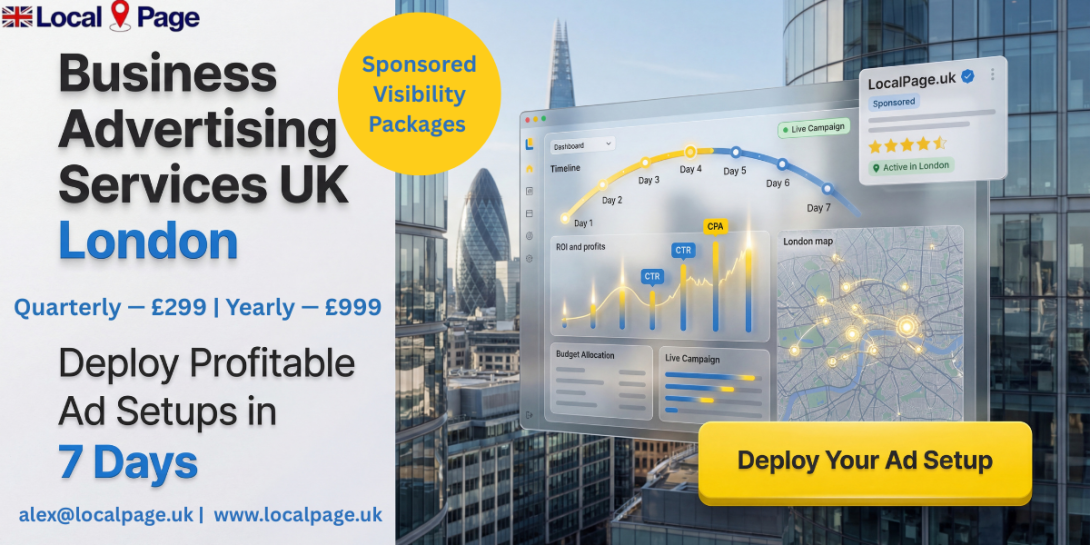
Monthly: £299
Quarterly: £999
Yearly: £2999
First 100 Sponsored Members
Quarterly: £299
Yearly: £999
Fixed pricing aligned with cost effective business advertising UK strategies — predictable, scalable and transparent.
Lead Generation Advantage
- Platform-wide UK city & category exposure
- Priority placement above competitors
- Direct enquiry forms & instant chat tools
- Product, service & media showcase
- Press releases, events & blog authority
- Early adopter positioning edge
Upgrade from a Free Business Listing UK and position your brand inside the Local Page UK Business Directory for nationwide reach.
Not Ready for Sponsored? Start Free — Capture Leads Today
If you're exploring visibility options, begin with a Free Business Listing UK. Add your services, service areas, media and contact details. Even a free listing allows customers to discover and contact you directly.
The strategy is simple: List → Optimise → Upgrade → Dominate. Establish presence, capture initial enquiries, then scale visibility when you're ready for nationwide exposure.
Secure Sponsored Placement
Preferred Billing OptionQuarterlyYearlyGet Priority UK Visibility Now
Local Page UK — Structured Business Advertising UK. Built for Visibility. Designed for Growth.
📧 alex@localpage.uk | | 🌐 www.localpage.uk